
America’s municipal solid waste (MSW) management is approaching a point of no return. While national political attention is focused mainly on plastic pollution or carbon capture technologies, a more immediate and potent climate threat is rotting in our communities. Food waste accounts for approximately 58% of methane emissions from municipal landfills.
Despite legislative mandates in states like California, Maryland, and Massachusetts requiring large-scale food waste diversion, the infrastructure to process this organic material has not kept pace with the law. We are attempting to solve a 21st-century waste crisis with 20th-century composting methods that are often land-intensive, slow, and odor-prone. To close this gap, American policy-makers must look toward a misunderstood biological engine: the cockroach.
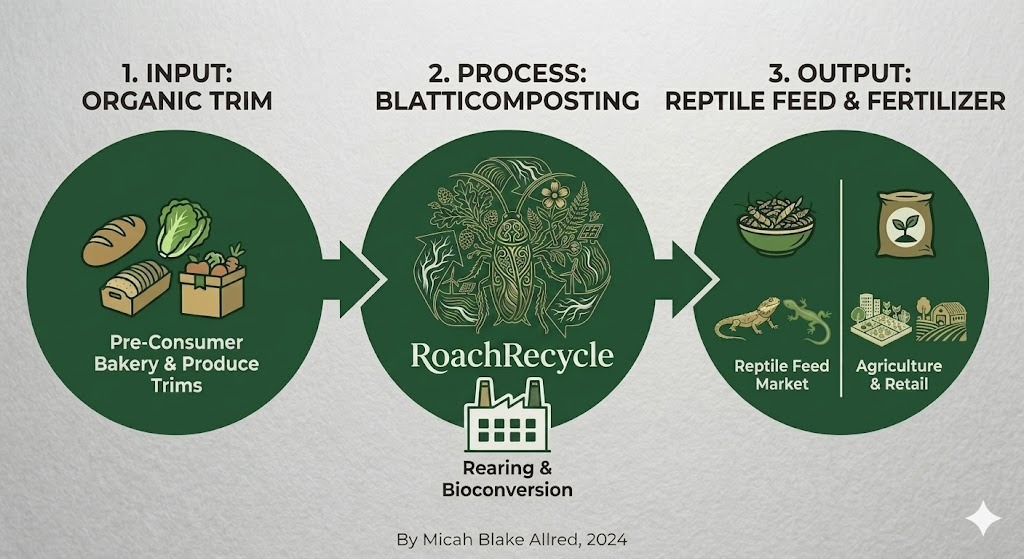
The technical term is blatticomposting: the use of cockroaches to facilitate the rapid decomposition of organic waste. While the concept may trigger a visceral emotional response, the industrial logic is undeniable. Cockroaches are omnivorous, highly reproductive, and were engineered by evolution to thrive in the exact high-temperature, high-humidity environments that organic waste’s decomposition naturally generates.
International precedents already exist. In Jinan, China, facilities utilize hundreds of millions of Periplaneta americana (the American cockroach) to process upwards of 60 tons of food waste daily. The waste arrives as a slurry, is consumed by the colony, and is converted into two high-value outputs: insect biomass and nutrient-rich frass (insect manure).
In a domestic context, blatticomposting offers a scalable, modular solution that can be integrated into existing waste management campuses. Lab studies indicate that cockroaches can reduce waste mass by 50–70%, performing at rates comparable to the current industry standard, the Black Soldier Fly (BSF).
The primary obstacle to blatticomposting is not biological or economic, but cultural. In the Western imagination, the cockroach is a symbol of domestic decay and a vector for disease. However, as a matter of public policy, we must distinguish between the “feral” cockroach in an unsanitary home and the “industrial” cockroach in a regulated bioconversion facility.
Relinquishing our environmental social prejudice is essential if America means to enact the creative and organic solutions necessary to sustain our climate infrastructure. We currently tolerate the massive methane plumes of landfills because they are largely “out of sight,” yet we recoil at the prospect of controlled insect rearing that could mitigate those very emissions. A pragmatic approach to the climate crisis requires us to embrace “strange” solutions when the data supports it. By utilizing enclosed, negative-pressure facilities and strict biosecurity airlocks, the risk of escape or odor is neutralized, transforming a perceived pest into a public asset.
The main reason blatticompositng exists in places like China and not the US, other than the cultural differences, is FDA restrictions. In China, the primary byproduct of blatticompsting (the dead cockroaches) is used as nutrient-rich chicken feed. In the US, however, the government would likely prevent the usage of cockroaches used as chicken feed for hens raised for human consumption, seemingly thwarting any potential for blatticompostings’ US market feasibility. But if the lawmakers won’t adjust to the markets, then the markets must adjust to the laws, and my proposed solution to both is: reptile feed.
Pursuing a formal AAFCO ingredient definition for livestock feed can take upwards of nine years. However, the live and dried feeder insect market (reptiles, amphibians, and ornamental fish) is a multi-million dollar industry with significantly lower regulatory barriers. By positioning the initial output of blatticomposting facilities as specialty pet food rather than agricultural livestock feed, operators can generate immediate revenue and operational data without waiting a decade for federal reclassification.
The motivation for this shift is rooted in public service. Landfill diversion is no longer a “nice-to-have” environmental goal; it is a fiscal and atmospheric necessity.
- Methane Avoidance: Every 1,000 tons of food waste diverted from a landfill prevents roughly 34 metric tons of methane from entering the atmosphere.
- Carbon Sequestration: The secondary product, frass, is a premium organic fertilizer. Studies show it can contain 43% more carbon and 47% more nitrogen than traditional poultry litter, offering a sustainable alternative to synthetic, petroleum-based fertilizers.
- Economic Stability: Unlike traditional composting, which is often a cost-sink for municipalities, insect bioconversion creates a “circular” revenue stream. The sale of biomass and fertilizer can offset the operational costs of waste management, reducing the burden on taxpayers and lowering municipal tipping fees.
To ensure these facilities serve the public interest rather than purely private profit, they should be structured as Public-Community-Private Partnerships (PCPPs). In this model, the public sector provides the land and regulatory framework; a private benefit corporation manages the technical operations; and local community organizations hold a meaningful equity stake. This ensures that the benefits of “green-collar” job creation and profit-sharing remain within the host community—particularly in areas that have historically been overburdened by industrial waste infrastructure.
The fundamental question facing American waste management is not whether cockroaches are aesthetically pleasing, but whether we are brave enough to let something “strange” be useful. The biology is proven, the market for the output is established and the regulatory hurdles are navigable through clever lane selection.
By scaling blatticomposting, we can transform regional burdens into national resources. We have the waste streams; we simply need the political will to relinquish our prejudices and adopt a more symbiotic relationship with the biological engines that are happy to do the work for us.

1 Comment
I won the American University Veloric Center for Entrepreneurship Fall 2024 Changemaker Challenge elevator pitching this idea in 90-seconds. Came up with it in 2 days and won $1250!