
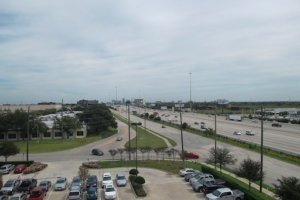
Governments in America constantly build far more new infrastructure for cars than for cyclists, trains, or pedestrians. It is no secret that the United States of America is an outlier in car-dependency. Americans rank near the top – if not the highest – per capita in yearly distance driven, vehicle ownership, and car-dependent commuters. American cities overwhelmingly prioritize making themselves quickly navigable by car instead of via public transportation in comparison to their European counterparts. But despite its popularity, car-dependent cities produce a wide range of negative externalities and result in worsened economic output for small businesses. And worse, they may not even be the most efficient for the drivers who are left with no other transportation options. Often, when traffic on a wide road is frequently strained, city planners will propose adding new lanes. After all, more space should mean a less clogged roadway, leading to reduced traffic jams. But what traffic planners fail to consider is the phenomenon of induced demand. Similar to how the higher price of a good in a perfectly competitive market incentivizes new businessmen to become its suppliers, the immediate drop in commute times following the new lane results in new drivers flooding into it, demanding the use of a public good. In both cases, equilibrium is restored in the long run after the change in profit opportunities or commute times reverts to zero as a result of new producers or consumers, respectively. Therefore, it should come as no surprise that widening roads has only widened the traffic jams on them while keeping their duration virtually unchanged, if not worse. And adding new road networks altogether is not the answer either, as explained by Braess’ Paradox. Clearly, a substitute for the least efficient mode of transport by surface area must be prioritized. Bicycles and trains can carry far more commuters per unit of surface area than cars, and also are much less prone to traffic jams due to their narrowness and fixed schedules, respectively. Thus, adding a lane on a road for cyclists and trams would actually improve congestion for its future drivers by taking current ones away into new methods of transportation. It would also make the experience for commuters safer, as a car trip of the same distance is magnitudes more likely to be fatal than a train journey. Americans have far higher traffic fatality rates than inhabitants of most European countries, costing hundreds of billions of dollars in productivity annually. Especially when commuters are parked, the space efficiency is more visible. Parking minima have resulted in parking lots devoid of businesses and economic activity consuming huge shares of American cities, also raising rents by leaving less land available for apartments. While small businesses suffer from these city plans, there is one major beneficiary of car-infested cities: big-box stores. Big-box stores take advantage of the massive parking lots required by parking minima that suit their structural needs in order to drive out competing small and locally owned businesses. This results in less sales and property tax revenue going to local governments, depressed wages through a monopsony, and contributes to the suburban sprawl that demands more car dependent cities. In contrast, pedestrian-friendly cities allow a high density of mostly small, locally owned businesses to thrive in close proximity to a dense area of customers, generating far greater tax revenue per acre for municipalities. And as cars are far more massive than bikes or their drivers, infrastructure for the latter two suffers less wear and tear, thus lowering repair costs on taxpayers. All in all, moving away from car-dependency is a major step towards fiscal and economic sustainability for cities.
 By Edward Kim
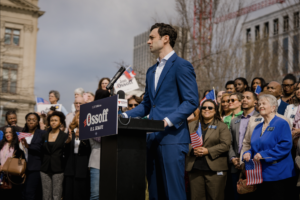
Earlier this year, I got to stand behind the podium alongside other young activists as U.S. Senator Jon Ossoff (D-GA) led a rally in Atlanta. We waved signs, clapped and cheered, and became symbols of resistance against Donald Trump’s chaotic and disastrous presidency. However, when the man of the hour gave his speech without a single wasted word or unflattering pose, I realized that he is scarily good at what he does. The former investigative journalist comes to life under the spotlight, packs quips, quotes, and comebacks for every occasion, and now cruises through election season with a cool confidence. As impressive as he is, I can’t help but feel alienated by a politician so skilled in his craft. Ossoff has supported major legislation on infrastructure, healthcare, and government accountability, but among Democrats, he’s recognized more as the face of the party’s next generation and one of its best communicators. As the youngest sitting U.S. Senator, he’s Gen Z’s ambassador to the Senate and he boasts about a campaign optimized for the algorithm. His attractiveness makes him shine on camera, and his words are confrontational enough to be exciting but restrained enough to stay within reason. If scientists tried to make a perfect politician, they would say you can’t do better than Ossoff. As reassuring as that should be for Democrats, I find it hard to connect with someone so on top of their game, and I find myself gravitating towards those who are genuine to a fault. Take Geoff Duncan, for instance. The former Republican Lieutenant Governor of Georgia became a Democrat after refusing to back Trump’s election denial, but he retained some of that “tell it how it is” attitude that tends to make Republicans more controversial. When I saw him speak at a town hall in the Atlanta suburbs, he told a room of devoted liberal activists that Joe Biden’s border policies were a mistake. It resulted in some frowns and looks of doubt, but it was a moment of imperfect authenticity that told me that he wasn’t afraid to speak his mind. I actually happened to agree with him and his candor inspired me to express my beliefs more confidently, even if doing so could cause a stir. Duncan, who ran to be the Democratic nominee for Governor of Georgia, went on to lose the primary to former Atlanta mayor Keisha Lance Bottoms. Although he was far from the favored candidate, one wonders if holding his tongue would have done him better. Ossoff, however, might have the opposite problem of being too tight-lipped. If he aspires to move up in Washington, he may have to work on appearing more personable. It’s not that he’s a poser or insincere—it’s that authenticity is demonstrated when you’re willing to risk upsetting many for what you believe. Trump’s habit of speaking his mind scored him points with an electorate tired of polished and inauthentic politicians in his 2016 campaign. Kamala Harris’ loss in 2024 can also be partially attributed to perceived inauthenticity, so future Democratic nominees will want to avoid seeming like they’re mouthpieces too afraid to be their own person. It may seem irrational to judge a candidate for being too controlled and composed, but Al Gore and John Kerry showed how a restrained public image can make a politician seem manufactured instead of relatable. Americans, like myself, want to see a part of themselves in their leaders, and since we aren’t perfect people, we don’t want our representatives to be perfect way either. Democrats don’t need to be as rough as Trump, but they don’t need to be as smooth as Ossoff. As a senator for a battleground state, Ossoff may find himself perpetually focused on defending his seat. It would be a respectable choice and one the party may push him to make, though White House hopefuls have to be willing to make a few enemies. Breaking with the party on this or any other matter would demonstrate his ability to go against the grain, and any executive should be able to say no to having their strings pulled anyway. To reference the Harris campaign again, overreliance on corporate consultants created a rift between candidate and voter that may have factored into her loss. It would be best for Ossoff to learn from Harris’ mistakes by not seeming like a puppet putting on a pre-rehearsed show. It’s an odd line of thinking that got us George W. Bush as president, but the million-dollar question is: “Would you want to have a beer with Jon Ossoff?” Even as a long-time supporter and constituent proud of his legislative record, I don’t have the answer—and I really wish I did. Ossoff is on track to win reelection come November, but his team would be wise to use the next six years as a way to tell the world who he is and the direction of the path he’s charting for himself. Whether through their own messaging or having him participate in low-stakes interviews, they must show the man, not just the mission. The Democratic Party may want a communicator and a fighter, but the people need a human being to lead. Ossoff went out of his way to intern for the late civil rights activist John Lewis, he exposed corruption and human rights abuses across the globe as a journalist, and he’s now defending democracy as a senator. He has the resume and the rhetoric to show he cares, but when I stand behind a leader, I want to know that they represent me in character, not just in beliefs. If there’s a story Ossoff’s life can tell, it should be told. And, if he has his fears or a reason to think he won’t get it all right, then we should know. He doesn’t need to create flaws out of thin air or be someone he’s not; he just needs to show the people that he’s not as distant or spotless as his public image can make him
 By Amaan Bhimani
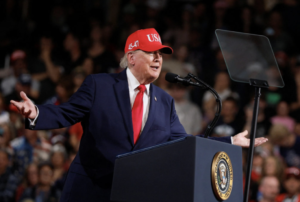
Photo Credit: PBS During this past week, President Donald Trump campaigned to protect Republican seats in Iowa as rising living costs, inflation, and disagreements over U.S. foreign policy create challenges for the party ahead of the Nov. 3 midterm elections. Ashley Hinson, the GOP hopeful nominee, who is running against Josh Turek, the Democratic nominee in the Iowa senate race, has strictly not wanted to be labeled as a “Trump ally” because she does not align with Trump’s ideologies and decisions. She even heavily criticized Trump when he initiated a war with Iran back in February. According to Reuters reporting published on Thursday Oct. 22, Trump is attempting to rally Republican voters in a state that has traditionally supported the party, even as some Republican candidates distance themselves from his policies. His push to ramp up polling numbers in key states continues in Iowa and is part of a string of states he plans on continuing to visit until the final stretch of the countdown to election night. Economic concerns, including high fuel and grocery prices, have become important issues for voters. The administration’s approach to the conflict involving Iran has also created divisions within the Republican Party. I believe that Trump shouldn’t have done what he did this year in regards to propagating a war in Iran. He’s received plenty of bipartisan backlash, mainly because some Republicans were conflicted by the fact that Trump had not received congressional approval to engage in an attack. We have secure borders and the means to protect our country from a retaliatory attack here in the United States so there’s not another 9/11. But I do agree Trump should’ve thought it out before he announced the preliminary attack on Iran. Some Republican lawmakers have joined Democrats in efforts to limit presidential war powers, highlighting disagreements over how much authority the president should have in directing military action. The outcome will depend on turnout, competitive congressional races and whether voters prioritize economic concerns, national security, or other issues when casting their ballots. Trump has to continue rallying if he wants Republicans to hold onto their Congressional control. Republicans hope to maintain control in this new term. As to what will happen on Nov. 3, the outcome remains to be seen. With early voting underway in many states and counties, more than 24.3 million ballots have already been cast nationwide in the 2026 midterm elections as of Saturday Oct. 24, according to On Point Politics’ early voting tracker. Trump visited Florida in efforts to support Rep. Byron Donalds running for Florida governor. It can be contested that many of his nominees will win, with the protected victory and successful campaigning Trump has had in deep-red states. Acknowledgement: The opinions expressed in this article are those of the individual author, not necessarily Our National Conversation as a whole.
 By Felipe Cisternas




Follow Us