

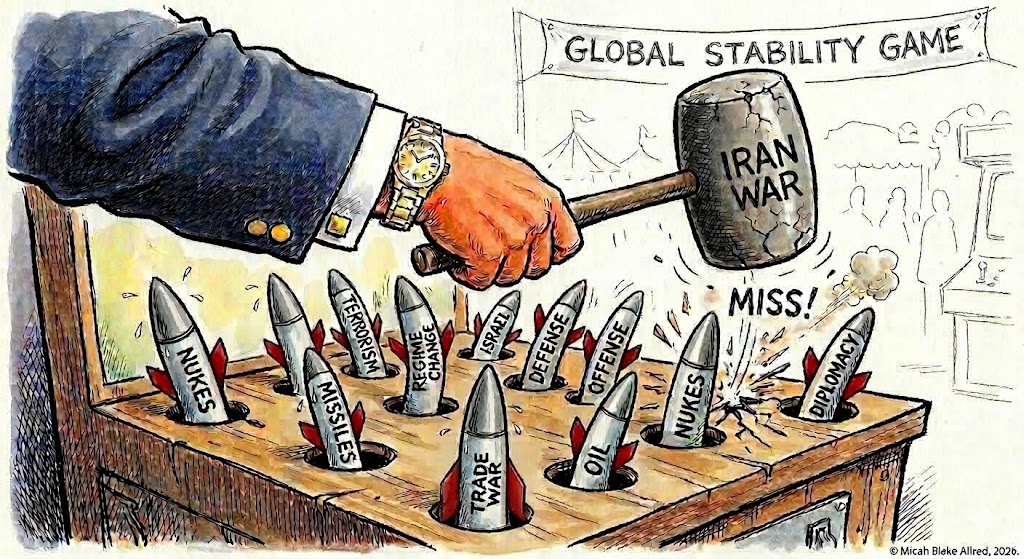
Ever since the United States and Israel launched coordinated attacks against Iran on February 28th, 2026, President Trump has given conflicting explanations. According to PBS, Trump initially said on March 3rdthat the U.S. has “the capability to go far longer” than the projected four to five week time frame. However, on March 9th, Trump stated in a phone interview to CBS that the war could be almost over:
“I think the war is very complete, pretty much. [Iran has] no navy, no communications, they’ve got no air force. Their missiles are down to a scatter. Their drones are being blown up all over the place, including their manufacturing of drones…If you look, they have nothing left. There’s nothing left in a military sense.”
Meanwhile, on March 10th, Iran’s Supreme National Security Council secretary, Ali Larigani, posted a warning against the Trump administration on X.
“The sacrificial nation of Iran doesn’t fear your empty threats. Even those bigger than you couldn’t eliminate Iran. Be careful not to get eliminated yourself,” said Larijani
These contradictory statements, as well as no exit strategy and different proclaimed reasons for the war has led to approval ratings shifting. Protests for and against the war have sprung up all across the US.
Wars have been protested against and for in the US before, with the Vietnam War being a prominent example. However, Charles Walldorf, a foreign policy and regime change wars from Wake Forest University, said that Trump’s war against Iran is unique in one important way: it began with a negative approval rating. A CNN poll stated that 59% of Americans oppose the war, a trend that has been affirmed in subsequent polls since the war began. Walldorf concludes that the reason there is less support at the war’s outset because there is an absence of a grand story and purpose to bolster public opinion.
This opinion is not unfounded. I remember getting a notification from The New York Times about the missile strikes and being entirely confused about the reason why. According to a poll conducted on March 3, 2026, the number of Americans who considered Iran a major threat was 44%. This is not only less than the 48% that was in July 2025, but even less than the number of Americans who saw Iraq as a threat during the 2003 war in Iraq (64%).
Lastly, during World War II, President FDR spent significant time giving speeches and delivering context to Americans on the upcoming dangers ahead. President Bush did the same for two years before the 2003 Iraq War. In comparison, five days before the war started, Trump only devoted three minutes to the Iran War in a two-hour State of the Union Address.
Trump has a lot of confidence in how the war is turning out so far, but that confidence can be quickly shattered by reality in hindsight. War is not something that should be taken lightly, as it affects not just Trump but every American and Iranian. Trump’s failure to inform the American people and his continuing contradictions are only going to lead to disaster if he doesn’t course-correct.
