

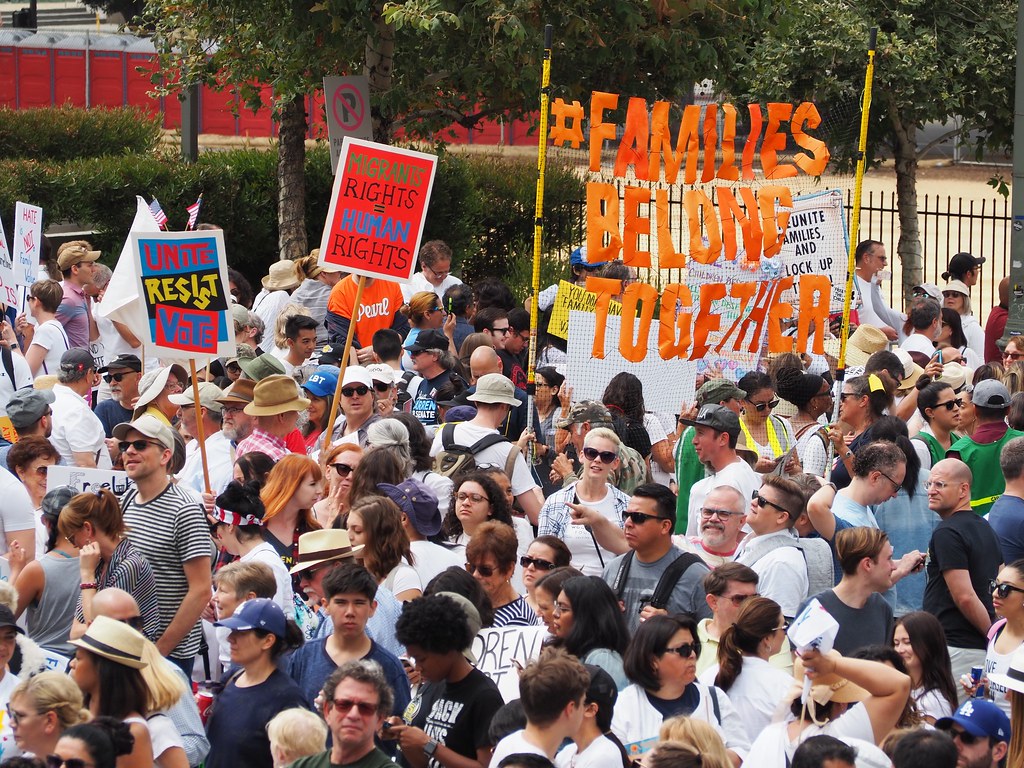
Following policy enacted by President Trump, Immigration and Customs Enforcement (ICE) has raided countless buildings and businesses across the U.S. In LA, the home of thousands of immigrants, raids received a heightened level of scrutiny. Receiving tips of potentially undocumented immigrants in several businesses, the officers followed warrants, searching a Home Depot and a clothing manufacturer. Family members and activists showed up at the scenes to protest, resulting in the arrest of a Union leader in an attempt to stop the officers. Mayor Karen Bass said, “[ICE’s] tactics sow terror in our communities and disrupt basic principles of safety in [LA]. We will not stand for this.”
On June 6th, “ICE Out of LA” protests erupted in the city, attempting to put pressure on lawmakers and officials to stop the raids. These raids are not always conducted in police uniform, and oftentimes are done with unmarked vehicles and plainclothes. The majority of the protests have been completely peaceful. However, news outlets covering the violent outbursts — the minority of the protests — have painted the movement as a whole in a negative, riotous light.
The main reason ICE raids have been so widely protested is that the group has been detaining people without proof of immigration status. Notably, deportations of several legal U.S. citizens have occurred. Previously, Trump intended to make the U.S. safer by promising the detention and deportation of undocumented immigrants who are criminals. Despite this promise, many of the people who were detained were merely existing, not causing problems.
Moreover, those who have immigrated to the U.S. illegally are often not even “criminals,” unless they have committed a separate crime. Illegal immigration to the U.S. is considered a civil violation, not a criminal offense. This legal difference mainly focuses on who the “offense” affects. A criminal charge is against a community or state and can result in a felony, misdemeanor or summary offense. A civil charge covers all other offenses and is mainly conducted through lawsuits, in which one side needs to prove their case is more compelling. This differs from criminal cases, where the evidence needs to be proven “beyond a reasonable doubt.”
Many detained individuals have been proven innocent, like in the case of Juan Carlos Lopez-Garcia. Lopez-Garcia was detained during a traffic stop in Florida, where Homeland Security claims that he said he was not in the U.S. legally. However, Lopez-Garcia is a dual citizen and has claimed that he provided proof of citizenship during the stop. Homeland Security stated that as soon as they determined Lopez-Garcia was a citizen, he was released. However, Lopez-Garcia said that he had presented his Social Security card as proof of identity, but it was dismissed. As LA protests continued, local law enforcement decided them to be “unlawful assemblies.”
In an attempt to limit the number of people on the streets, protest curfews were implemented, but only for a small portion of the city.
One intern at ONC explains that he experienced an increase in traffic due to police blockades on the highways, which disrupted everyday business. “I personally saw police lined up closing off certain streets, even blocking people from going to work or their home,” The intern said.
His 13 year old brother also recounted officers “overreaching their authority and acting aggressive” towards people who were not in violation of the curfew.
On the evening of June 7th, Trump deployed 2,000 National Guard soldiers to LA in an attempt to quell the protests.
In response, Governor Newsom issued a lawsuit against Trump, as military control has typically been relinquished to the state. Alongside other Democratic governors, Newsom has referred to Trump’s decision as an “alarming abuse of power.” Many California Republicans have backed the decision.
According to the First Amendment, there is the protection of five fundamental freedoms, which are essential for providing a functioning democracy, individual autonomy and limiting the power of the state. These include the freedoms of speech, religion, press, assembly and right to petition the government. They protect free speech, petition and assembly from the U.S. government, and, when combined, become what we call a “protest.”
Therefore, using the National Guard to end “ICE out of LA” protests is in direct violation of the First Amendment. As a result, the founding document of our country, the US Constitution, is called into question.
Alongside the implementation of the National Guard, Trump hosted a June 14th military parade through Washington D.C. This date coincides with his birthday, which also just happens to share the anniversary of the U.S. Army’s founding. This birthday military parade combo was met with further backlash.
Across the nation, on the same day, people took to the streets to protest against the Trump administration’s actions. “No Kings Day” displayed the people’s voices as they referred to him as a king who has taken over a democracy.
The protests garnered wide support all over the country, while seldom attended the parade through D.C. Despite the protests, little has been done to deter the Trump administration. But, attention from the media and public is a good start in creating change.
Bottom line, don’t stop protesting. The government cannot infringe on your First Amendment rights. Make your voice heard; you can make a difference.
Acknowledgement: The ideas expressed are those of the individual author.

1 Comment
Very interesting. I live in LA. We’re all watching this closely. A guy I know, HIspanic, runs a local restaurant. He said his restaurant and staff haven’t been affected yet, but he knows of a guy runs a food truck, which is common in LA. Some ICE agents allegedly snatched him from the truck, leaving his wife behind. Nobody knows where he has been taken. Mexican laborers do all the hard and yucky work in LA; it’s hard to imagine how our economy could function without them. Because of the fires, we need to rebuild housing. At some work sites, undocumented workers are afraid to show up.