

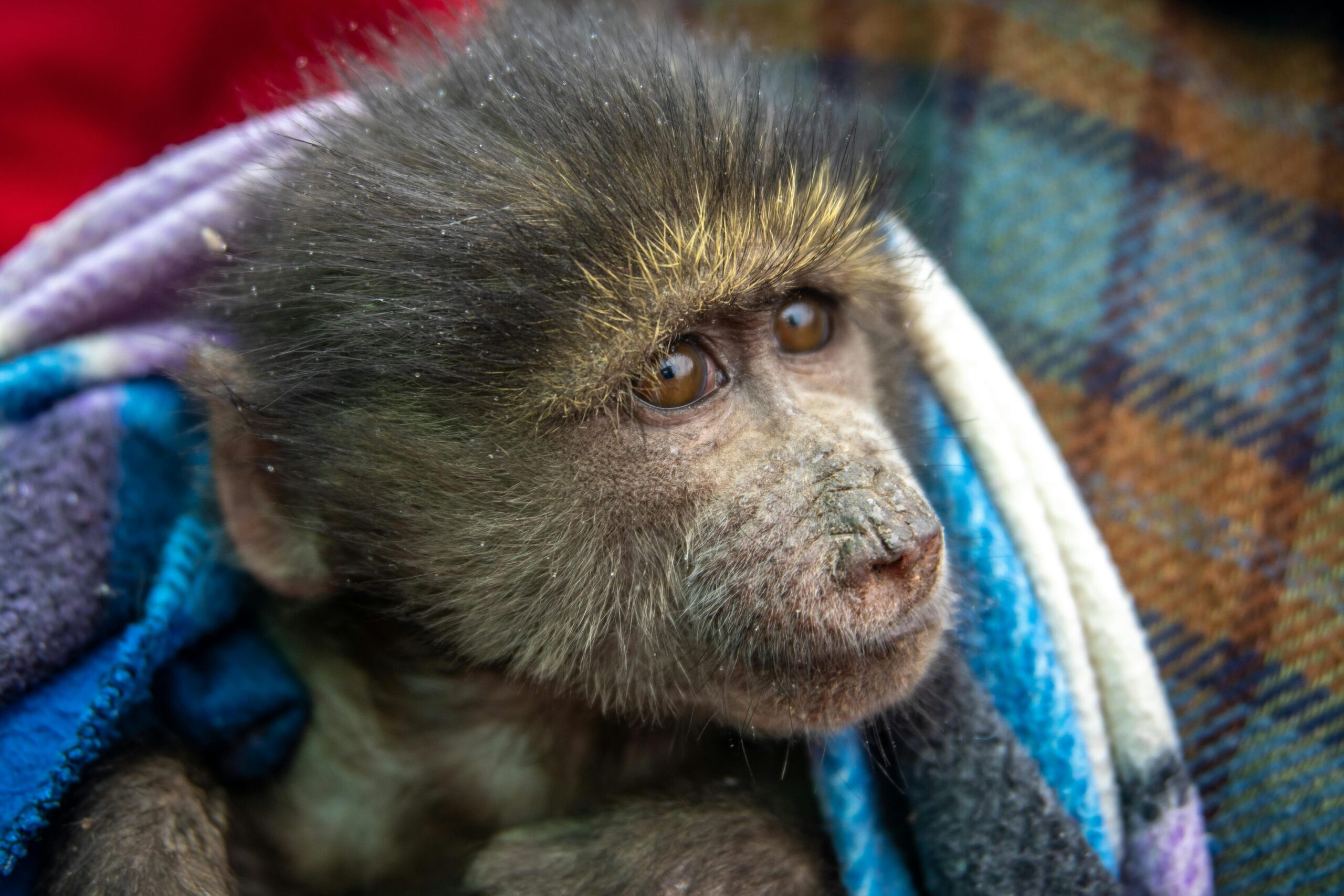
Millions of animals – from mice to monkeys – endure confinement, manipulation, pain and severe psychological distress in the name of understanding the human mind. An estimated 7.5 percent of all psychological experiments are conducted on animals. But is this practice truly necessary, especially in the 21st century?
Consider Kanzi, a bonobo who drew attention due to his exceptional language skills. In the 1970s, researchers subjected Kanzi to a series of experiments designed to test his ability to understand human language. These included blasting loud noises and showing him disturbing images, all while monitoring his reactions. While the study yielded some valuable insights, the ethical cost of inflicting such distress on an animal is too high.
A few of the most famous animal psychological experiments were The Harry Harlow experiments, infamous for their cruelty, which involved isolating infant rhesus monkeys placed in isolation or with surrogate mothers made of wire or cloth. These experiments aimed to understand human attachment and the impacts of different parenting styles, but the results, showing the monkeys’ desperate clinging to the cloth surrogate, tell us little about the complexities of human love and bonding, only offering surface-level results that could have been found in various other ways.
These experiments instead had irreversible impacts on the monkeys that would last them for life. They were depressed, sexually inactive, abusive toward offspring, and lacked basic skills. This one experiment altered the monkeys’ lives forever, solely to “benefit” human lives.
Statistics paint a clear picture: a Pew Research Center survey revealed growing numbers of Americans (52 percent) believe animals should not be used in scientific research. Why stick to dangerous, antiquated methods when better alternatives exist, and will continue to develop?
Such alternatives include new technologies that offer a window into the human mind without harming animals. Functional Magnetic Resonance Imaging (fMRI), for example, is a technology that measures brain activity by detecting changes in blood flow. By observing which brain regions activate during specific tasks, researchers can gain valuable insights into decision-making, emotional processing and social cognition. A study at the University of California, Berkeley, utilized fMRI to map the brain activity of human participants while they performed various tasks. This study, free of animal suffering, provided valuable insights into the neural mechanisms underlying human social behavior.
Another such technology is electroencephalography (EEG). This measures electrical activity in the brain using electrodes placed on the scalp. EEG offers high temporal resolution, allowing researchers to track brain activity in real time. Studies using EEG have shed light on topics like attention, memory and emotional processing.
As virtual reality (VR) technology rises, more opportunities for its use in psychological research arise. It creates immersive experiences that can be used to study human behavior in controlled environments – researchers can use VR to simulate social interactions, phobic situations, or decision-making scenarios, allowing them to observe human responses safely and ethically.
Similar to VR, artificial intelligence (AI) has also made great strides recently. AI algorithms can be trained on large datasets of human behavior to identify patterns and make predictions. This can be used to develop more sophisticated models of human psychology, potentially leading to new insights into mental health and behavior.
Finally, eye-tracking is another alternative. The technology measures eye movements, which can provide clues about attention, memory and cognitive processing. Studies using eye-tracking have revealed how humans scan visual information, make decisions and process emotions.
We need to move beyond the cages and torment. Embracing ethical and useful alternatives can greatly eliminate the need to run harmful psychological experiments – we can gain knowledge past the limitations of animal models and gain a deeper understanding of the human mind without inflicting suffering on innocent creatures.
Acknowledgment: The opinions expressed in this article are those of the individual author.
