

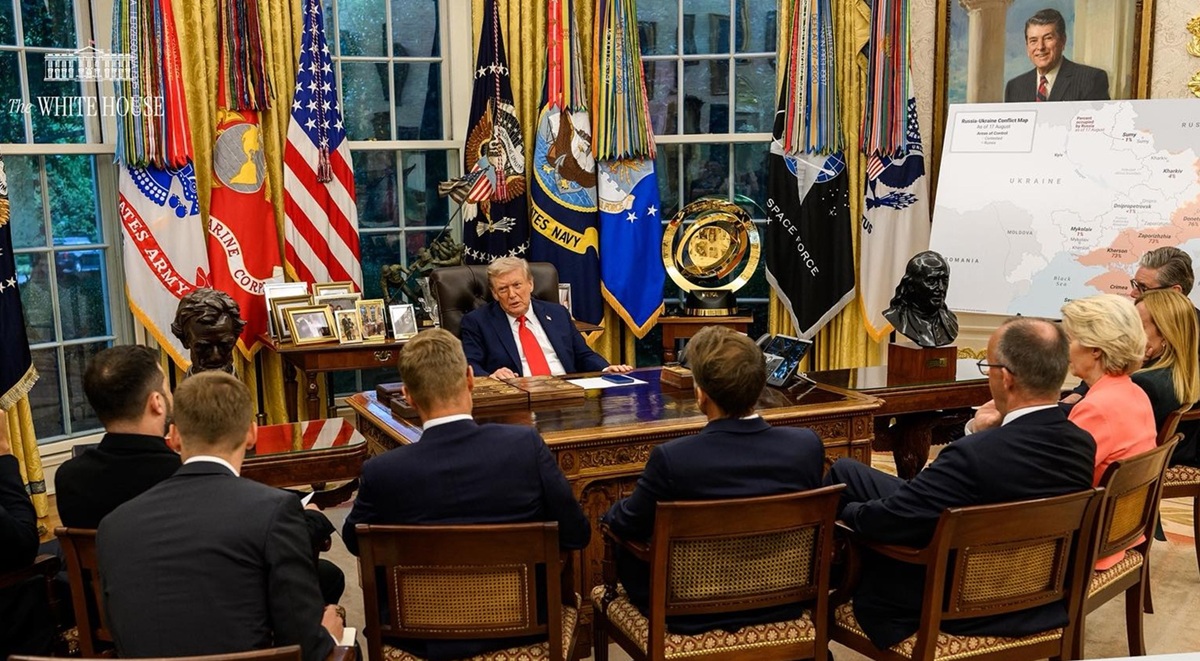
Since taking office on Jan. 20, President Trump has taken several steps aimed at ending the Russia-Ukraine conflict, including mounting pressure on Ukrainian President Volodymyr Zelensky. The tension between the two leaders escalated to a heated exchange in the Oval Office on Feb. 28.
Despite these efforts, Democrats have criticized the Trump administration. They initially accused Trump of repeating Russian propaganda during his negotiation attempts between Russia and Ukraine. Now, they are faulting Trump again for using trade as leverage to pressure countries over their ties to Russia.
However, the Trump administration’s recently imposed high tariffs on India are a bold move to curb these nations’ support for the Russo-Ukrainian war. The tariffs are part of a broader effort by the administration to pressure countries that have been purchasing Russian oil, thereby funding Russia’s military efforts.
Steps Taken to End War Since January 2025
The Trump administration is long reputed for advocating for both countries ending the war. Recognizing the current challenge, the administration decided to pursue negotiations between the two nations.
The Phone Call
Weeks after beginning his second term, Trump facilitated a phone call with Russian President Vladimir Putin on Feb. 12, 2025. The conversation reportedly lasted over an hour, centering on multiple issues, including Russia’s invasion of Ukraine. Afterward, President Trump announced possible negotiations between the two countries. Despite these efforts, the call was met with Congressional disapproval.
Congress showed concerns that Trump’s approach was too soft on Russia, lacking concrete outcomes. Some lawmakers criticize Trump’s reluctance to impose new sanctions, while others question the effectiveness of his negotiation attempts with Putin.
Boots on the Ground
During his March 2025 visit to Jeddah, Saudi Arabia,, all efforts were aimed at bringing peace to the region. Trump spoke with Ukrainian officials about potential solutions to the war and successfully convinced them to engage in negotiations. The visit highlighted the importance of humanitarian relief efforts as part of the peace process during a ceasefire, including prisoner exchanges.
In a joint statement by the U.S. and Ukraine, they noted, “Both countries’ presidents agreed to conclude as soon as possible a comprehensive agreement for developing Ukraine’s critical mineral resources to expand Ukraine’s economy and guarantee Ukraine’s long-term prosperity and security.”
Additionally, on March 11, 2025 (during the same trip), the Ukrainian delegation expressed their readiness to accept a U.S. proposal for an immediate 30 day ceasefire. U.S. military officials issued another statement, saying “Killing must stop,” further emphasizing the U.S.’s stance on the war. The U.S. then told Russia that their reciprocity is crucial for achieving peace.
Democratic Backlash
Despite this small success in Jeddah, Kamala Harris was degrading the progress back home in the states. During her campaign, she called Trump’s attitude and negotiation proposals on Russian sanctions “weak.” Meanwhile, Bridget Brink, the U.S. Ambassador to Ukraine, resigned, citing criticism of the administration’s appearance of favoring Russia by putting more pressure on Ukraine. Additionally, Senator Chuck Schumer was critical of Trump’s approach by advocating for a tougher stance on Russia. Lastly, former president Joe Biden accused Trump of “modern -day appeasement” of Russia, warning that Putin will not stop after territorial concessions in Ukraine.
Republican Backlash
Even within the Republican Party, the Trump administration faced massive backlash on this issue. Sen. Roger Wicker called Putin a “war criminal” and expressed doubts about Putin’s willingness to negotiate a fair peace. Senator John McCain delivered a blistering speech criticizing Trump’s attempt to “reset” U.S.-Russian relations and denounced Putin’s actions.
In addition to Republican disapproval, Trump’s negotiation attempts received a large scale of media criticism on both sides. A recent survey published by FirstPost shows that nearly 60% of Americans lack confidence in Trump’s judgment on the issue, and they are not confident that Trump can make a wise decision about Ukraine.
The U.S. media also remained divided on Trump’s negotiation attempts. Despite praising Trump during his campaign and first term, Fox News has deemed Friday’s Alaskan Summit “unsuccessful.”
Additionally, Russian State T.V. questioned President Trump’s March 2025 “Psychological Deadline” Remark. This remark refers to a comment made by President Trump suggesting that Russian President Vladimir Putin would face consequences if he didn’t agree to a ceasefire in Ukraine within a certain timeframe. This deadline was more psychological, aiming to pressure Putin into negotiations rather than a specific, tangible deadline with clear consequences.
New Sanctions on Russian Oil, Gas and Banking Sectors
In March 2025, as Russia’s attacks continued and both countries struggled to reach a ceasefire agreement, President Trump imposed stricter sanctions on Russia’s oil, gas and banking sectors. The sanctions forfeited a previous deal that allowed certain Russian banks to conduct energy transactions through U.S. payment systems. Numerous banks were affected; Vnesheconombank, Sberbank and VTB Bank; Alfa-Bank, Sovcombank, and Bank Financial Corporation Otkritie; Rosbank, Bank Zenit and Bank Saint-Petersburg. Finally, the Central Bank of Russia was also affected.
These U.S. sanctions on Russia’s oil, gas and banking sectors have significantly impacted the country’s economy by reducing revenue generation. They’ve caused economic contraction, inflation and isolation from global markets. The effects have hindered the country’s ability to modernize its industries and maintain economic growth. Russia’s military capabilities were also affected, making it difficult for them to maintain equipment and produce advanced weapons. The Russian military now has to rely on inferior suppliers and restricted access to international technology.
Trump Finally ‘Disgusted’ by Putin’s Actions
This month, after a recent strike on Ukrainian hospitals killing 31 people — five children among them — President Trump said he’s “disgusted” by Russia’s attacks on Ukraine. Trump told the media, “I think it’s disgusting what [Russia’s] doing.” He doubled down on his comment and then added, “We’re going to put sanctions. I don’t know that sanctions bother [Putin].”
President Trump Threatens Russia with Additional Sanctions
Since then, the Trump administration has warned Russia of severe tariffs, including 100 percent tariffs on countries trading with Russia. Trump previously threatened a 500 percent tariff on certain countries, specifically mentioning India, for their dealings with Russia. India is now facing a 25 percent tariff for purchasing Russian oil.
With the passing of the August 8th deadline, Trump’s warning of more sanctions on Russia is once again under discussion, leaving a narrow window for a potential ceasefire deal.
Convincing Russian Allies
At the same time, Trump is also trying to convince Russia’s allies, including China and India, to stop purchasing Russian oil. In a recent interview, Trump stated, “Putin will stop killing people if you get energy down another $10 a barrel.”
Russia’s Demands
Russia’s impractical demands have been a major factor why the Trump administration cannot end the negotiation talks. Trump has mentioned several times that both countries have to compromise to end this ongoing conflict, but Putin’s wish list is long:
- Ukraine’s NATO membership exclusion, meaning Ukraine must not join NATO.
- No foreign military presence in Ukraine, prohibiting foreign military forces from being stationed on Ukrainian soil.
- Recognition of territorial changes, requiring international acknowledgment of Russia’s annexation of Crimea and control over Donetsk, Luhansk, Kherson and Zaporizhzhia regions.
- Limiting Ukraine’s military capabilities, imposing restrictions on Ukraine’s military operations and capabilities.
- Lifting Western sanctions on Russia, requiring the removal of Western sanctions imposed on Russia.
- Written pledge on NATO expansion, demanding a formal written guarantee from Western powers not to expand NATO eastwards.
- Ukraine’s neutrality, requiring Ukraine to commit to remaining neutral and not joining any military alliances that could threaten Russian security.
- Resolution of frozen Russian assets, seeking a resolution on the issue of frozen Russian sovereign assets in the West.
- Protection for Russian speakers, ensuring protection for Russian-speaking populations in Ukraine.
So far, it’s only negotiation talks that are progressing at a slow speed due to various diplomatic obstacles and other countries’ involvement. Furthermore, monitoring and verifying the ceasefire along the 1,200 km front line in eastern Ukraine would be a challenging task, even if both countries reach an agreement.
Trump’s Conflict with Ukraine President
During his first term, Trump referred to Ukraine as the “most corrupt country” in the world. Since then, Trump has clashed with Ukrainian President Zelensky several times over economic interests, including possible U.S. access to Ukraine’s critical minerals. Trump questioned Zelensky about pausing elections during wartime, and called him a “dictator without elections.” The conflict between Trump and Zelensky did not stop there.
There was also an Oval Office argument between Vice President J.D. Vance and Zelensky in the presence of President Trump. Vance asked Zelensky, “Have you said thanks, once?” Zelensky requested Vance to reduce his voice, and then Trump added, “He’s not speaking loudly. You’ve done a lot of talking. You’re not winning this.”
After all these, Ukraine is not making it easy to reach a deal and insists on full sovereignty and NATO security guarantees, directly opposing Putin’s demands.
On Wednesday, August 6th, Russian President Vladimir Putin met with U.S. Special Envoy Steve Witkoff in Moscow — just two days before a critical deadline set by Trump — to agree to a peace deal with Ukraine. If Russia failed to comply, significant changes in the U.S.-Russia relations were to be expected.
After the Alaskan Summit
That same day, in a call with European leaders, President Trump said he intends to meet with both Putin and Zelensky in person by next week. The meeting was anticipated to include a trilateral gathering with Trump, Putin and Zelensky.
Trump and Putin met separately in Alaska during the Alaska summit on Friday. Meanwhile, Zelensky, who had expressed strong reservations about a potential agreement made without Ukraine’s involvement, was also invited by Trump to meet him in D.C. on Monday.
According to schedule, Zelensky met Trump in the presence of other European leaders that included the likes of European Commission President Ursula von der Leyen, NATO Secretary-General, Mark Rutte, French President Emmanuel Macron, German Chancellor Friedrich Merz, UK Prime Minister Keir Starmer and Italian Prime Minister Giorgia Meloni.
The meeting ended with a positive outlook, and talks are still underway with Trump negotiating a final ending to the war.
Despite the many obstacles and complications of war, there’s still hope for a ceasefire agreement between Russia and Ukraine, with the U.S. acting as mediator.
Acknowledgement: The ideas expressed in this article are those of the individual author.
