

University lecture halls, newsrooms, the halls of Congress, and the boardrooms of large companies are places where climate change is frequently discussed. The physical effects of the climate disaster, however, do not pose the greatest threat in these places. Low-income populations will experience the most extraordinary hardship, despite studies concluding that the wealthiest ten percent in the United States and China emitted enough greenhouse gases to increase heat extremes in vulnerable regions — the Amazon, Southeast Asia, and Southern Africa — by a factor of three. To build awareness of the hardships faced by those at the forefront of the climate crisis, stories about these individuals and communities must be shared.
Construction workers
In the summer heat of the Lone Star State, mirages distort the appearance of half-built homes baking under the scorching sun. James Roosa, in an interview with NPR, told reporters that he has worked on most of the buildings of Austin’s skyline. He said there are times when “you might just be going, going, going. And our partner says, ‘Man, you know what?’ You stopped sweating. You’re not sweating anymore, and it’s over a hundred degrees.” A cessation of sweating (anhidrosis) is a sign of heatstroke: when a person’s body temperature rises rapidly, their heat-regulating mechanisms shut down, and their organs begin to fail. Roosa had been lucky. Others haven’t.
Roendy Granillo, a construction worker with an eleven-year-old sister named Jasmine, worked on a construction site in Melissa, Texas, on July 19th, 2015, in 95-degree heat. He began to feel deathly sick, and his coworkers noticed that his fingers had stopped working. A witness spoke in an interview with PBS and said that Roendy had told his boss he was feeling sick, and the boss “just shoved him aside.” First responders rushed Roendy to the hospital, where doctors measured his temperature at 110 degrees Fahrenheit and attempted to save his life from catastrophic organ failure. Roendy died that evening. Researchers have estimated that the death toll among outdoor workers caused by extreme heat is likely in the thousands every year. A 2024 report developed by researchers at the non-profit organization Texas 2036 confirms that, due to climate change, triple-digit temperatures in Texas will occur four times as often in 2036 as they did in the 70’s and 80’s.
The Sinking Country
Tuvalu sits midway between Australia and Hawaii and is the fourth-smallest country in the world. The Island nation of fewer than ten thousand people (97 percent of whom are indigenous) appears to be a tropical paradise. The residents, however, fear for their future as the sea slowly creeps further up the shores year by year. The islands of Tuvalu may be underwater in 50 to 100 years. Frank, a 32-year-old Island resident, says that “the sea is eating all the sand. Before, the sand used to stretch out far, and when we swam, we could see the sea floor and the coral. Now, it is cloudy all the time, and the coral is dead.”
Research has confirmed that sea levels around Tuvalu have risen by 15 centimeters, which is higher than the average heights recorded over the previous three decades. If the sea continues to rise, high tides will submerge Tuvalu’s critical infrastructure in approximately 25 years. Tuvalu and Australia signed the “Falepili Union Treaty” in 2023, the first plan to relocate an entire nation. 280 Tuvaluans are to migrate to Australia each year until the whole population has left the islands. The plight of Tuvalu has been at the forefront of international humanitarian discussion for years. In 2019, Time magazine published a cover featuring U.N. Secretary General António Guterres wearing a polished suit and standing knee-deep in the ocean off the coast of Tuvalu. Tuvalu’s Foreign Minister, Simon Kofe, delivered an address to the United Nations in 2021 about the dangers of bending to the interests of superpower nations, as he stood knee-deep in the sea off the shores of Tuvalu.
Nausaleta Setani sleeps in a little shack by the sea and uses a buoy as a pillow. She says, “I am from a small country. All I want is for the bigger countries to respect us and think of our lives.” Leaders of Island nations across the world have had to collaborate to influence developed nations to adopt more ambitious climate goals under international climate agreements as the sea continues to rise.
The Great Green Wall
Droughts in West Africa are becoming more common. The Sahel — a transition region between the dry, scorching Sahara to the north, and the wetter Sudanian savannas to the south — is particularly sensitive to changes in rainfall. Droughts in the 1960s, 1970s, and 1980s caused crops in the Sahel to wither, resulting in a mass famine that claimed over one million lives. The Republic of Gambia, a country in West Africa, is facing food insecurity. Rainwater is falling less frequently, and salty water from the Atlantic is moving up the Gambia River and saturating critical floodplains where rural farmers, who comprise around 60 percent of the country’s population, grow essential crops such as rice. Temperatures in the Sahel will likely rise 1.5 times faster than in other parts of the world, even though Gambia contributes roughly 0.05 percent of the world’s greenhouse gas emissions. Biodiversity loss, poverty, mass emigration, violence, and food insecurity are destabilizing the region as climate change worsens. In a documentary produced by Civic, a UK social enterprise, a Gambian woman struggles to compose words to describe the experience of fighting against the brutal elements as the life is sapped from her crops by the salty soil: “This story is difficult because…now, this is sad for me, here. This is my life.”
Kemo Fatty, a climate activist from a village in northern Gambia, has witnessed family members leave the country and relocate to European countries, where they hope to support their families from abroad. Fatty says, “These are not economic migrants; they are climate migrants. Because the climate is affecting the economic power of our state.” Fatty is now involved in a gargantuan mission: to plant an 8000km wall of forests across the entire continent. The Great Green Wall is an African-led initiative that aims to safeguard the Sahel by reforesting a massive stretch of desert extending from Senegal (west) to Djibouti (east). The project launched in 2007 with the support of the African Union. A decade later, the wall was 18 percent completed. The Great Green Wall project has restored over 44 million acres of land in Africa and created about 3 million jobs. Fatty is still working on the project, leading Gambia’s frontline efforts. He advocates for making African locals the primary stewards of the land, as climate initiatives from overseas often come and go too quickly to produce any lasting change in the Sahel.
Firefighters
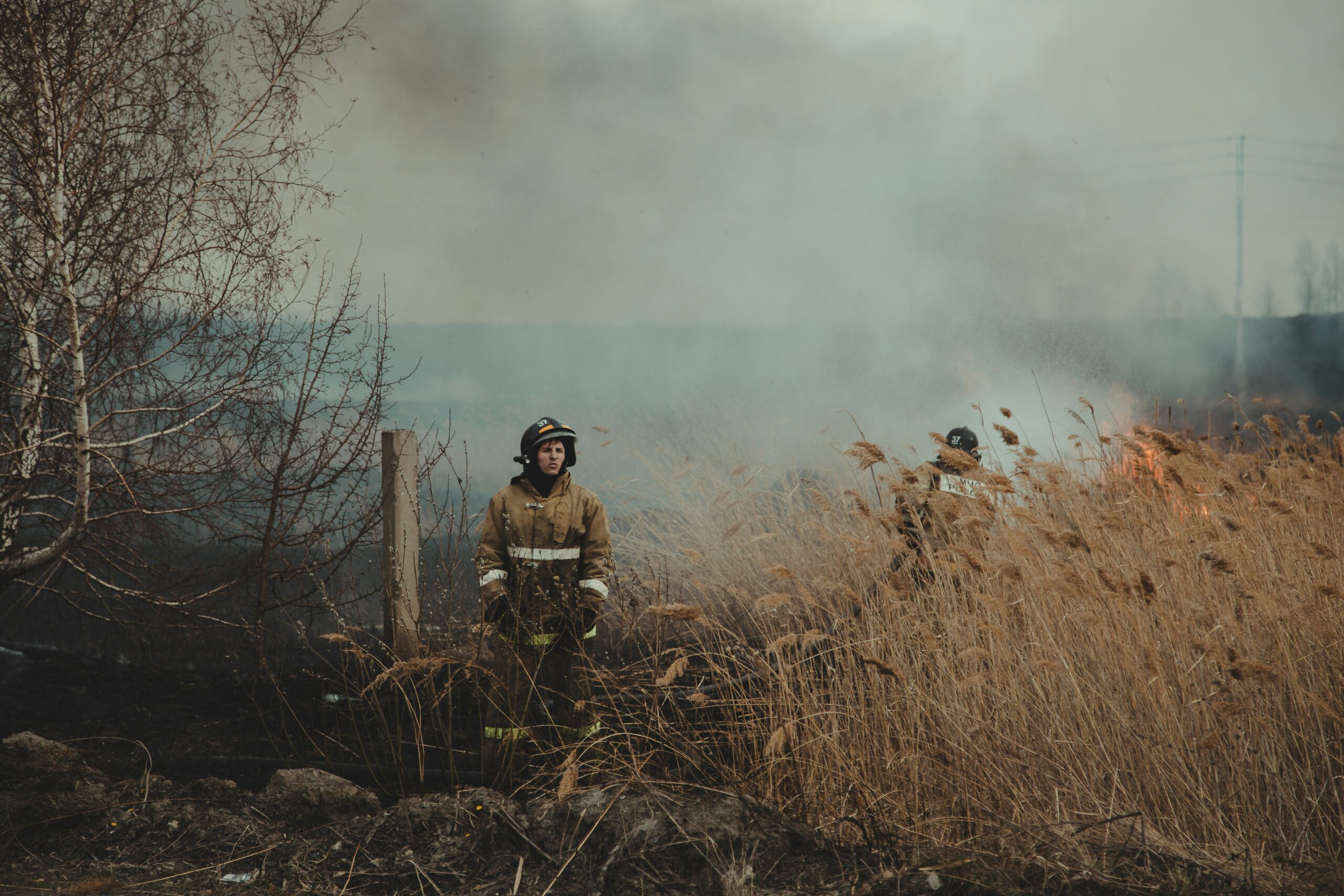
Noelle Bahnmiller woke up every day for months and threw up. She usually didn’t sleep a wink. She was diagnosed with post-traumatic stress disorder after a seemingly normal day of firefighting suddenly became a nightmare. In a remote forest of Mendocino County, a bolt of lightning ignited tinder, and soon a 250-foot-high tower of flames ascended above the canopy. Sizzling embers rained from the sky, landing on small twigs and branches and further fueling the fire. One moment, Bahnmiller had been walking through a peaceful forest she described as “heaven,” the next, it was something closer to hell. After Bahnmiller and her team had hunkered in their fire engine, ready to defend against the rapidly advancing inferno, she heard screams echoing down from the slopes of the mountain. The flames had surrounded a crew of eight firefighters. The men survived, but suffered second-degree burns on their hands and faces. The Lodge Complex Fire burned 12,535 acres of forest in 2014.
The frequency and severity of wildfires in California have been increasing as climate change accelerates. Of the 20 largest fires in the state’s history, eight have occurred since 2017. Firefighters, who carry upwards of 50 pounds of gear, labor tirelessly to contain fires. In the process, their health severely worsens. Cancer claims the lives of many. Fernando Allende was a firefighter in the U.S. Forest Service. As his crew worked to contain the blazing inferno, they began coughing up black mucus, and some fell to the ground to vomit after becoming dizzy. Fernando found himself unable to breathe, and his team raced him to the hospital. The doctors found blood clots in his lungs and a non-Hodgkin lymphoma pressing against his heart. Fernando is still alive, but he now lives with a severe form of cancer. The leading cause of death in the line of work as a firefighter is sudden cardiac death, and the job claims an average of 105 firefighters every year. According to recent research, wildfire frequencies have increased by a factor of two globally from 2003 to 2023. The need for firefighters is greater than ever, but the work is highly hazardous.
Climate change threatens the lives of people worldwide, and as temperatures continue to rise, the consequences of the crisis will intensify. It is imperative to continue sharing the stories of people who are most vulnerable to climate change, as their experiences can inspire others to take action in ways that help mitigate global temperature rise. To bring light to the hardship felt by those at the forefront of the climate crisis is to acknowledge the plight of real people who suffer a disproportionate share of the consequences of a catastrophe mainly caused by a handful of wealthy corporations. Climate change is causing widespread suffering; thus, it becomes the moral obligation of those most responsible for the crisis to take action to mitigate its effects and secure a more sustainable future for humanity.
Acknowledgment: The ideas expressed in this article are those of the individual author.