

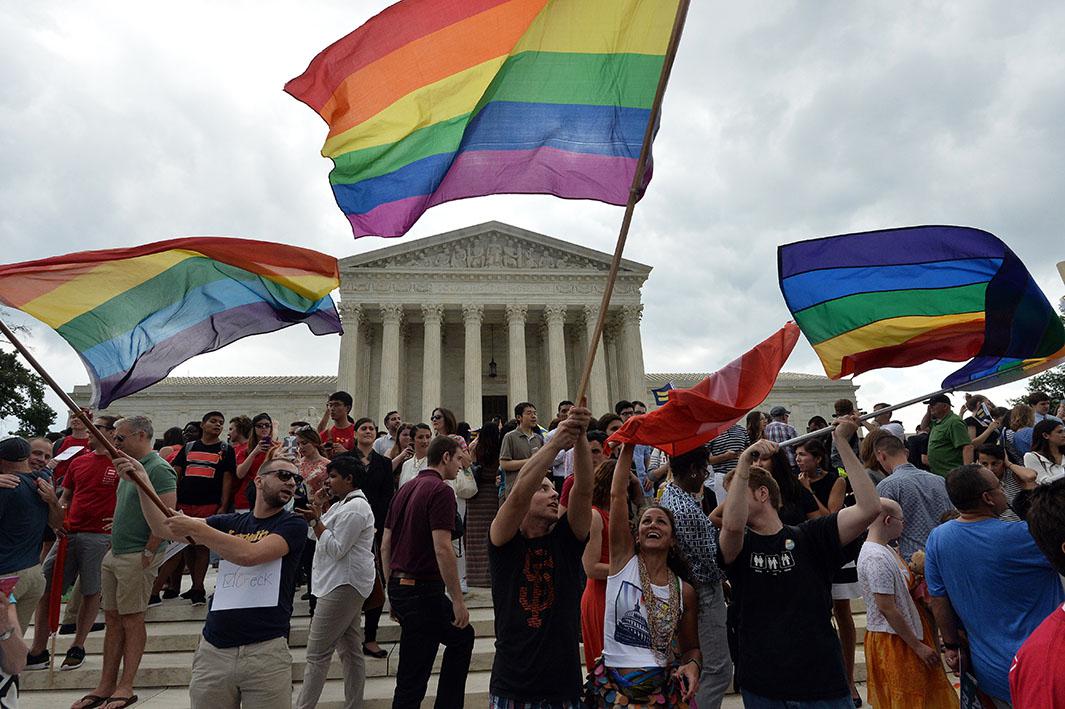
 Americans celebrate after the landmark ruling in Obergefell v. Hodges on June 26, 2015. Photo by Mladen Antonov/AFP/Getty Images
On November 7th, the Supreme Court will be deciding whether to overturn Obergefell v. Hodges, a Supreme Court ruling that decided gay marriage would be federally legal. Despite this landmark decision being a turning point for increasing LGBTQ+ civil rights in America, the decision was never codified into law. Some argue that it was a congressional oversight, while others contend that it was intentional. I’ll let you decide for yourselves.
Obergefell v. Hodges (2015) was the U.S. Supreme Court case that legalized same-sex marriage nationwide. The lead plaintiff, Jim Obergefell, sued the State of Ohio after the state government refused to recognize his marriage to his dying husband, John Arthur. In the decision, the court ruled 5-4 that same-sex couples have a constitutional right to marry under the Due Process and Equal Protection Clauses of the Fourteenth Amendment. Dissenting justices argued that marriage laws should be decided by states, not the federal judiciary. Overall, a Supreme Court ruling interprets the Constitution or federal law and sets the legal precedent for the entire country. A law, on the other hand, is legislation passed by Congress or a state legislature and signed by the president or governor.
I am incredibly disappointed and, at the same time, unsurprised that this issue is the one the current administration has chosen to zero in on. That is not to say that the Trump Administration is directly making this decision. At the end of the day, it is in the hands of the Supreme Court. The Supreme Court, however, is largely dominated by conservative judges who often side with Trump through their use of the shadow docket. Despite the many issues of concern by Americans across party lines, our president has decided that gay people getting married is one of the biggest issues facing our country today. My personal opinion is that maybe we shouldn’t let a man with two divorces dictate what a healthy marriage is.
As I stated before, many of the judges who dissented in the original opinion argued that the power to make the final decision should be left up to the states rather than the federal government, and that power is too centralized in national rather than local governments. I’ll do you one better. Instead of leaving it up to the states, why don’t we just leave it up to the counties? Instead of the counties, what if we left it up to the cities? Instead of the city, what if we left it up to the neighborhood? What if we went even smaller and left it up to the individuals who wanted to get married? Some of you need to recognize that this is not the federal government telling you that you have to marry a woman if you don’t want to; the decision just states that those individuals who do love another individual of the same sex should be allowed to get married. I mean, for God’s sake, child marriage is still legal in 34 states, and we’re concerned about consenting adults getting married? Where is the uproar for the Supreme Court to rule to protect our nation’s children?
Some people argue this is just a sway in public opinion. A feeble attempt to grab at power. Something reversible. No, this is something much more sinister. This is the government putting to a vote who you are allowed to love.
Acknowledgment: The ideas expressed in this article are those of the individual author.
