
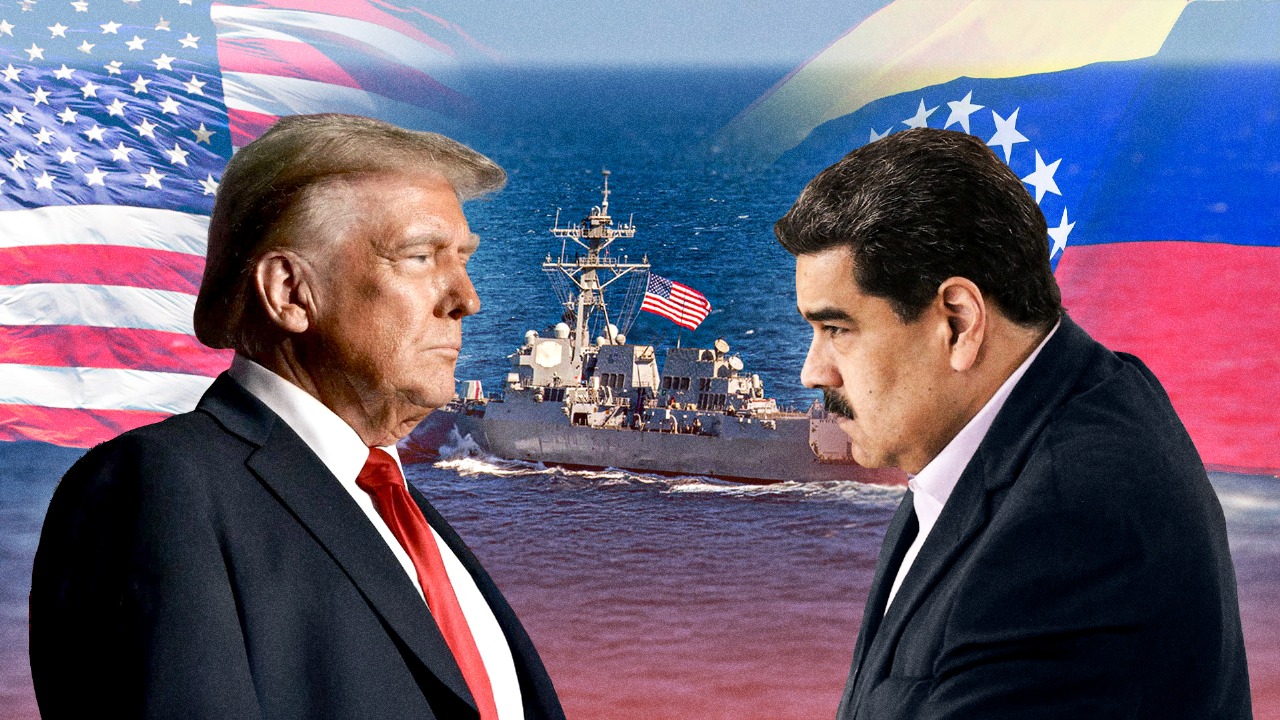
Foreign policy experts predicted Trump’s second term would deliver pure isolationism and “America First” restraint. Well, someone apparently forgot to tell the USS Gerald R. Ford, the world’s largest aircraft carrier, now parked off Venezuela’s coast with 15,000 troops backing it up. Welcome to the strangest chapter yet in the Trump-Maduro saga, where the president’s pledge to avoid foreign entanglements collides head-first with his determination to stop drugs and gangs from poisoning American communities.
Nicolás Maduro is Venezuela’s authoritarian president who has ruled since 2013 after succeeding his mentor, Hugo Chávez. A former bus driver and union organizer, Maduro has overseen Venezuela’s economic collapse, stolen the 2024 election, and presided over the exodus of nearly eight million Venezuelans fleeing poverty and repression. The Trump administration now labels him a narco-terrorist and leader of the Cartel de los Soles.
The current standoff escalated dramatically when Trump reportedly offered Maduro a simple ultimatum during their November 21 phone call: “take your family and leave, or face the consequences.” Maduro’s response? A public rally where he danced for supporters and declared Venezuela would never accept “a slave’s peace.” Trump has since declared Venezuelan airspace “closed” and authorized more than 20 strikes on alleged drug boats traveling through Caribbean waters.
Trump is not playing by the traditional foreign policy playbook. There are no tedious UN resolutions, no endless multilateral negotiations, no “leading from behind.” Instead, he is leveraging American military might to solve what he sees as a direct threat to American security—the flood of Venezuelan migrants and the drug trafficking that follows unstable regimes.
The Trump administration’s logic is straightforward: Venezuela under Maduro has become a narco-state facilitating the flow of drugs and criminal gangs like Tren de Aragua into the United States. The administration has placed a $50 million bounty on Maduro’s head, labeling him “one of the largest narco-traffickers in the world.” By applying maximum pressure through military deployments and strikes, Trump believes he can either force Maduro out or cripple the trafficking networks that threaten American communities. It is a high-stakes gamble that puts action over endless diplomatic theater.
The same president who campaigned on ending forever wars and putting America First is now marshaling the largest Caribbean military deployment since the Panama invasion of 1989. Katherine Thompson, a senior fellow at the Cato Institute, points out that Trump has few tools left to oust Maduro besides military action—sanctions and backing opposition leader Juan Guaidó during Trump’s first term already failed. Recent polling shows 70% of Americans oppose military action in Venezuela, including many within Trump’s own base who supported him precisely because he promised no new conflicts.
Few doubt that Maduro deserves to go. His fraudulent elections and brutal repression have impoverished a nation with the world’s largest proven oil reserves. The real question is whether removing him serves America’s interests enough to justify potential military intervention, and whether Trump has learned from Iraq and Afghanistan about the importance of planning for the day after regime change.
Maduro is playing his own game of calculated defiance. He reportedly demanded full amnesty, removal of all sanctions, and dismissal of his International Criminal Court case in exchange for stepping down—conditions Trump has rejected. Meanwhile, both Russia and China, Venezuela’s traditional allies, have remained conspicuously silent. Russia, still consumed by its war in Ukraine, lacks the will and ability to stop U.S. intervention in the Western Hemisphere. China analysts note that Beijing may even be wondering if diverting the USS Gerald R. Ford to the Caribbean provides an opportunity to move on Taiwan—a concerning strategic calculation as Trump plays Caribbean chess.
What Americans are witnessing is Trump’s doctrine of peace through strength applied in real time. The massive show of force is not necessarily about invasion—it is about creating conditions where Maduro’s own generals might decide their leader has become too costly to keep. It is coercive diplomacy with an aircraft carrier as the exclamation point.
Whether this approach succeeds or becomes another cautionary tale about mission creep will depend on what happens in the coming weeks. Trump has backed himself into a corner where retreating without results would damage American credibility. However, charging forward without clear objectives risks the very foreign entanglements his base elected him to avoid.
The Trump-Maduro standoff is a test of whether “America First” can coexist with American interventionism when the president believes America’s national security is at stake. The answer will define not just Trump’s foreign policy legacy, but the future of foreign policy thinking for years to come.