
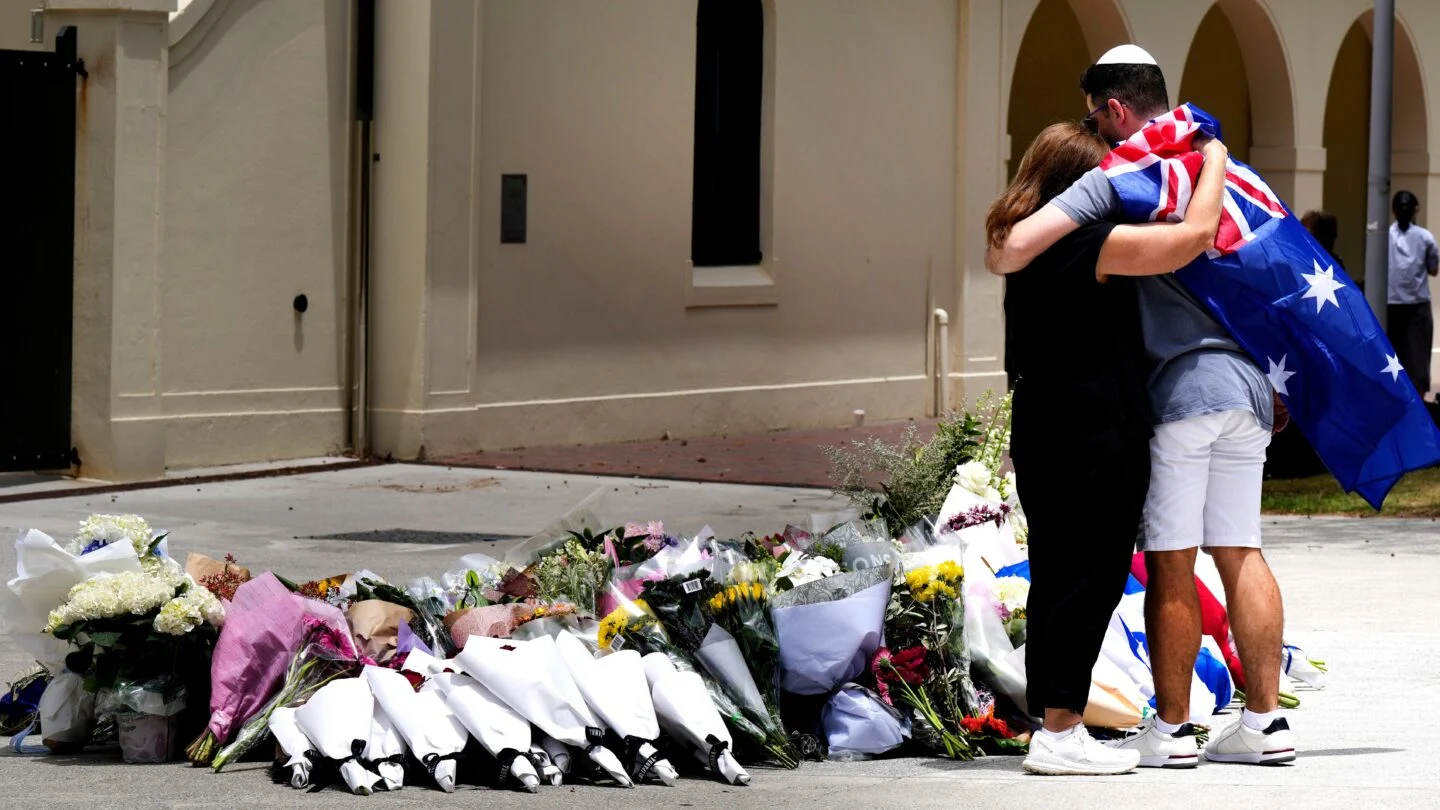
On the first night of Hanukkah, a Jewish festival celebrating miracles, light triumphing over darkness, families gathered at Sydney’s iconic Bondi Beach for “Chanukah By The Sea.” Jewish children laughed and built sandcastles while parents smiled, watching grandparents hold grandchildren close. Music filled the warm evening air. A community that has survived millennia of persecution gathered together as a rabbi prepared to light the first candle of the menorah, a symbol of hope, resilience, and the miracle of light defeating darkness. Then two gunmen shattered everything, opening fire on them specifically because they were Jewish.
By the time the shooting stopped, at least 15 people were dead, and more than 40 were wounded. Among the victims: 10-year-old Matilda Britvan, who had been playing on the beach with her six-year-old sister. 87-year-old Alex Kleytman, a Holocaust survivor who had escaped one genocide only to die in another act of hatred. Rabbi Eli Schlanger, a British-born father of five who had recently welcomed his newest child and organized this community celebration out of love.
Australian officials designated this a terrorist attack exclusively targeting Jewish people. The perpetrators, a father and son who had legally obtained firearms, opened fire on families celebrating light in a world that feels increasingly dark. The younger suspect had ties to the Islamic State that intelligence agencies investigated in 2019 but deemed not an ongoing threat.
How do you tell a six-year-old her sister won’t come home because someone hated Jews? How do you explain to five children that their father was murdered, spreading light? These are unbearable realities for Jewish families whose loved ones were slaughtered for their faith.
The Jewish Community Had Been Screaming for Help
Australia’s 117,000 Jews have endured a horrifying surge in antisemitic attacks. Between October 2024 and September 2025, 1,654 anti-Jewish incidents were documented, nearly five times the pre-October 7, 2023 average. Synagogues were firebombed. Jewish schools were attacked. Families were terrorized for being Jewish.
Jewish leaders warned that tragedy was inevitable. One official’s anguished statement: “There’s been a heap of inaction.” They predicted this. They begged for help. Jewish families still bled out on the sand.
Prime Minister Albanese’s government implemented measures—appointing an antisemitism envoy, enhancing synagogue security—but not enough to prevent Jewish children from being gunned down at Hanukkah.
Conservatives argue that political correctness has paralyzed authorities from confronting Islamic extremism. Netanyahu accused Australia of “pouring fuel on the antisemitic fire” by recognizing Palestinian statehood. How many more Jewish lives before we acknowledge the threat?
Progressives counter that Netanyahu exploits Jewish grief politically. Most democracies recognize Palestinian statehood, and supporting Palestinian rights doesn’t justify murdering Jews. The shooter was investigated in 2019, years before diplomatic moves. Why politicize this massacre instead of fixing intelligence failures?
Both contain painful truths. Intelligence agencies monitor thousands of threats with finite resources, but the rare threats that act annihilate Jewish children celebrating Hanukkah.
The Gun Control Question
Australia enacted strict gun control after the 1996 Port Arthur massacre, virtually banning rapid-fire rifles. For nearly three decades, it worked. Yet the Bondi Beach father held a firearms license for ten years and legally possessed six registered guns. Albanese now proposes further restrictions: limiting the number of firearms per individual, reviewing open-ended licenses, and restricting ownership to citizens.
Conservatives worry that each tragedy triggers reflexive bans restricting law-abiding citizens while failing to stop determined killers. Two improvised explosive devices were also found, suggesting those intent on mass murder find means regardless of weapons restrictions.
Progressives counter that this was Australia’s worst mass shooting in 29 years, a record proving gun laws work. They argue the father’s legal gun access proves current laws have deadly loopholes.
The challenge is refining regulations to address demonstrated gaps without security theater that wastes resources while missing actual threats.
A Muslim Hero Saved Jewish Lives
Ahmed al Ahmed, a 43-year-old Syrian immigrant and Australian citizen, saw the gunman and made a choice. He didn’t run. He didn’t hide. He charged from behind, wrestling away the weapon before being shot twice. He’s undergone multiple surgeries, and a fundraiser has raised over $1.4 million for his recovery.
A Muslim immigrant risked everything to protect Jewish families celebrating a holiday that means nothing to him but everything to them. It’s a reminder of our shared humanity that transcends every label we use to divide each other. Officials say his courage saved countless lives.
The Path Forward
There are no easy answers, but there are necessary ones. Conservatives are right that we need honest conversations about radicalization within communities without fear of being labeled bigots. Progressives are right that collective punishment based on ethnicity or religion is unjust and counterproductive, punishing innocent people for crimes they didn’t commit and views they don’t hold.
Intelligence agencies need better tools and realistic expectations. Gun regulations should be evidence-based. Political leaders must take antisemitism seriously as a genuine threat, not a partisan talking point to be wielded when convenient.
As Australians lit candles in their windows to honor the victims, Pope Leo XIV urged, “Enough with these forms of antisemitic violence. We must eliminate hatred from our hearts.”
That’s not a liberal or conservative position—it’s a human one. It demands more from all of us than pointing fingers while children bleed and families bury loved ones who were murdered for celebrating their faith. Matilda Britvan deserved to grow up. Alex Kleytman deserved to die in peace. Rabbi Schlanger deserved to watch his children grow. They’re gone now, and we’re left with a choice: Do we actually fix the systems that failed them, or do we just argue about whose fault it was until the next massacre?