

American energy policy often frames itself as a single, optimized solution: one national grid, one universal model, and one set of answers. This view works well enough inside dense urban networks, but not in the vast stretches of rural land where reliable heat is not optional but essential to survival.
Wood stoves occupy that uneasy space between policy regulation and hard necessity. They remain old technology in principle, but far from obsolete. In recent years, millions of U.S. households have continued to depend on wood for heating, with the fuel supplying a meaningful share of residential energy, especially in rural areas where grid reliability lags, and fuel costs fluctuate sharply (U.S. Energy Information Administration).
Rural households use wood at rates far higher than urban ones, reflecting not preference alone but also constraints of infrastructure, distance, and economics (U.S. Forest Service). States like Vermont, Maine, Montana, and Alaska show the highest reliance, with Vermont leading at around 14 percent of homes using wood as the primary source (Arbor Analytics). These regions feature long winters, frequent outages, and limited access to natural gas or electricity.
The irony emerges in regulatory pushes. Some of the most aggressive federal and state-level restrictions on wood stoves originate in jurisdictions like Washington and Alaska themselves, places that also face severe winter disruptions and elevated rural energy vulnerability. In rural Alaska, studies confirm that burning wood provides substantial annual savings and serves as a critical backup against heating-oil price swings and delivery failures (Petrov et al.).
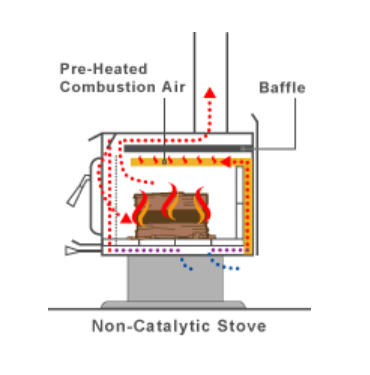
Health and emissions concerns drive much of the regulation. Wood smoke does contribute to particulate pollution, particularly when polluted air gets trapped in waterways. Yet policies frequently import urban dense assumptions into low-density rural contexts. Communities where a quarter or more of homes depend on wood tend to be rural, lower-income, and short on viable substitutes (Kittler et al.). Mandating urban-style standards without concurrent rural alternatives risks trading air-quality gains for heightened heat insecurity. Wood heating technology is not frozen in time. EPA-certified modern stoves achieve markedly higher efficiency and lower particulate output than older units, thanks to advances in combustion chambers, catalytic converters, and hybrid designs (Environmental and Energy Study Institute). Targeted regulation that speeds the adoption of these cleaner models makes sense. Blanket restrictions that eliminate access without replacements do not.
The core tension lies in governance from afar. National energy planning presumes constant grid access, redundant supply lines, and ready capital for upgrades, luxuries rural areas often lack. During major winter storms in the Pacific Northwest and Alaska’s interior, wood stoves have repeatedly proven to be the final dependable heat source when power and fuel deliveries collapse.
FEMA and related federal resources (including the U.S. Fire Administration) consistently emphasize safe alternative heating sources, such as wood stoves, fireplaces, and portable heaters, for winter power outages, which are especially prolonged and common in rural areas due to weather, infrastructure, and grid challenges. Guidance includes maintaining wood stoves safely (e.g., annual chimney inspections, keeping flammables 3 feet away) and using them as a reliable backup when grid-dependent systems fail. While not always explicitly “rural-only,” this advice is practical and frequently applied in rural contexts where wood fuel is abundant, and outages can last days or weeks. Broader preparedness sites aligned with FEMA also recommend wood stoves as a primary backup option for winter storms when electricity is unavailable.
Regulation now outpaces viable substitution in many places. Heat pumps demand reliable electricity and high upfront costs. Propane and oil remain price-volatile. Constraining wood without scaled alternatives does not advance decarbonization; it merely shifts vulnerability onto households least able to bear it.
This is not a plea against cleaner air or technological progress. It is a plea against treating rural energy patterns as marginal errors on a national map. Geography matters. Weather matters. So does the reality that some Americans cannot delegate their survival to systems that have failed them before.
Transitions endure when they respect ground conditions. They falter when policy pretends survival can be neatly abstracted away.
Works Cited
Arbor Analytics. “Homes that heat with wood: data by state.” Arbor Analytics, 31 Aug. 2025, https://arbor-analytics.com/post/2025-08-31-25-wood-heating-by-state/.
Environmental and Energy Study Institute. “Technology Advancements & Renewable Power Showcased at Wood Stove Design Challenge.” EESI, https://www.eesi.org/articles/view/technology-advancements-renewable-power-showcased-at-wood-stove-design-chal.
Kittler, Bernd, et al. “Residential Wood Heating in Rural America.” Land, vol. 13, no. 10, 2024, https://www.mdpi.com/2073-445X/13/10/1569.
Petrov, Andrey N., et al. “Stoking the flame: Subsistence and wood energy in rural Alaska, United States.” Energy Research & Social Science, vol. 70, 2020, https://www.sciencedirect.com/science/article/pii/S2214629620303947.
U.S. Energy Information Administration. “Wood and wood waste.” EIA, https://www.eia.gov/energyexplained/biomass/wood-and-wood-waste.php.
U.S. Forest Service. Various reports on rural/urban firewood use, e.g., via related studies cited in secondary sources.
Federal Emergency Management Agency (FEMA). “4 Tips to Prepare for Winter Weather Risks.” FEMA.gov, https://www.fema.gov/blog/4-tips-prepare-winter-weather-risks. (Advises maintaining heating equipment like wood stoves safely and preparing for outages that disrupt utilities, with clear warnings against unsafe alternatives like using ovens for heat.)
U.S. Fire Administration (USFA, under FEMA). “Heating Fire Safety.” USFA.FEMA.gov, https://www.usfa.fema.gov/prevention/home-fires/prevent-fires/heating/. (Provides outreach resources reminding residents to use wood stoves and fireplaces safely as heating options, including during emergencies.)
