

When the Dietary Guidelines for Americans for 2025–2030 were released on Jan. 7, they arrived the way most federal nutrition advice does: quietly, wrapped in PDFs, accompanied by earnest press briefings that few people outside policy and health media will ever watch. And yet, beneath the familiar bureaucracy, something had shifted.
Not everything. Not nearly enough to satisfy critics on either side of the endless food wars. But enough to suggest that the long-running experiment of treating Americans as carbohydrate-burning machines fueled by grains and fortified products may finally be losing its grip.
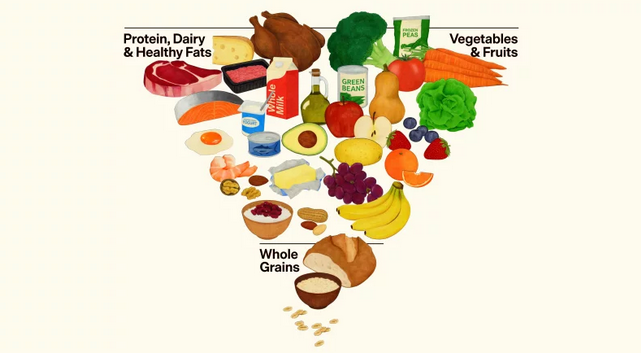
One of the most talked-about changes was visual. Several outlets reported that the new guidelines move away from the MyPlate graphic introduced in 2011 and toward a revised food pyramid, often described as “inverted,” with protein-rich foods, dairy, fruits, vegetables, and fats given more visual prominence than grains (CNN, 2026; NBC News, 2026). Whether the graphic itself becomes the enduring symbol matters less than what it signals: grains are no longer treated as the unquestioned foundation of a healthy diet.
That alone marks a break from decades of orthodoxy. The food pyramid many Americans grew up with placed bread, cereal, rice, and pasta at its base, reflecting a late-20th-century consensus that fat was dangerous, carbohydrates were safe, and hunger was best managed with volume rather than density. That advice coincided with the rise of low-fat, high-sugar foods engineered to meet the letter of the guidelines while undermining their spirit. Obesity, diabetes, and metabolic disorders surged during the same period. That does not prove causation, but it does make the old certainty harder to defend.
The new guidelines stop short of declaring that experiment a failure, but they do quietly step back from it. By emphasizing whole foods and de-emphasizing refined carbohydrates, the document aligns more closely with how people actually experience eating. Meals built around protein, vegetables, fats, and dairy tend to satisfy. Meals built around starch often do not, at least not for long. This is not ideology. It is the ordinary observation of anyone who has tried to make it from breakfast to lunch on toast alone (CNN, 2026).
Protein, however, is where the reporting around the guidelines has occasionally run ahead of the text itself. Some coverage has suggested dramatic increases in recommended protein intake. The guidelines themselves remain anchored to the long-standing adequate intake level of about 0.8 grams per kilogram of body weight for the general adult population, while acknowledging that higher intakes may be appropriate for older adults, physically active individuals, and others with specific needs (NBC News, 2026; Dietary Guidelines for Americans, 2025–2030). That distinction matters. The document does not declare that everyone should eat like a strength athlete. What it does do is move protein from a background nutrient to a central consideration, particularly for children and aging adults, where underconsumption has been a quiet problem.
That recalibration reflects something nutrition policy has often resisted: common sense reinforced by experience. Many parents did not need a federal guideline to tell them that children who eat eggs or yogurt for breakfast behave differently than children fueled by sugar and refined flour. The guidelines do not endorse any single dietary pattern, but they now leave more room for meals that look recognizably like food.
The sharpest rhetorical shift comes in the treatment of ultraprocessed foods. For the first time, federal dietary guidance explicitly identifies highly processed products as something to limit, rather than sidestepping the issue with euphemisms (Food Safety Magazine, 2026). This is not a small change. Ultraprocessed foods make up a majority of caloric intake in the United States, and they are designed less for nourishment than for shelf life and compulsion. The new language reflects a growing consensus that the problem is not merely sugar or fat in isolation, but the industrial context in which those ingredients are delivered.
Added sugars, especially in children’s diets, receive firmer limits and stronger warnings than in previous editions, though the guidelines stop short of framing sugar as a substance with no safe level at all (STAT News, 2026). This is still a political compromise, but a meaningful one. It narrows the rhetorical space that allowed soda, candy, and packaged snacks to hide behind the phrase “everything in moderation.”
Much of the media attention around the rollout focused on Robert F. Kennedy Jr., whose involvement in nutrition policy and vocal opposition to ultraprocessed foods has made him both influential and controversial. While his political status and future role remain contested, his presence at the center of the messaging underscores how fraught food policy has become. His blunt summary, “Eat real food,” landed precisely because it cut through decades of technocratic hedging (U.S. Department of Agriculture, 2026). It is also a reminder of how far federal guidance drifted from that basic premise in the first place.
The guidelines also retreat, cautiously, from the reflexive hostility toward full-fat dairy and traditional animal fats. The long-standing recommendation to limit saturated fat to under 10 percent of daily calories remains, but the document places greater emphasis on overall dietary patterns rather than isolated nutrients (CBS News, 2026). In practice, that means whole milk, butter, and cheese are no longer treated as moral failures when consumed as part of minimally processed diets. This is not an endorsement of excess. It is an acknowledgment that demonizing individual foods often leads people toward worse substitutes.
Critics argue that the visual emphasis on animal products risks marginalizing plant-based diets. The guidelines themselves continue to include legumes, nuts, seeds, and other plant proteins as valid options and explicitly state that multiple dietary patterns can support health (STAT News, 2026). The document is not a manifesto. It is a framework. Its real impact will depend on how it is interpreted by schools, hospitals, and federal food programs, where cost, logistics, and institutional inertia often matter more than graphics.
That is where skepticism remains warranted. Federal dietary advice has a long history of being diluted as it moves from paper to practice. Still, the 2025–2030 guidelines represent a modest but genuine correction. They pull back from grain absolutism, name ultraprocessed foods as a problem rather than an afterthought, and re-center meals around foods that existed before nutrition labels did.
This is not a revolution. It is a course adjustment made years later than it should have been. But in a culture saturated with engineered convenience, even that adjustment feels consequential. Health, it turns out, may not be found in clever formulations or fortified abstractions, but in the unglamorous discipline of eating things that still resemble what they are.
Sources
CBS News. “RFK Jr.’s New Food Pyramid Emphasizes Protein, Healthy Fats. Here’s What to Know About the Dietary Guidelines.” CBS News, 7 Jan. 2026,
www.cbsnews.com/news/dietary-guidelines-rfk-jr-sugar-processed-foods-gut-health/.
CNN. “New US Dietary Guidelines Include Inverted Food Pyramid, Urge Less Sugar, More Protein.” CNN, 8 Jan. 2026,
www.cnn.com/2026/01/07/health/dietary-guidelines-rfk-maha.
Food Safety Magazine. “Eat Real Food: New U.S. Dietary Guidelines Name and Shame ‘Highly Processed Foods’.” Food Safety Magazine, 7 Jan. 2026,
www.food-safety.com/articles/11025-eat-real-food-new-us-dietary-guidelines-name-and-shame-highly-processed-foods.
NBC News. “New U.S. Dietary Guidelines: 6 Biggest Changes to Know.” NBC News, 8 Jan. 2026,
www.nbcnews.com/health/health-news/dietary-guidelines-changes-takeaways-meat-dairy-alcohol-rcna252808.
STAT News. “Dietary Guidelines Declare War on Processed Foods and Sugar, Encourage More Protein and Dairy.” STAT, 7 Jan. 2026,
www.statnews.com/2026/01/07/dietary-guidelines-revised-more-protein-less-sugar-highly-processed-foods/.
United States Department of Agriculture. “Kennedy, Rollins Unveil Reset of U.S. Nutrition Policy, Put Real Food Back at Center of Health.” U.S. Department of Agriculture, 7 Jan. 2026,
www.usda.gov/about-usda/news/press-releases/2026/01/07/kennedy-rollins-unveil-reset-us-nutrition-policy-put-real-food-back-center-health.
United States Department of Health and Human Services and United States Department of Agriculture. Dietary Guidelines for Americans, 2025–2030. DietaryGuidelines.gov, 2026,
www.dietaryguidelines.gov/.
