
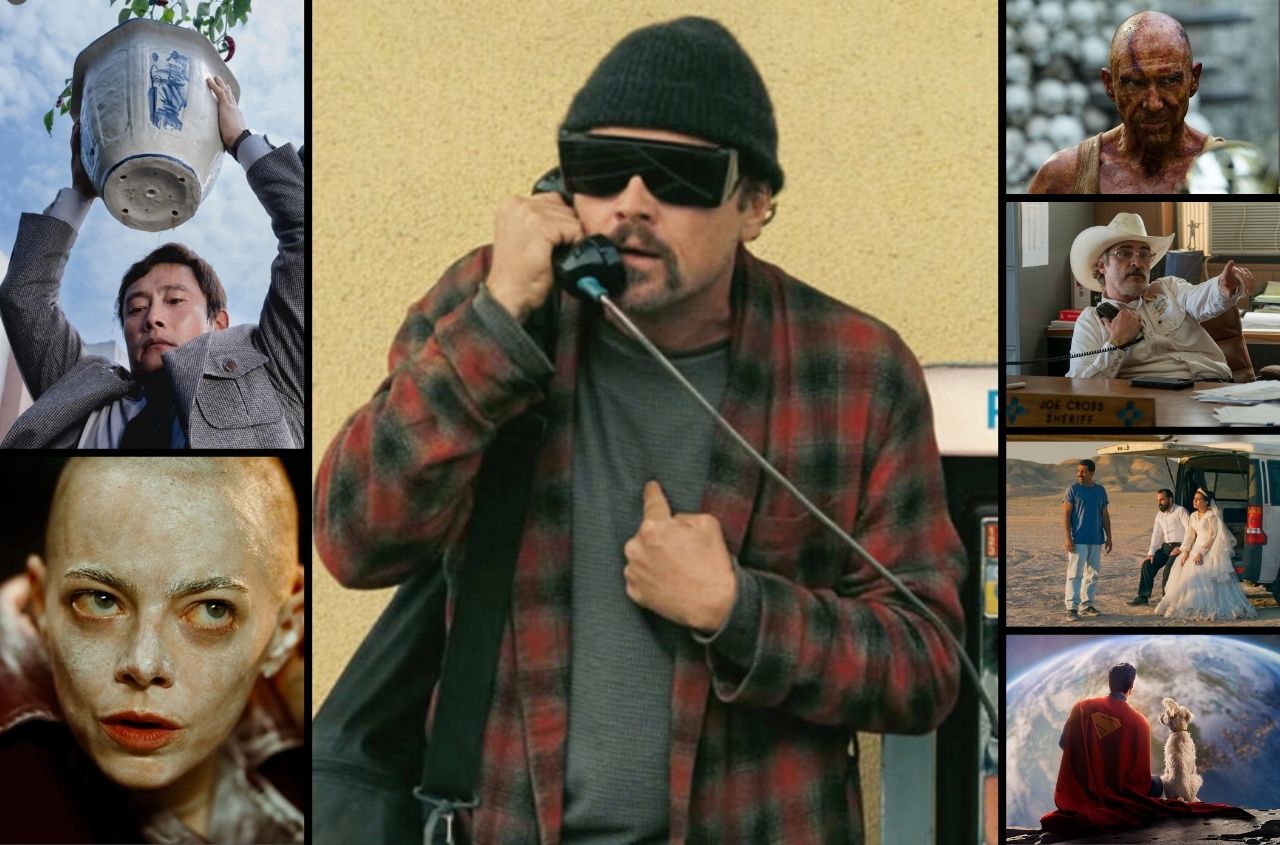
The following contains vague plot details but no spoilers for the films of 2025.
With the Golden Globes and Critics Choice Awards passed and the nominations for the 98th Academy Awards just announced this past week, awards season is in full swing.
For all of the turbulence of 2025, it was a great year for movies, producing many of the standout cinematic experiences of the decade so far. As new films rolled out over the year, a recurring trend became apparent across many of the landmark releases, communicating an attitude of society’s own reflection onto itself.
When we look back on history, one of the best ways to understand a civilization past is to look at its art. Art communicates stories– emotions. It tells us what people were thinking, what they valued, what they feared, what was happening.
Today there is no more popular and complex expression of art than film. It is a major industry, it is a product everyone consumes, and there is no better, more popular, more well rounded medium for storytelling.
Some of the greatest films this year thematically dealt with many societal issues that one can’t help but recognize as contemporary concerns. Across even the most crowd-pleasing, middle of the aisle films, it’s impossible to miss the concern for environmental conservation and colonialism seen in the newest installation in James Cameron’s Avatar series, Avatar: Fire and Ash.
For three films now, the indigenous alien species Na’vi have fought off military industrial human incursions on their home planet. Per movie, Avatar is the biggest cinematic franchise in the world; the previous two installations are the first and third highest grossing films of all time, these are action films that surround deforestation, whaling, and colonialism in a dystopian future of late-stage capitalism and military occupation.
Interestingly, one of the most anticipated films of the year tackled very similar concepts, and ended up being a massive disappointment. Unlike Avatar 3, Bong Joon-ho’s Mickey 17 does not work. The film centers around Mickey Barnes, played excellently by Robert Pattinson, who through a series of misfortunes finds himself on a space expedition from a dystopian Earth to a far off inhabitable planet in the near future. Severely down on his luck and without any money or skills to offer, he gets his ride on this space ship by participating in a cloning program, which makes him an expendable worker, and often times guinea pig for testing. By the time we meet Mickey, he has died and been cloned sixteen times (hence Mickey 17). By now Mickey has become accustomed to this treatment, after all, he has no other prospects back home. This clear analogy for class struggle using the science fiction genre was a really interesting set up, and is very in-keeping with Director Bong’s masterpiece Parasite (2019). This film unfortunately finds itself tied up in a bad Trump parody that is really just more cringey than critical. The film was slated to release in 2024 but pushed back to March 2025, and it’s clear because this is clearly a post-Trump film released during an unexpected second term. Just to complicate things, a last minute colonialism allegorical plot line is added right at the start of the third act, completely unfocusing any thematic power.
Looking over my curated selection of films during research, it was very interesting to discover a certain trend. Along with Mickey 17, two other films fit comfortably in the category of class-focused films: Bugonia and No Other Choice. What was specifically interesting was that none of these films were directed by American filmmakers. Yes, Mickey 17 and Bugonia are mainstream Hollywood productions, but their guiding voices were not American. It’s important to make clear right here that none of these movies that have or will be mentioned are homework– moral lessons too busy being impressed with themselves to be entertaining. These are some of the greatest films of the year, and some of the most fun theatrical experiences.
With that said, Bugonia and No Other Choice are an interesting pairing. Bugonia, from Greek director Yorgos Lanthimos follows Jesse Plemons as a recluse conspiracy theorist who lives in his rundown childhood home with his autistic younger cousin played by Aidan Delbis. Plemon’s character believes he has uncovered a massive conspiracy, and enlists his cousin to help him kidnap the CEO (played by Emma Stone) of a massive pharmaceutical company under the belief that she is secretly an alien sent to infiltrate Earth.
Park Chan-wook’s No Other Choice is a Korean film that starts with an upper-middle class manager at a paper manufacturing company of 25 years being laid off after the business is bought out by an American company. After months unable to find a new job, and growingly increasingly insecure in his inability to support his wife, son, and neurodivergent daughter, Yoo, played by Lee Byung-hun finds a very competitive position at a remaining paper company and decides that if he wants to protect his family, he has “no other choice” but to discreetly kill all of the best applicants to eliminate any of his competition for the job. What ensues is a darkly comedic spiral as You finds himself way in over his head.
Both Bugonia and No Other Choice center around men caught in a system that does not care for them. While Lee Byung-hun’s character works in this increasingly Americanized corporate landscape in South Korea, Jesse Plemons’s character works in an Amazon-esque warehouse packing boxes. They result to violence and project blame onto others because of the ease with which they are discarded by society.
Something like No Other Choice is a great example to look at when talking about societal trends in art. Not only is it immensely thrilling and entertaining, it shows a criticism of very common concern of job scarcity and obsolescence, and the hollowing out of an economic class that is just as common in South Korea as it is in the United States. 28 Years Later and It Was Just an Accident also give a voice of universal concerns through the lens of their own specific countries.
Director Danny Boyle and writer Alex Garland’s 28 Years Later is a follow up to their 2002 British zombie horror, 28 Days Later. This is one of my all time favorites of the year. It is an immensely compassionate film that just happens to feature some of the most gnarly horror scenes. Besides the very human elements that really just have to be experienced first hand, the film has a lot to say on national identity and isolationism. The film takes place 28 years after the British zombie apocalypse that is seen in the original film, and the British Isles have since been quarantined from the rest of the world to prevent the spread of the zombie “Rage Virus”. In this post-apocalyptic Northern England, villages are run down and reclaimed by the wilds, and survivors hunt with bow and arrow. Early in the film, our protagonists’ adventure is inter-spliced with a montage of clips from Laurence Olivier’s Henry V (1944) – a film commissioned by Churchill to inspire British troops, just around the time of the invasion of Normandy. Also playing over this montage is a haunting 1915 recording of the Rudyard Kipling poem Boots cut in with footage of marching WWI British soldiers, and marching young boys. This is the vision of an England cut off from the rest of the world and left to iterate on symbols and propaganda recreating its own true history.
Rather than a post-apocalyptic England, It Was Just an Accident finds its story in modern day Tehran, Iran. Director Jafar Panahi is a controversial figure in Iran. A prolific and celebrated filmmaker, he has also been imprisoned several times by the Iranian government, and has faced multiple travel bans. Panahi just recently was convicted with another travel ban once he returns to his home country after his tour with this film ends, as he filmed the movie illegally in and around Tehran. Winner of the Palm d’Or Award at Cannes Film Festival, this movie is very abrasive but sometimes funny. It follows a former prisoner of the Iranian regime who believes he has discovered the man who tortured him in prison, though he can’t be sure because he was blindfolded the entire time. So he rounds up a gang of former prisoners to see if they can confirm the man’s identity. The plot is driven by the pain and rage inflicted upon the main cast of characters by someone they cannot even be sure is the man they believe he might be.
Last comes a duo which may be the yin and yang of the year– Eddington and One Battle After Another.
Ari Aster’s Eddington is set in May 2020, which from the title card sets the tone for just about the entire rest of the movie. It follows Joaquin Phoenix as Joe Cross, the sheriff of Eddington, New Mexico as he faces off the incumbent Mayor Ted Garcia played by Pedro Pascal in the mayoral race amidst the most chaotic period of the COVID-19 pandemic. A pitch black comedy, this movie has been criticized by a wide variety of people for making fun of the wrong people, but that is not what it does at all. The strengths of this movie are its objectivity to its absurdity. It is fully self aware, and the parts that we can identify with most cause genuine discomfort and comedy.
My favorite film of the year, and after six viewings, perhaps of all time, is One Battle After Another. Criticized by many far-right commentators as woke propaganda; that just seems like a complete misreading. I have trouble with calling this a political film. This movie’s strengths are in its characters and their relationships. There is a lot of Strangelove-esque comedy around it, but at its core, it’s a movie about a movement that failed, a man that burned out, and a girl who has to be let free.
That is obviously not all. There are several scenes set in and around immigration camps run by US military, specifically Sean Penn’s villainous Colonel Lockjaw. The film is political in that it shows acts of political violence, leftist extremist terrorism, white supremacist secret societies, military police occupying streets and inciting riots amongst protesters, and underground immigrant asylum. These are presented with objectivity if not with comedy. It is not political to make racists villains, it is not political to show things that actually happen. This film was filmed more than a year ago. The project has been in the works for around twenty years, and it is adapting (though quite loosely) a Pynchon novel from the 1990 set in the 80s. The past work of director Paul Thomas Anderson show a track record of him never judging his characters, he lets you. He simply shows you their actions.
Ultimately Eddington and One Battle grapple with the same thing; what do you do when you don’t like the world?– or even worse– when the world is after you? Eddington says you can go on your phone, to hide and be miserable. One Battle calls for you to be in and a part of the world.
Looking back across all these movies, the biggest recurring theme is control, or rather the feeling of losing it.
The native characters of Avatar fighting back against an invasion of their home. Mickey’s willingness to sell himself for just the right to live. The blame that Jesse Plemons is trying to find a place for as he violently lashes out at the cards he was dealt, and those who would sooner discard him than help. The quickness with which the security of a man’s career could just fall apart on the whim of a stranger for the sake of capital. The embrace of nationalism from the isolation of the zombie apocalypse or the years of life lost in an Iranian torture cell. The fact that the world could just stop and go insane, and you just had to figure out your own way. This is why Superman was so powerful this year with the simple lesson of the power of kindness.
The fact that these are the stories that our greatest working artists like Paul Thomas Anderson, Park Chan-wook, James Cameron or Alex Garland are compelled to tell, and even more, the fact that these films are so resonant communicate a collective feeling of being out of control of the circumstances of our own lives. There is an immense anxiety about our futures, who controls them, and how we can reclaim a sense of ease. Who builds the future, and do they care why?
Films mentioned:
One Battle After Another – Paul Thomas Anderson
Eddington – Ari Aster
Mickey 17 – Bong Joon-ho
28 Years Later – Danny Boyle
Avatar: Fire and Ash – James Cameron
Bugonia – Yorgos Lanthimos
It Was Just an Accident – Jafar Panahi
No Other Choice – Park Chan-wook
2 Comments
Excellent piece. I agree with the author’s succinct analysis of the movies I’ve seen and look forward to watching movies I haven’t yet seen that were mentioned like No Other Choice and Bugonia.
Please write more about how art relates to the world. I would love to read in-depth reviews of film from Josh.
I haven’t watched all these movies, but I did watch “One Battle After Another” just the other evening. It felt very political — and very timely — to me, especially given what’s going on in Minneapolis. Many of the Trump officials involved with ICE and DHS seem cartoonish to me in the way they justify their policies and actions. Sean Penn as Colonel Lockjaw was similarly cartoonish. The lefty radical on the run, played by Leonardo diCaprio, reminded me of the radicals of the sixties and seventies. They really were that brazen, often on the run or in hiding. The Unabomber comes to mind. We live in a world of political theater, and I think this film helps make that clear.