

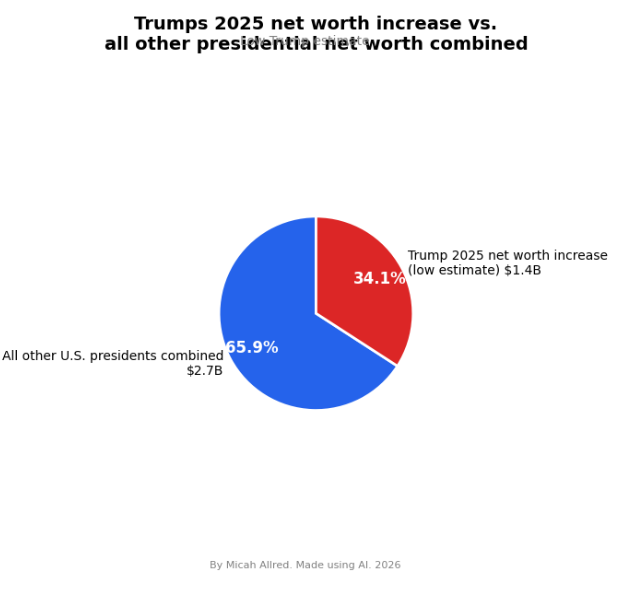
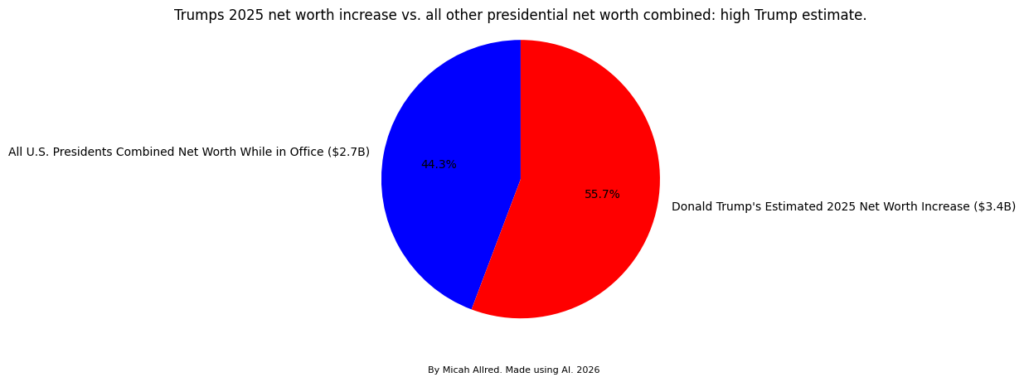
President Donald Trump’s financial trajectory during his second term has sparked questions about the most unprecedented accumulation of presidential wealth in American history. According to a New York Times investigation, Trump personally gained approximately $1.408 billion in 2025, his first year back in office (New York Times Editorial Board, 2026). Forbes reported his net worth jumped from roughly $3.9 billion in 2024 to $7.3 billion by year’s end, a gain of around $3.4 billion (Alexander, 2025a). This single-year increase approaches—and by some measures may exceed—the combined net worth of every other U.S. president while in office.
To contextualize this figure, Our National Conversation compiled published estimates of all 44 presidents’ net worth during their time in office, adjusted for inflation. The combined total reaches approximately $2.7 billion, near the feasible higher-end of Trump’s 2025 gains (McIntyre et al., 2016). The comparison reveals not just Trump’s extraordinary wealth accumulation but also illuminates how dramatically presidential financial profiles have evolved across American history.
Presidential Net Worth Estimates While in Office (1789-2025)
- George Washington (1789-1797): $525 million. Virginia plantation owner with 8,000 acres at Mount Vernon, hundreds of enslaved people producing tobacco, grain and whiskey (McIntyre et al., 2016).
- John Adams (1797-1801): $19 million. Successful law practice and inheritance; married into the wealthy Quincy family (McIntyre et al., 2016).
- Thomas Jefferson (1801-1809): $212 million. Inherited 3,000 acres and enslaved people; built 5,000-acre Monticello plantation (McIntyre et al., 2016).
- James Madison (1809-1817): $101 million. Virginia’s largest landowner; owned 5,000-acre Montpelier estate (McIntyre et al., 2016).
- James Monroe (1817-1825): $27 million. Married a wealthy wife; sold Highland plantation (3,500 acres) to pay debts after leaving office (McIntyre et al., 2016).
- John Quincy Adams (1825-1829): $21 million. Inherited father John Adams’s land holdings (McIntyre et al., 2016).
- Andrew Jackson (1829-1837): $119 million. Married into slaveholding wealth; owned 1,050-acre Hermitage plantation in Tennessee (McIntyre et al., 2016).
- Martin Van Buren (1837-1841): $26 million. Career attorney and politician; owned 225-acre Lindenwald estate in New York (McIntyre et al., 2016).
- William H. Harrison (1841): $5 million. Married judge’s daughter; inherited 3,000 acres; owned Indiana estate. Died in office insolvent (McIntyre et al., 2016).
- John Tyler (1841-1845): $51 million. Inherited 1,000-acre tobacco plantation; bought Sherwood Manor (1,600 acres). Died in debt after the Civil War (McIntyre et al., 2016).
- James K. Polk (1845-1849): $10 million. Born to a plantation family; earned income as Speaker and Governor (McIntyre et al., 2016).
- Zachary Taylor (1849-1850): $6 million. Inherited family lands; profited from land speculation and warehouse leasing (McIntyre et al., 2016).
- Millard Fillmore (1850-1853): $4 million. No significant inheritance; founded college (now SUNY Buffalo); owned New York house (McIntyre et al., 2016).
- Franklin Pierce (1853-1857): $2 million. Farming family; career attorney; owned New Hampshire property (McIntyre et al., 2016).
- James Buchanan (1857-1861): Under $1 million. Farming family origins; lifelong public servant; owned modest Pennsylvania farm (McIntyre et al., 2016).
- Abraham Lincoln (1861-1865): Under $1 million. Log-cabin origins; lawyer for 17 years; owned a small Illinois home (McIntyre et al., 2016).
- Andrew Johnson (1865-1869): Under $1 million. Tailor’s son; owned a small Tennessee home; career politician (McIntyre et al., 2016).
- Ulysses S. Grant (1869-1877): Under $1 million. Lost fortune in business; lived on general’s salary; war memoirs later earned family money.
- Rutherford B. Hayes (1877-1881): $3 million. Attorney and Ohio governor; owned a 10,000-square-foot home on Spiegel Grove estate (McIntyre et al., 2016).
- James A. Garfield (1881): Under $1 million. Humble Ohio beginnings; long House career; owned a small Mentor, Ohio property (McIntyre et al., 2016).
- Chester A. Arthur (1881-1885): Under $1 million. Collector of Customs in New York in the 1870s (lucrative position); owned a Tiffany-furnished townhouse (McIntyre et al., 2016).
- Grover Cleveland (1885-1889, 1893-1897): $25 million. Lawyer and Buffalo mayor; married a wealthy wife; sold New Jersey “Westland Mansion” estate (McIntyre et al., 2016).
- Benjamin Harrison (1889-1893): $5 million. Attorney with no inheritance; high-paid international law career; owned a large Indiana home (McIntyre et al., 2016).
- William McKinley (1897-1901): $1 million. Working-class roots; 30-plus years in public office; went bankrupt in the 1893 panic (McIntyre et al., 2016).
- Theodore Roosevelt (1901-1909): $125 million. Born wealthy (trust fund); owned Sagamore Hill estate on Long Island (McIntyre et al., 2016).
- William H. Taft (1909-1913): $3 million. Married into money; successful lawyer, Supreme Court Chief Justice; earned from law career and investments (McIntyre et al., 2016).
- Woodrow Wilson (1913-1921): Under $1 million. Little inherited wealth; Princeton president’s salary; stroke in office ended career (McIntyre et al., 2016).
- Warren G. Harding (1921-1923): $1 million. Fortune by marriage (wife was a bank heiress); owned an Ohio newspaper (McIntyre et al., 2016).
- Calvin Coolidge (1923-1929): Under $1 million. Small inheritance; earned from autobiography and syndicated column (McIntyre et al., 2016).
- Herbert Hoover (1929-1933): $75 million. Mining engineer/executive fortune; made a large fortune overseas in mining (McIntyre et al., 2016).
- Franklin D. Roosevelt (1933-1945): $60 million. Inherited Roosevelt family wealth; owned 800-acre Springwood estate.
- Harry S. Truman (1945-1953): Under $1 million. Modest income (haberdasher); saved small sums from a $12,000 annual salary (McIntyre et al., 2016).
- Dwight D. Eisenhower (1953-1961): $8 million. Career Army general; bought farm near Gettysburg; earned from memoirs and speeches (McIntyre et al., 2016).
- John F. Kennedy (1961-1963): Approximately $1 billion. Heir to a vast fortune (father Joseph Kennedy was extremely wealthy) (McIntyre et al., 2016).
- Lyndon B. Johnson (1963-1969): $98 million. Built wealth via 1,500-acre Texas ranch, radio and TV stations, banks (McIntyre et al., 2016).
- Richard Nixon (1969-1974): $15 million. No inheritance; made money from post-presidency book deals and Frost interviews (McIntyre et al., 2016).
- Gerald R. Ford (1974-1977): $7 million. Post-presidency income from book deals and board memberships (McIntyre et al., 2016).
- Jimmy Carter (1977-1981): $7 million. Born to a peanut farm; became wealthy from speaking fees and approximately 30 published books (McIntyre et al., 2016).
- Ronald Reagan (1981-1989): $13 million. Former actor and TV host; owned real estate; earned from autobiography and GE spokesperson contract (McIntyre et al., 2016).
- George H.W. Bush (1989-1993): $23 million. Son of wealthy Prescott Bush; made money in oil and banking; owns 100-plus- acre Kennebunkport estate (McIntyre et al., 2016).
- Bill Clinton (1993-2001): $70 million. No inheritance; post-office riches from books and speeches (e.g., $15 million advance on “My Life”) (McIntyre et al., 2016).
- George W. Bush (2001-2009): $35 million. Inherited Texas oil wealth; sold Texas Rangers stake (approximately $15 million profit); earned $7 million advance on “Decision Points” (McIntyre et al., 2016).
- Barack Obama (2009-2017): $7 million. Earned $15.6 million in book royalties (2009-2017); Netflix and Spotify deals added millions (Forbes estimated $70 million in 2024) (McIntyre et al., 2016).
- Joe Biden (2021-2025): $7 million (2026 estimate). Career politician with pensions and real estate (Jakiel, 2026).
So the combined net worth of all 44 presidents, excluding President Donald Trump, is estimated at around $2.7 billion (Jakiel, 2026; McIntyre et al., 2016).
Trump’s Estimated 2025 Net Worth Increase
According to Forbes, Trump began 2025 with an estimated net worth of $3.9 billion and ended the year with $7.3 billion (Alexander, 2025c). Roughly $2 billion of that increase came from crypto-related ventures, including the launch of a Trump-branded memecoin, token sales through World Liberty Financial, and involvement in a stablecoin enterprise (Alexander, 2025a). An additional $410 million was attributed to a rebound in licensing and management deals, while $470 million came from the dismissal of a major fraud judgment that had previously deflated his net worth (Alexander, 2025b).
These breakdowns are based on reported estimates drawn from observable transactions, public filings, and market valuations, but they still depend on subjective valuation judgments (Alexander, 2025a). While it is clear that Trump profited by at least $1.4 billion since returning to office (NYTEB, 2026), the true total could be higher or lower depending on how unrealized crypto gains and opaque private deals are ultimately valued or disclosed.
Historical Analysis and Implications
When compared to the combined $2.7 billion adjusted net worth of all 44 predecessors, Trump’s reported single-year profit of $1.408 to $3.4 billion is likely just below the total wealth accumulated by all previous U.S. presidents during their respective terms (McIntyre et al., 2016; Alexander, 2025c). It is certainly less than Trump’s own net worth upon resuming office in 2025, estimated at $3.9 billion, and likely amounts to less than half of his current net worth, which stood at $7.3 billion by year’s end (Alexander, 2025c).
The comparison highlights how presidential wealth patterns have evolved. George Washington’s $525 million and Thomas Jefferson’s $212 million represented fixed assets: land, enslaved people, and plantation holdings, accumulated over decades (McIntyre et al., 2016). Twentieth-century presidents like Herbert Hoover and the Roosevelts entered office with established fortunes built through business ventures and inheritance, rather than public service salaries (McIntyre et al., 2016).
Modern presidents such as Clinton and Obama typically enriched themselves after leaving office through book deals and speaking engagements, creating a semblance of separation between power-holding and wealth accumulation (McIntyre et al., 2016). By contrast, Trump’s 2025 wealth surge concentrated in volatile assets: cryptocurrency holdings, meme coins and shares in Trump Media, is unprecedented in the historical or modern presidency (Bennett, 2025).
The 2025 windfall effectively rebranded Trump financially, replacing the majority of his net worth from a real estate empire he spent five decades building to a crypto-centric portfolio assembled in months (Alexander, 2025a). It also coincided with mounting questions about pardons issued during Trump’s presidency. Approximately one in five of Trump’s non-January 6th pardons went to individuals or associates who made substantial contributions, ranging from $800,000 to $6 million, to Trump’s political action committees and campaign funds, according to Forbes investigations (Durkee, 2026). Though no criminal charges have resulted, Justice Department investigators documented offers of “substantial political contributions in exchange for presidential pardons,” with total documented donations linked to clemency decisions reaching tens of millions of dollars.
Whether this represents innovation in executive compensation or a warning about unchecked conflicts of interest remains contested. What cannot be disputed is its historical anomaly: no previous president has been proven to have directly profited from mixing office holding and private ventures at this scale while serving in American history.
While Trump, his family, and Administration officials have denied conflicts of interest, the timing between regulatory approval and profitability remains difficult to ignore. Whether Trump favored deregulation because he believed in cryptocurrency’s promise or because he had financial stakes in its regulatory outcome is a question central to evaluating presidential accountability.
The mathematical reality is stark: Trump’s 2025 earnings rival, and by some calculations may exceed, the combined net worth of every other U.S. president who served before him; a consolidation of presidential wealth without historical precedent.
Works Cited
Alexander, Dan. 2025a. “Crypto Now Accounts For Most of Donald Trump’s Net Worth.”
Forbes. https://www.forbes.com/sites/danalexander/2025/06/12/crypto-now-accounts-for-most-of-donald-trumps-net-worth/
Alexander, Dan. 2025b. “Here’s How Trump Made an Estimated $1 Billion on Crypto.”
Forbes. https://www.forbes.com/sites/danalexander/2025/06/05/this-is-how-much-trump-has-made-from-crypto-so-far/
Alexander, Dan. 2025c. “Presidency Boosts Trump’s Net Worth by $3 Billion in a Year.”
Forbes. https://www.forbes.com/sites/danalexander/2025/09/09/presidency-boosts-trumps-net-worth-by-3-billion-in-a-year/
Bennett, Brian. 2025 “3 Ways Trump’s Wealth Has Soared Since He Returned to Office.”
TIME. New York City. https://time.com/7342470/trump-net-worth-wealth-crypto/
Cerullo, Megan. 2024. “Who Is the Richest U.S. President Ever?”
CBS News. https://www.cbsnews.com/news/election-2024-richest-us-presidents-ever/
Dorn, Sara. 2025. “Trump’s Net Worth Drops $1.1 Billion.”
Forbes. https://www.forbes.com/sites/saradorn/2025/11/22/trumps-net-worth-drops-11-billion/
Durkee, Alison. 2026. “Everyone Pardoned by Trump With Political or Financial Ties to the President.” Forbes. https://www.forbes.com/sites/alisondurkee/2026/01/16/trumps-pardon-list-puerto-rico-governors-co-conspirator-latest-big-time-donor-sprung-free-by-president/
Jakiel, Olivia. “Find Out Joe Biden’s Net Worth in 2026—and How It Compares to Other Presidents.” Parade, 2 Jan. 2026. https://parade.com/celebrities/joe-biden-net-worth
McIntyre, Douglas A., Alexander E. M. Hess, and Samuel Stebbins. 2016. “The Net Worth of the American Presidents: Washington to Obama.”
24/7 Wall St. https://247wallst.com/banking-finance-and-taxes/2010/05/17/the-net-worth-of-the-american-presidents-washington-to-obama/
New York Times Editorial Board. 2026. “How Trump Has Used the Presidency to Make at Least $1.4 Billion.” The New York Times. https://www.nytimes.com/interactive/2026/01/20/opinion/editorials/trump-wealth-crypto-graft.html
Roeloffs, Mary. 2025. “The Definitive Net Worth of Donald Trump.”
Forbes. https://www.forbes.com/sites/danalexander/article/the-definitive-networth-of-donaldtrump/.

1 Comment
Pingback: Woe – Laura Gerling, unsolicited Poet and educator