
The following containers spoilers for 28 Years Later: The Bone Temple
“What’s your name?” asks Sir Lord Jimmy Crystal.
“Spike.”
“No.” Sir Lord Jimmy replies, “I think your name is… Jimmy.”
When these lines close out the opening scene of 28 Years Later: The Bone Temple, the next we see of young Spike, he is already dressed in the peroxide wig and matching tracksuit of the Jimmys.
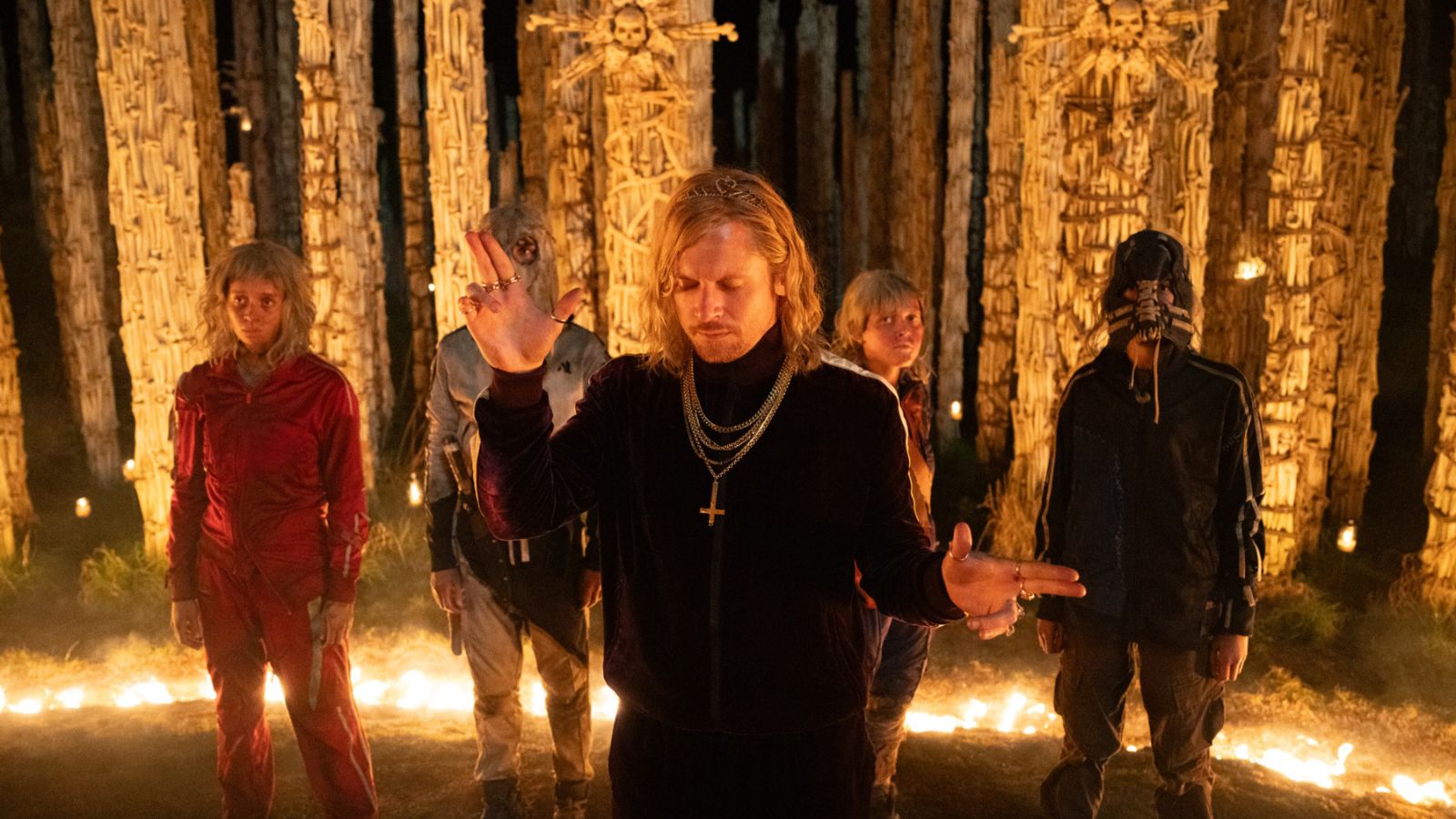
The first blockbuster release of 2026, 28 Years Later: The Bone Temple picks up almost immediately where last year’s 28 Years Later left off. When we last left our hero Spike, a young boy played by Alfie Williams, he had left the safety of his settlement, and set out on his own journey of self discovery in post-apocalyptic England, leaving us on a cliffhanger in which he is saved from a horde of rage zombies by a gang of teenagers in matching tracksuits and wigs, led by the charismatically eccentric Sir Lord Jimmy Crystal played by Jack O’Connell.
Formally, Bone Temple is strikingly restrained compared to its predecessor. With Nia DaCosta taking over directing duty from Danny Boyle and a shift in both cinematography and score, the film separates itself from the previous installments’ frenetic urgency in favor of a more traditional, deliberate style. What remains consistent is writer Alex Garland’s commitment to differentiating this series from the traditional zombie apocalypse story.
The story of Bone Temple widens to encompass a full cast of characters with no one clear protagonist, though it maintains Spike as its central focus, as it places him in a vulnerable position at the brink of darkness. The zombies are incidental.
What truly interests this film is a study of young men in crisis.
In the opening minutes of Bone Temple we are immediately placed in an abandoned recreational center, where from his makeshift throne, Sir Lord Jimmy watches Spike face his gang of Jimmys in an empty swimming pool. In order to survive, Spike is forced to fight one of Jimmy’s “seven fingers” – the identically named members of his gang – and replace them. He does just that when in an unexpected chance, he hits his opponent’s femoral artery; and so by accident, Spike takes his first uninfected life.
This surprising act of intense violence sets the precedent for Spike’s journey. He embodies a universal adolescent crisis. He has gone off on his own, leaving behind his family and community in search of independence, but has found that with that freedom comes with danger.. The Jimmys find him right at this point of vulnerability. They are terrifying, violent and cruel, but they also offer belonging. Without them, Spike would already be dead.
At no point does Spike ideologically buy into the Jimmys. Somewhere between A Clockwork Orange’s droogs and the Teletubbies, these teenagers commit acts of sadistic violence under the banner of “charity”. Spike is forced to witness truly horrific acts that they inflict on others, but he never actively participates. He does not want to be a part of this group, but is horrified by the alternative. Still he is implicated; he shares their name, and wears their costume. Spike is not pulled into the orbit of the Jimmys because he believes in their ideology, but because belief is secondary to belonging. He is not being recruited through persuasion, but through survival.
Spike’s identity has not yet hardened, which makes his proximity to Sir Lord Jimmy all the more concerning. If Spike represents adolescence in danger of corruption, Jimmy represents the logical end of that road.
The previous film begins with a flashback to the outbreak of the zombie “Rage Virus”, in which a young boy witnesses his entire family violently massacred by infected. The boy’s father, a vicar, hides him in the floor of the church just before the infected horde breaks down the doors and overtakes him as he welcomes them with religious ecstasy like Judgment Day has come. This boy is revealed to be Jimmy.
In the twenty eight years since, Jimmy’s faith has not been destroyed but inverted. The imagery of his father swallowed by the horde has led him to believe the infected are not victims of a virus, but demons sent to Earth. He communes with “Old Nick” and asserts his power with the claim that he is his chosen son. His Satanism is not rebellion, but a rationalization of chaos.
This inversion is reinforced through Jimmy’s deliberately childish performance. He styles himself after British celebrity Jimmy Savile, once widely regarded as a benevolent philanthropist and children’s television personality. Jimmy embodies cruelty disguised as playfulness. Critically, the outbreak in this film occurred in 2002, years before Savile died and years of sexual abuse toward children were unearthed. Jimmy grew up idolizing a figure who presented as charitable and eccentric, but was in fact predatory. Jimmy cloaks absolute control and violence in childlike aesthetics, renaming torture “charity”, invoking the imagery of the Teletubbies, dressing his young acolytes in colorful tracksuits and teaching them silly dances borrowed from children’s television.
One of Bone Temple’s greatest strengths is that it never falls for the tired trope of softening a villain with their trauma. Jimmy is evil. It pathologizes him and seeks to understand him, but it never sympathizes with him. Jimmy was also once a boy whose entire world was inverted, and he already had an ideology in place to be twisted in the absence of structure. The world ended.
Opposing Jimmy is the film’s third central character. Ralph Fiennes, who comes in at the third act of the previous film, returns in Bone Temple and emerges as the film’s moral center as Dr. Ian Kelson, a now career-defining role of who I might argue is the greatest living actor.
From a distance, Kelson appears sinister. His skin is stained a reddish-orange with iodine which he has discovered to be a “prophylactic” that kills the virus, and his home is a magnificent ossuary: the titular Bone Temple. What appears as a shrine to death is actually a monument to life. Built from the bones of infected and uninfected alike, Kelson has dedicated his life to honoring the life of every single person lost since the collapse. “Memento mori” he imparts on Spike, “Remember you must die”.
Before the outbreak, Kelson was a general practitioner for the National Health Services, and he acts like it. He behaves like a doctor. He does not judge or moralize. Where Jimmy controls, Kelson cares.
When last we saw Kelson, he sent Spike off on his way home after what is perhaps the best cinematic moment of last year. In Bone Temple his story orients itself around his growing relationship with Samson, played by Chi Lewis-Parry, an alpha infected, whose body has been reshaped into a hulking killing machine by the Rage Virus. The first we see of Samson, we are on a hunt with him. For the first time in the franchise, we see the perspective of an infected person, revealing that Samson hallucinates monstrous threats where there are only men.
Like with Jimmy, we get a look into Samson’s final moments before the outbreak when he was infected as a child. Similarly, Samson was a boy whose development was violently arrested and turned into a monster, but unlike Jimmy, Samson’s corruption was biological, not ideological.
Unlike most other survivors, Kelson does not meet the infected with violence. He sedates Samson, treats his wounds, and studies his suffering. He shows compassion and care to a literal monster, and seeks to treat him. When Kelson realizes he only has about two weeks worth of morphine left to ease Samson’s pain, he prepares to euthanize him, wishing to grant him peace in the face of unmedicated torment. He only laments that Samson cannot consent to this– he does not want to take away any more autonomy than he has already lost. But when Samson shows signs of recognition, looking to the night sky and whispering “moon”, Kelson stops. Rather than interpreting this as consent, he sees a mind that is not beyond saving. Instead Kelson considers the virus itself, the root of Samson’s pain and corruption, theorizing that beyond its physical and sensory effects, there is a psychiatric component. “Infection lies over the mind,” he says, “clouding it.” As an audience, we have already seen proof that Samson hallucinates, a symptom of psychosis. Kelson attempts treatment of the cause rather than execution of its victim, administering the brute antipsychotics in the hope that some bit of Samson can be reached.
The film’s two storylines collide when one of Jimmy’s fingers, played by Erin Kellyman, discovers the Bone Temple and spots Kelson from afar, stained in iodine, dancing with Samson amidst his temple of human remains. All things considered, it’s not a stretch when she mistakes him for Satan himself..
For Jimmy, this exposes the fragility of his authority. His control over the fingers depends on maintaining the myth he has constructed, even when confronted with evidence that threatens it. In a private meeting in which Jimmy introduces himself to Kelson, Jimmy quickly reveals he regularly hears the voice of his father (who is Satan) speak to him. Kelson responds to this like a doctor. He does not challenge the delusions, nor does he indulge them. He listens, disarming Jimmy into speaking soberly for the first time in the film, not with force but with attention. What destabilizes Jimmy is not exposure, but the possibility of being seen without all the extra performance.
Still, Jimmy ends this encounter with a threat: Kelson has to convince his followers that he is in fact the devil, or Jimmy will kill him.
Out of obligation to see Samson’s treatment through, Kelson plays along. He stages an elaborate ritual of fire, music and spectacle, and standing before an inverted cross, declares that Jimmy is the son of Satan. He commands the Jimmys to continue their work, spreading charity, and to grow their numbers. Kelson begins to hesitate though when Jimmy continues to press him, taunting by demanding permission for increasingly explicit acts of violence. Only when he notices Spike, does Kelson go off script. By twisting the mythology that Jimmy has invented, Kelson catches him in a contradiction that would require Jimmy either to die, or to delegitimize his entire claim to power. Either way means the end of his reign, so in one last desperate play for power, Jimmy results to violence, fatally stabbing Dr. Kelson. The illusion shatters, the Jimmys are in disarray and unsure of what to believe. Ultimately, it is Spike who delivers the blow to Jimmy, putting a knife beneath his ribs in a very Christlike manner, making a deliberate act of violence that, while rejecting Jimmy, perhaps still bears his imprint.
When Spike comes to the side of the dying Dr. Kelson, the boy apologizes and begs that he should have let them go. Kelson replies that when he saw it was Spike, he could not let that happen to him. Kelson chose the future of one boy over the future of the world.
The film ends on an epilogue that in retrospect feels inevitable. In a cottage in the countryside, a young girl studies for an exam. Her father, played by Cillian Murphy reprising his breakout role from the original 28 Days Later enters the room and gives her a history lesson on the Treaty of Versailles, comparing the Allies’ treatment of its enemies after World War I and World War II, asking what happens when wounded enemies are humiliated rather than rehabilitated. “Why help bankrupt your enemy? Let the ideas go bankrupt.”
Samson was not destroyed, the root of his pain was addressed. As far as we know, Jimmy was never given the chance, his beliefs were warped into violence. Spike, however, was given a chance; offered a different path. Where Jimmy built his following with fear, Spike was met with care and compassion, someone willing to sacrifice everything for his future.
The lesson is interrupted by a sound outside, where from a distance they see Spike and a companion tumbling down a hill from a horde of zombies. “Do we help them?” the girl asks. After a brief hesitation, Murphy replies with the final line of the movie: “of course we do.” Closing out this film with a clear thesis statement.
28 Years Later: The Bone Temple does not communicate a moral panic. It identifies a real contemporary concern and argues that young men are not inherently monsters, but they can be shaped quickly, and whether they succumb to violence and darkness is dependent on intervention, to show compassion and support rather than humiliation and contempt.