As protests continue in Minneapolis, the human toll is undeniable. Loss of life, community disruption, and prolonged tension have reshaped daily life across the city. But beyond the immediate humanitarian impact, another question looms: what are the economic consequences of sustained unrest—and what responsibility do major corporations have to the communities they operate in?
Moving from prolonged corporate silence to carefully worded statements, responses from large companies have drawn increasing scrutiny, particularly as local businesses bear the brunt of economic disruption.
Corporate Silence and a Call for De-Escalation
“Operation Metro Surge” began in Minneapolis in December, intensifying federal immigration enforcement and triggering widespread protests. For weeks, major corporate leaders based in Minnesota remained largely silent.
That changed on Jan. 26, 2025, when more than 60 CEOs of Minnesota-based companies signed an open letter published by the Minnesota Chamber of Commerce calling for “an immediate de-escalation of tensions and for state, local and federal officials to work together to find real solutions.”
The letter acknowledged “widespread disruption and tragic loss of life,” though it did not name victims directly. Its language was measured—recognizing instability without explicitly condemning U.S. Immigration and Customs Enforcement (ICE) operations or naming President Donald Trump. Supporters viewed the letter as a necessary first step in a polarized environment; critics argued that its careful phrasing appeared designed to avoid jeopardizing corporate relationships with the White House.
The letter ultimately walked a narrow line: acknowledging the severity of events in Minnesota while stopping short of assigning blame. While praised for collective engagement, many observers noted that statements alone are unlikely to satisfy public demands for accountability.
Target at the Center of the Debate
Target, headquartered in Minneapolis, has emerged as a focal point for public frustration. The retailer has faced online criticism and in-person demonstrations as its new CEO, Michael Fiddelke, stepped into the role on Feb. 2.
Fiddelke’s arrival follows a turbulent year for the company. Boycotts in 2025, prompted by a rollback of DEI initiatives, weighed on sales and contributed to weaker performance, culminating in the forced retirement of his predecessor. Fiddelke signed the January open letter and addressed protesters early in his tenure, assuming leadership amid heightened tension and public scrutiny.
In Target’s 2025 third-quarter earnings press release, Fiddelke acknowledged the challenges facing the company:
“Thanks to the incredible work and dedication of the Target team, our third quarter performance was in line with our expectations, despite multiple challenges continuing to face our business.”
During the earnings call, he added:
“While our third quarter performance came in as expected, we’re far from satisfied with our current results, and we won’t be satisfied until we’re operating at our full potential.”
While these statements focused on operational performance rather than political context, they underscore the pressure facing large corporations navigating both market expectations and public unrest.
According to Axios, major national retailers have not yet experienced a significant long-term financial impact from the protests. However, small, main-street businesses—particularly those in affected neighborhoods—appear to be absorbing disproportionate economic harm. Target is expected to report its fourth-quarter 2025 earnings on March 3, which may provide further insight into whether consumer behavior is shifting.
International Corporate Reactions
The fallout from Minneapolis has not been confined to domestic companies. Several international firms have begun reassessing their relationships with U.S. immigration agencies amid broader concerns about reputational risk.
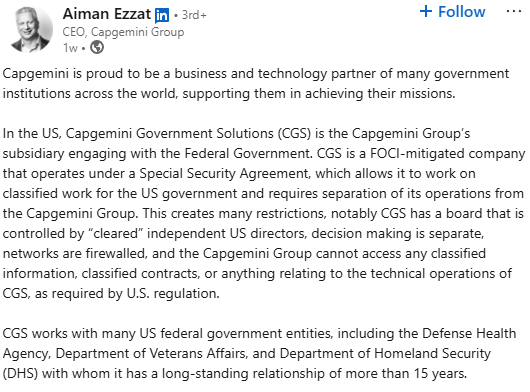
Capgemini, the French technology and consulting firm, recently announced steps to review its U.S. operations following the disclosure of a contract awarded to one of its subsidiaries by ICE in December 2025. In a LinkedIn post, CEO Aiman Ezzat wrote that the nature and scope of the work raised questions about its alignment with Capgemini’s core business. The subsidiary’s independent board has since initiated a review of the contract and its contracting procedures.
These developments illustrate a growing tension between multinational corporations and U.S. immigration enforcement policy, particularly as companies weigh government partnerships against global brand perception.
Economic Pressure as Political Expression
Not all corporations have distanced themselves from ICE, and several high-profile figures and companies have faced public backlash for perceived alignment with federal enforcement efforts. At the same time, protest tactics increasingly emphasize economic pressure as a tool for political expression.
Boycotts, consumer slowdowns and a recent general strike in Minneapolis—estimated to involve thousands of participants—reflect a strategy aimed at leveraging economic disruption rather than traditional political channels. While the long-term effectiveness of general strikes and consumer boycotts is debated, history suggests sustained economic pressure can influence corporate behavior, even when political institutions remain gridlocked.
For many participants, these actions represent frustration not only with government policy but also with what they view as corporate neutrality during moments of crisis.
What Comes Next
As protests in Minneapolis continue, residents navigate daily life under national scrutiny. For many, the question is no longer whether corporations should issue statements, but whether their actions will meaningfully support affected communities.
Corporate leaders now face a narrowing path: silence risks public backlash, while engagement carries political and economic consequences. The coming months—particularly upcoming earnings reports and policy decisions—may reveal whether corporations view this moment as a reputational risk to manage or a responsibility to address.
Ultimately, corporate responses may shape not only short-term profitability but long-term trust. As consumers, employees and shareholders continue to watch closely, the balance between neutrality and accountability is becoming increasingly difficult to maintain.