

By Micah Blake Allred, MA in Comparative Politics from American University SPA.
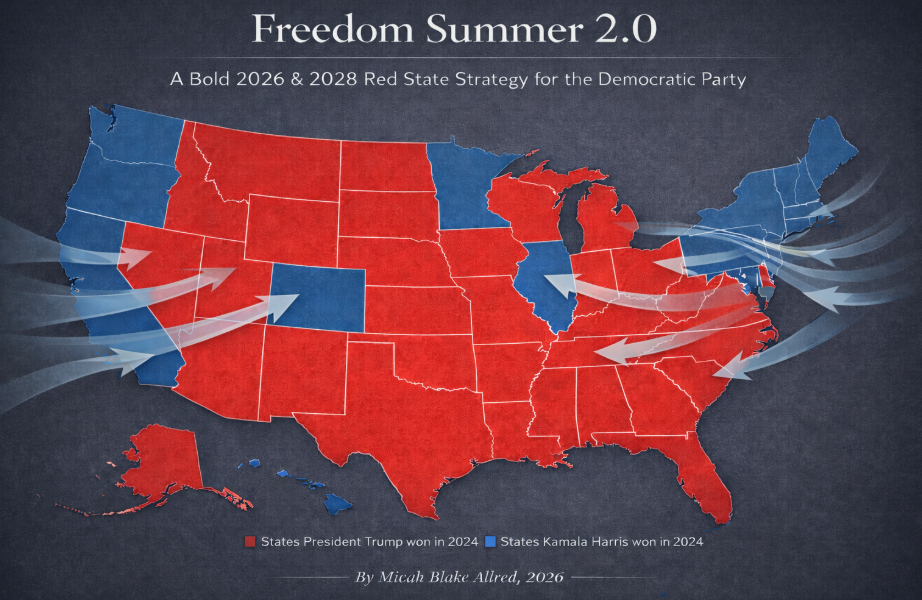
The summers before the 2026 midterms and 2028 presidential election will be one of the most consequential political moments Gen Z and millennials ever face. We need two modern Freedom Summers where volunteers from populous safe blue states travel to deep red states to work with local Democratic groups to register voters and explain democratic rights, face to face.
Social media activism is saturated. If democracy is going to hold, it will be because people showed up where it is weakest, not where it is easiest.
Freedom Summer 1964 sent just over a thousand college students into Mississippi to work alongside African American organizers in the South. Together they helped about 17,000 Black Mississippians attempt to register to vote and launched more than 40 Freedom Schools. The raw numbers were modest. The impact on national consciousness and the Voting Rights Act was not.
What One Volunteer Can Actually Do
For two decades, researchers have run randomized field experiments on voter turnout. Their core finding: high-quality, face-to-face canvassing can raise turnout among contacted low-propensity voters by a few percentage points. A landmark New Haven study found in-person canvassing increased turnout by roughly 7 percentage points. More recent meta-analyses suggest that in real-world conditions, the boost is more often 2–4 points (Gerber & Green, 2000).
A motivated volunteer who treats this as their full-time summer job might log 800 to 1,200 real contacts over a season. The conservative math: about 1,000 meaningful conversations focused on low-propensity voters, producing a 2–3 percentage-point turnout increase among those contacted (Gerber & Green, 2000).
A 2–3 point increase among 1,000 targeted voters is 20–30 additional ballots cast. Add in new registrations and persuasion of conflicted independents, and each full-summer volunteer can realistically net 20 to 40 votes (Gerber & Green, 2000; UNITE HERE, 2022).
The Closest States: Nevada, Pennsylvania, Michigan, Georgia, North Carolina, Arizona, Maine
For the presidency, the best proxy for “votes needed to flip” is the 2024 presidential margin in that state. For Senate races, the presidential margin tends to overstate the difficulty a bit, and for House races it can overstate it a lot. But it’s better to plan for the hardest version of the fight than to be caught unprepared (Politico, 2024d).
In Nevada, Donald Trump beat Vice President Kamala Harris by about three points—roughly 45,000 votes. At 20–40 votes per volunteer, closing that margin would take 1,125 to 2,250 serious summer volunteers (Politico, 2024b).
Pennsylvania is bigger and closer. Trump’s 1.7-point margin translates to roughly 120,000 votes. That requires 3,000 to 6,000 full-summer volunteers—not all in Philadelphia and Pittsburgh, but spread through the Lehigh Valley, small cities, and exurbs where marginal Democrats and left-leaning independents have been drifting out of the electorate (Politico, 2024d).
Michigan and Georgia have similar dynamics. In Michigan, Trump’s 1.4-point edge and Georgia’s 2.2-point margin translate to tens of thousands of ballots, requiring low thousands of intensive volunteers per state to make up the difference.
North Carolina and Arizona are harder but not hopeless. North Carolina’s three-point gap is about 180,000 votes, requiring 4,500 to 9,000 volunteers. The opportunity: in 2026, North Carolina has an open Republican Senate seat, Maine has Susan Collins on the ballot, and Alaska has a GOP senator up. These aren’t states where Democrats start as favorites, but where a Freedom Summer-level volunteer infusion could make the difference.
If Freedom Summer 2.0 can put the lion’s share of its most intense volunteers into Nevada, Pennsylvania, Michigan, Georgia, North Carolina, Arizona, and Maine, it’s operating where each person’s work has the highest return (UNITE HERE, 2022).
The Big Red States: Texas, Florida, Iowa, Alaska, Nebraska, etc.
Texas presents a different challenge. Trump’s 14-point margin is about 1.6 million votes—requiring 40,000 to 80,000 volunteers, which isn’t realistic.
Texas presents a different challenge. Trump’s 14-point margin is about 1.6 million votes—requiring 40,000 to 80,000 volunteers, which isn’t realistic.
But that doesn’t mean Texas should be written off. The mission becomes: flip or defend House seats where margins are smaller; narrow the statewide gap so Republicans spend serious money defending dominance; build long-term organizing infrastructure for the 2030’s.
Florida, Iowa, Alaska, and Nebraska tell similar stories. The math on fully flipping statewide presidential races doesn’t add up, but the math on tipping House seats or poaching a Senate seat absolutely does. Alaska’s Mary Peltola is running for Senate. A fractured Republican Party could lose that race in 2026 if Democrats unite independent-minded Alaskans against the Trump Administration (Ballotpedia a, 2026).
The Deep Reds: Alabama, Mississippi, Louisiana, and Beyond
Alabama, Mississippi, Louisiana, West Virginia, South Carolina, Kentucky, Tennessee, Oklahoma, Utah, and Montana have presidential margins often exceeding 20 points. In these places, Freedom Summer 2.0’s job is not to flip states blue in one cycle, but to focus on what’s actually in reach: build turnout in under-represented communities, flip or contest uncontested congressional districts, and recruit local candidates and organizers.
A few hundred to a thousand volunteers in Mississippi, Alabama, or Louisiana—working with local Black-led organizations and churches—can change participation in ways that don’t show up immediately in presidential maps, but fundamentally alter people’s relationship to politics.
Freedom Summer 2.0 should not be people from New York, California, and D.C. telling residents how to run their states. The emphasis must stay on federal power: who writes the federal budget, confirms judges, gives orders to ICE, decides on war and peace. Out-of-state volunteers listen, register, answer questions, and back up locally led campaigns.
Where to Find Volunteers
One of the biggest untapped pools is blue-state, college-educated Democrats who are unemployed or under-employed. At any given time, roughly 900,000 to 1.1 million unemployed college-educated adults are likely Democrats. Factor in recent graduates with higher unemployment rates, and you have a talent pool in the low millions.
Stop treating them as generic “volunteers” and start treating them as short-term democratic contractors. A feasible package: $500–$800 per week for 8–10 weeks, plus housing and travel. Call it $4,000–$8,000 total, framed as a fellowship that can be listed on a résumé. If even 5–10% of that million-person pool says yes over the next two summers, Freedom Summer 2.0 suddenly has 50,000–100,000 trained, available people.
Works Cited
American Presidency Project. “Election Results: National Popular Vote and State-by-State Totals.” University of California, Santa Barbara. https://www.presidency.ucsb.edu/statistics/elections
Ballotpedia a. “Alaska Senate Election, 2026.” Ballotpedia. https://ballotpedia.org/United_States_Senate_election_in_Alaska,_2026
Ballotpedia b. “Maine Senate Election, 2020: Results.” Ballotpedia. https://ballotpedia.org/United_States_Senate_election_in_Maine,_2020
Cervantes Institute. “The Hispanic Vote in the 2024 U.S. Presidential Elections.” Instituto Cervantes, 2024. https://cervantesobservatorio.fas.harvard.edu/sites/default/files/95_en_the_hispanic_vote_in_the_2024_u.s._presidential_elections.pdf
Cook Political Report. “2026 Senate Race Ratings.” The Cook Political Report with Amy Walter. https://www.cookpolitical.com/ratings/senate-race-ratings
Florida Department of State, Division of Elections. “Voter Turnout Reports.” Florida DOS Elections. https://dos.myflorida.com/elections/data-statistics/
Gerber, Alan S., and Donald P. Green. “The Effects of Canvassing, Telephone Calls, and Direct Mail on Voter Turnout: A Field Experiment.” American Political Science Review 94, no. 3 (2000): 653-663. Summary available at Yale ISPS. https://isps.yale.edu/research/data/d001
Legal Defense Fund. “60 Years of Freedom Summer.” NAACP Legal Defense and Educational Fund, 2024. https://www.naacpldf.org/freedom-summer/
NextGen America. “2022 Youth Vote Plan.” NextGen America, 2022. https://nextgenamerica.org/docs/2022youthvoteplan.pdf
Daniller, Andrew, Ted Van Green, Hannah Hartig, and Scott Keeter. 2023. “Voter Turnout in U.S. Elections, 2018–2022.” Pew Research Center. https://www.pewresearch.org/politics/2023/07/12/voter-turnout-2018-2022/
Montellaro, Zach. 2024. “2024 Arizona Election Results.” Politico. https://www.politico.com/2024-election/results/arizona/
Montellaro, Zach. 2024. “2024 Nevada Election Results.” Politico. https://www.politico.com/2024-election/results/nevada/
Montellaro, Zach. 2024. “2024 Pennsylvania Election Results.” Politico. https://www.politico.com/2024-election/results/pennsylvania/
Shepherd, Steve. 2024. “2024 Presidential Election Results Hub.” Politico. https://www.politico.com/2024-election/results/
ScienceDirect. “A Meta-Analysis of Voter Mobilization Tactics by Electoral Salience.” Electoral Studies, overview. https://www.sciencedirect.com/science/article/abs/pii/S0261379418303573
Sister District Project. “Our Impact: 90,000 Volunteers and State Legislative Wins.” Sister District. https://www.sisterdistrict.com/our-impact
SNCC Digital Gateway. 2014. “Freedom Summer Overview.” SNCC Digital Gateway, Duke University. https://snccdigital.org/events/freedom-summer/
Swing Left. “2020 End of Year Impact Report.” Swing Left, 2020. https://swingleft.org/p/2020-impact
UNITE HERE. 2022. “Largest Canvass Operation in NV, AZ, and PA Sees Path to Victory vs. MAGA Republicans.” Unite Here! https://unitehere.org/press-releases/largest-canvass-operation-in-nv-az-and-pa-sees-path-to-victory-vs-maga-republicans/
U.S. Census Bureau. 2023. “Voting and Registration in the Election of November 2022.” Current Population Survey, U.S. Census Bureau. https://www.census.gov/data/tables/time-series/demo/voting-and-registration/p20-586.html
Zinn Education Project. 2010. “Freedom Summer Resources and Teaching Guide.” Zinn Education Project. https://www.zinnedproject.org/materials/freedom-summer/

1 Comment
I was in my early teens when the Freedom Riders went to the south in order to register voters. It was all very tumultuous, but extremely impactful. A spotlight was focused on how much white resistance there was to Black voting rights. Sometimes things have to get worse before they can become better. There is no doubt the Freedom Riders contributed to sweeping civil rights and voting rights legislation passed under LBJ.