

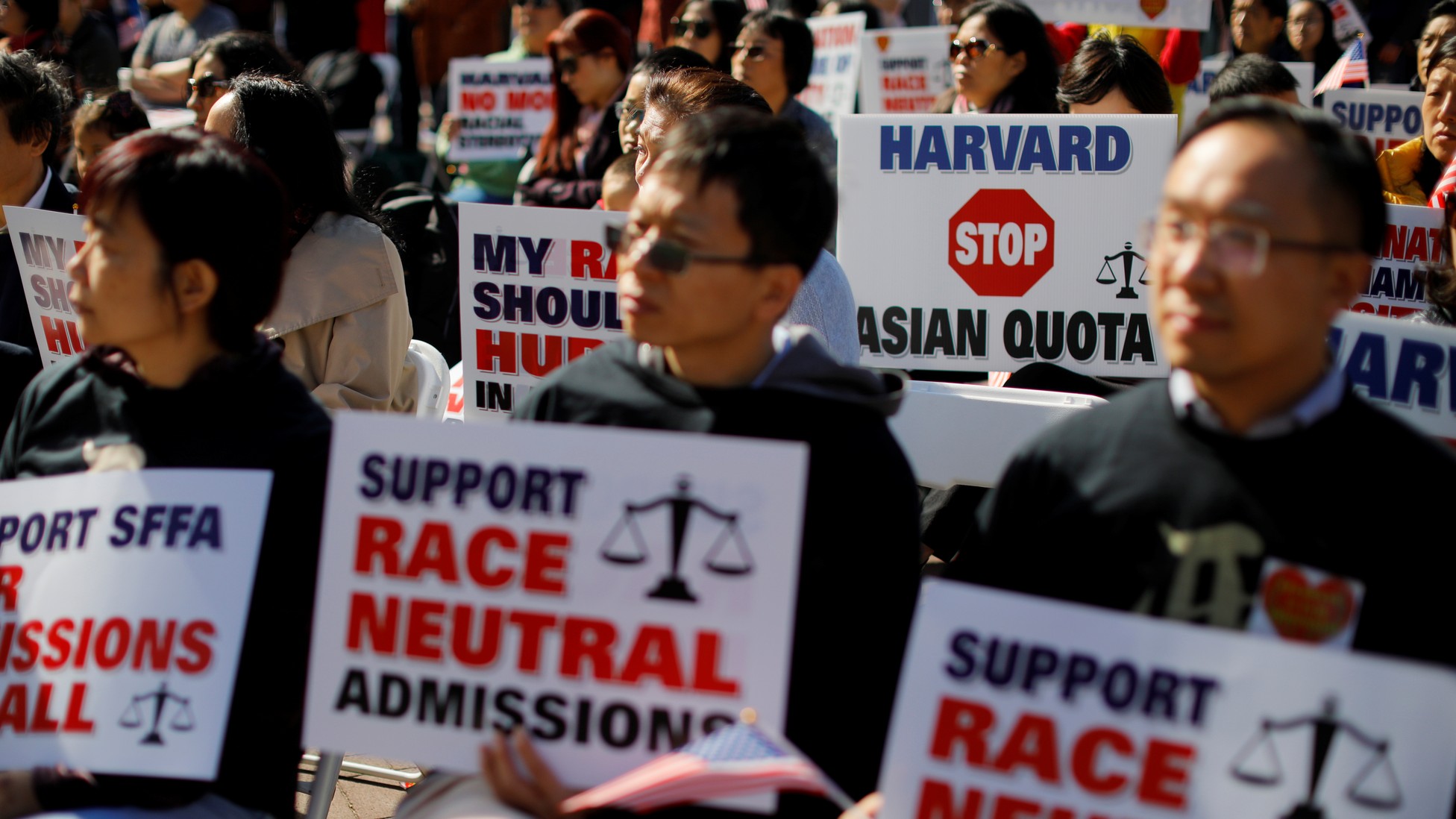
When applying to universities, the average experience requires some sort of diversity statement. These are only one of the aspects considered to be part of a university’s holistic review of candidates. You might have to scratch your head and think back to discover how exactly your background, race, ethnicity, gender, or whatever other immutable characteristic is now considered as important as your character, and makes you stand out from the crowd.
In June 2023, the Supreme Court ruled against the affirmative action policies employed in Harvard’s and University of North Carolina’s (UNC) admissions system. The court found that the use of race in admissions, even with the intention of leveling the playing field, was a violation of the equal protection clause of the Fourteenth Amendment – rendering it unconstitutional.
Since the ruling, there have been distinct opinions. Student for Fair Admissions, the organization that originally sued Harvard’s and University of North Carolina’s admissions committee, described affirmative action in a press release as “discriminatory admission practices” that “undermined the integrity of our country’s civil rights laws.”
The Lawyers’ Committee for Civil Rights Under Law who co-counseled on behalf of multiracial groups of students and alumni from both UNC and Harvard described the decision as “one of the greatest ironies that the Court has undermined such policies.” They specified the policies’ importance: “Race-conscious policies were created to mitigate centuries of wrongdoings against people of color and to bring students of all races and backgrounds together.”
The Supreme Court’s main argument was disagreeing with the principle of using race to favor anyone, equating it to being as prejudicial as using race as a disfavorable factor.
The main argument supporting affirmative action was to eliminate the discrepancies in education – minority groups, mainly Black and Latino students, do not have the same opportunities as wealthier, middle-class students, and therefore are less likely to be accepted solely on the basis of merit. Essentially, the support of affirmative action views a pure meritocracy as an unrealistic fiction.
The decision was made three years ago. Since then, according to a report by Class Action, a grassroot organization that aims to reduce classism and inequality in elite institutions, Black freshman and Latino enrollment was down by 27 and 10 percent respectively in the top 50 most prestigious and selective universities in the U.S. Contrastingly, public flagship universities saw an increase of 7 and 4 percent in Latino and Black freshman enrollment, respectively.
Lower enrollment rates in these prestigious universities risk perpetuating social inequality cycles. By ignoring how one’s background might have influenced one’s opinions, prestigious universities might result in a homogenous student body – students that have had the access to early SAT courses, better programs from private schools, or the means to pay for private tutors to obtain better grades.
As a direct result, those that do not have access to these boosters are put at a disadvantage. This is the root of discrepancies in elite universities. But is affirmative action the solution?
To prioritize preservation of a diverse classroom is valuable, especially in an educational environment. Heterogeneous views can foster great and productive discussions.
Supporters of affirmative action are incorrect, however, in assuming that one’s race or ethnicity is necessarily tied to having a diverse perspective.
A wealthy Latino applicant could hold the same perspective as a lower-income White applicant, or not. Opinions and perspectives are not contingent on their respective backgrounds.
In my view, the main issue lies more in increasing the level of opportunity for low-income applicants and fostering a safe environment to share different perspectives. To do so, universities could increase the focus on providing financial aid by either facilitating the process for incoming students or allocating more funding to its current programs.
The solution isn’t to eliminate conversations on the impact of race on one’s life. Students should still feel comfortable with sharing their experiences in a university application. However, applicants should not feel the need to categorize, victimize or limit their experiences by adding race arbitrarily simply because they believe they will be at an advantage if they do so.
One thing is certain – using race alone as a tipping or eliminating point is not only unconstitutional, it is immoral. But, to ignore the historical impacts of racism on the current applicant pool and student body is to wake up every morning and put on rose-colored glasses.
Acknowledgement: The opinions expressed in this article are those of the individual author, not necessarily Our National Conversation as a whole.