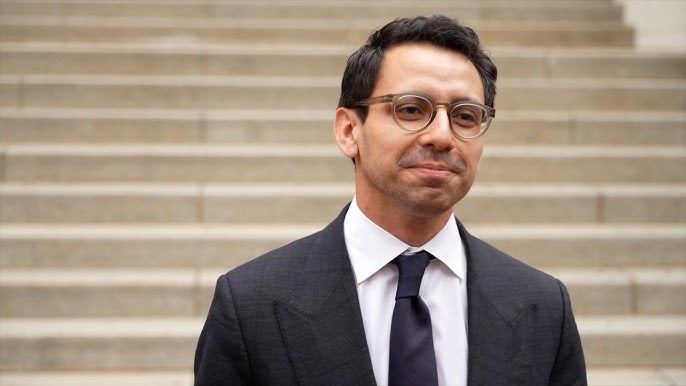
In Florida’s accelerated political climate, the 2026 gubernatorial election has become a hot topic, much of that due to the new controversial Republican candidate. James Fishback, a fourth-generation Floridian and former hedge fund manager, launched his campaign in November 2025 on a platform of affordability, conservation, and what he described on his campaign website as “dignity for all Floridians,” according to Fishback 2026. The tone was measured, stability over spectacle. Yet within days, coverage began supplying sharper adjectives.
CBS News introduced him as “controversial” while outlining his economic proposals. NBC Miami described him as “polarizing” in reporting on his campaign’s connections to advisers who had previously worked for Governor Ron DeSantis. Before most voters had encountered the details of his platform, a storyline had already congealed. Conflict travels faster than spreadsheets.
The most debated plank of Fishback’s agenda was his proposal for a 50 percent “sin tax” on income generated from online subscription platforms such as OnlyFans. He framed the measure as a way to discourage what he called “exploitative digital economies” while redirecting revenue toward education and environmental programs. Coverage from CBS emphasized the cultural flashpoint more than the fiscal blueprint. Critics called it moralistic and economically naïve. Supporters saw an attempt to yoke taxation to social consequence. Either way, the mechanics receded behind the metaphor. The argument became less about revenue models than about whether Fishback presumed authority over public virtue.
In February 2026, a campaign video circulated in which Fishback said schools should “teach every genocide,” listing Gaza alongside Rwanda, Armenia, and the Holocaust. The Hill reported that critics accused him of minimizing atrocities and signaling bias. His campaign maintained that the point was curricular breadth, not equivalence. But context proved fragile. Clips detached from their scaffolding moved quickly; clarifications did not. Within hours, the discussion shifted from educational standards to moral character.
The pattern is familiar. In their seminal study The Agenda-Setting Function of Mass Media, published in Public Opinion Quarterly, Maxwell McCombs and Donald Shaw argued that journalism influences audiences less by telling them what to think than by shaping what they think about. In the digital era, that shaping occurs at a velocity that compresses framing, reaction, and judgment into a single cycle. For Fishback, each headline generated interpretive aftershocks that often outpaced rebuttal.
Smaller incidents reinforced the impression. NBC Miami reported that Fishback had blocked critics on X, prompting speculation about his tolerance for dissent. The act itself was minor, almost banal in modern political life, yet it nested neatly within the existing storyline. Individually, such episodes carried little policy consequence. Together, they accumulated into temperament.
On February 9, 2026, authorities responded to a fire at Fishback’s home in Madison County. WCTV reported that investigators believed the blaze had been intentionally set while members of his campaign team were inside. CBS Miami included Fishback’s statement condemning the incident as political intimidation. For a brief interval, coverage softened. Then speculation returned, with some online voices questioning the event despite the absence of evidence. Empathy proved provisional. Suspicion scaled more efficiently.
Spring brought another flare-up when a low-quality recording circulated that appeared to capture Fishback referring to rival candidate Byron Donalds as a “slave.” The audio was muddled and possibly misquoted, yet it propagated quickly. The Hill and other outlets reported the backlash and demands for explanation. Again, ambiguity mattered less than circulation. Reaction outran verification.
According to Ballotpedia, Fishback’s name recognition has risen as these controversies have unfolded. His Wikipedia page now reads as much like a ledger of disputes as a summary of policy positions. Visibility has expanded. So has volatility. The two appear correlated.
As the August 2026 Republican primary approaches, Fishback occupies a peculiar position, highly visible and unevenly defined. His campaign raises a broader question about political communication in an age calibrated for speed. Candidates who advance morally charged proposals will provoke response. Digital systems, however, privilege amplification over calibration and heat over sequence. Under those conditions, nuance becomes expensive.
Whether Fishback’s message of dignity and discipline resonates will depend not only on the proposals themselves but on whether voters can distinguish between a platform and the narrative scaffold built around it. His campaign, in that sense, functions less as an anomaly than as a specimen, a study in how scrutiny and distortion increasingly share the same bandwidth.
Fishback 2026 Campaign Website. https://fishback2026.com
CBS News (Miami). “James Fishback Florida Governor Race Arson Attack.” 2026.
NBC Miami. “Florida Governor Candidate Claims He Was Victim of Arson After Fire Starts in Front Yard.” 2026.
WCTV. “Florida Gubernatorial Candidate Alleges Arson at Madison Home.” 2026.
The Hill. “Florida Republican Gubernatorial Candidate Faces Backlash Over Genocide Comments.” 2026.
Ballotpedia. “James Fishback.” 2026.
McCombs, Maxwell E., and Donald L. Shaw. “The Agenda-Setting Function of Mass Media.” Public Opinion Quarterly, 1972.