

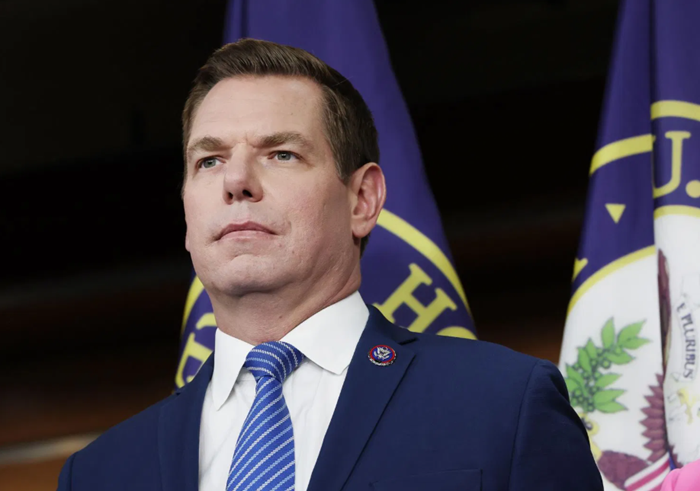
Every few years someone new arrives promising to defend democracy, clean up the system, and restore trust. Only for a headline to surface exposing their true intentions or poor character. Congressman Eric Swalwell at this point seems like a caricature of political corruption.
He talks about national security and how we must protect the nation from outside interference. The messaging is something we all heard before but also comes with it memories of distrust in the government.
A photograph from 2013 shows Swalwell at an event inside the Chinese consulate in San Francisco with Song Ru’an, a senior official in the Chinese Communist Party. At the time it was a routine diplomatic gesture.
That began to fill countless political outlets. Fox News brought the image back with new urgency. Prior to this the same photo had been liked on social media by Christine Fang, known better as Fang Fang, the person Axios reported in 2020 as suspected a Chinese intelligence operative.
Fang’s network once stretched across parts of California’s local political scene. She was the type who attended fundraisers and volunteered. She helped place interns for several Bay Area politicians who were then still rising.
Reports indicate she supported Swalwell’s early races for local office with small donations. After the FBI warned him in 2015 about potential concerns, he ended contact and no evidence of wrongdoing was ever found.
He remained on the House Intelligence Committee, but the name Fang Fang still lingered around.
Swalwell then announced his gubernatorial run and the story returned. It did not matter that nothing new had been revealed. Social media revived it immediately and familiar channels began rearranging the same details.
CNN described the coverage as recycled opposition research. While MSNBC treated it as partisan theater. In the online echo chamber, the keywords did the work by themselves. In late 2025 there was another element reported.
Swalwell’s campaign reported a donation of just under fifteen thousand dollars from DeHeng Law Offices. This is a firm originally founded under China’s Ministry of Justice that maintains a branch in Silicon Valley.
Conservative commentators cited the company’s Beijing origins as evidence of influence. Supporters insisted the California office operates independently. Snopes confirmed the contribution and that no legal issue had been identified. The pattern was impossible to ignore. An older narrative had found new fuel.
Swalwell’s team continues to answer calmly. They point out that no classified information was ever shared, that he followed appropriate procedures, and that no federal agency accused him of any violation. Yet explanation rarely competes with algorithms. The internet prefers the rhythm of the comeback story, the same suspicion returning at slightly higher volume. It also fits the national mood.
FBI Director Christopher Wray has said the agency now opens a China related counterintelligence case roughly every ten hours. That number appears repeatedly across news segments and congressional hearings, settling into public consciousness as a drumbeat. Against that background, the idea of subtle influence or quiet compromise no longer sounds theoretical. It feels ambient.
Swalwell’s situation carries another irony. In 2019 and 2020 he was one of the most vocal Democrats warning about Russian interference in American elections.
His critics now point to that record as reason for renewed scrutiny, arguing that anyone who investigated foreign meddling should withstand the same. His supporters counter that the attacks show how quickly legitimate service can be reframed as hypocrisy in the current media environment.
None of this changes the deeper reality that foreign governments have always sought proximity to American power. The difference now is that everything leaves a record. Every coffee meeting and photo opportunities become permanent.
What would once have been a diplomatic coincidence can now be reassembled years later into a perceived pattern. Whether or not the pattern proves meaningful becomes almost irrelevant next to its online life.
Many Californians remember the initial story from 2020 and see the new cycle as predictable. Others view it as one more proof that global players have easy access to domestic politics.
The gulf between those perspectives defines much of the coming election. It is not just a contest of policies but of trust, memory, and the ability to distinguish a real threat from an endlessly replayed one.
Eric Swalwell’s campaign remains confident that voters will separate rumor from reality. Yet the line between the two grows thinner every cycle.
The more our democracy depends on total transparency, the more it exposes every ambiguity that transparency reveals.
The California race may decide how much the public still cares about the difference between being accused of proximity and being guilty of collusion. What has become clear is that facts move slower than their own headlines.
Stories like this often end not with resolution. The photograph, the donation, the claim, the denial, each return when politically convenient, each fade again until the next revival. The remains the same suspicion, exposure, dismissal.
It speaks to great lengths where the United States now stands in its long dialogue with power. We have grown accustomed to watching the same scandal reappear and still acting surprised.
