

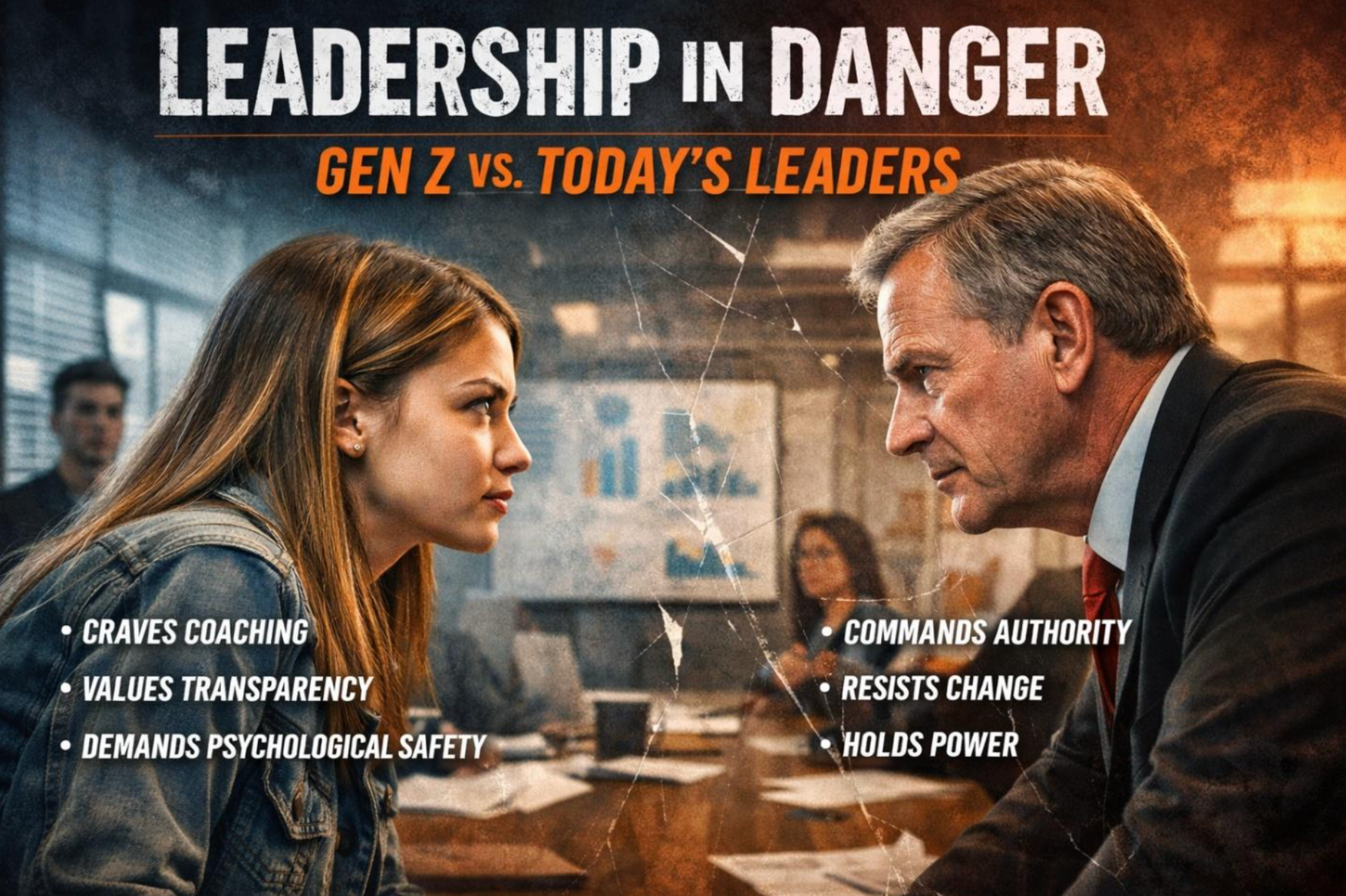
Leadership is in danger, and today’s leaders are the problem. The danger is not that Gen Z does not want structure, standards or accountability. The danger is that many leaders still believe leadership is primarily authority and instruction, which creates a guaranteed disconnect with a generation that expects development, transparency and real dialogue. The Society for Industrial and Organizational Psychology flagged leadership development and coaching as a major workplace trend in 2023. That is not a random prediction. It is a signal that organizations are feeling pressure because old leadership habits are not producing the same engagement, retention and performance outcomes they once did (SIOP, 2023).
Gen Z does not respond well to leadership that hides behind their position of authority. They want leaders who are present, who can explain the why, and who can build people instead of just correcting them. This does not mean they want no direction. It means they want direction that includes thinking, ownership and growth. Research examining how Gen Z perceives managerial communication shows that they want autonomy without micromanagement, but they also want clearly defined roles and expectations (Brown, 2024). That combination matters because it proves this is not about Gen Z rejecting leadership. It is about Gen Z rejecting unclear, inconsistent, ego-driven leadership that either overcontrols or disappears.
That is where coaching becomes relevant. Coaching is not leadership, and it is important to separate the two. Leadership involves decision-making, standard enforcement and accountability for outcomes. Coaching is the development process that builds capability, confidence and judgment without turning every conversation into an order. Industrial and organizational psychology research has consistently emphasized that leadership effectiveness in modern workplaces depends heavily on developmental behaviors and adaptive management approaches (Conte, 2024). Too many leaders still rely on authority alone. Gen Z is reacting to that gap.
If leaders want to understand why coaching matters, they must understand psychological safety. Psychological safety is the shared belief that it is safe to take interpersonal risks, such as raising concerns, asking questions, or admitting mistakes (Edmondson, 1999). It is not about comfort. It is about learning. When leaders rely on fear, dismissiveness or public correction, people shut down. Learning slows. Performance drops. Coaching behaviors increase learning because they allow people to think out loud, explain their reasoning, and improve without humiliation. That dynamic is supported both in foundational research on psychological safety and in modern organizational behavior literature (Edmondson, 1999; Conte, 2024).
Here is the hard truth. Leadership roles are in danger of becoming ineffective if leaders refuse to overhaul how they lead. Authority alone is no longer enough to hold attention, trust or loyalty. Gen Z is going to reshape leadership by rewarding leaders who develop people and rejecting leaders who only enforce. If current leaders do not adapt, they may still hold titles, but they will lose influence. And influence is the real currency of leadership.
The organizations that win will be the ones that build leaders who can enforce standards while also coaching decision-making, communication and professional growth. Gen Z is not asking to be babied. They are asking to be built.
SOURCES
Brown, A. (2024). Exploring how Generation Z perceives managerial communication. ERIC.
Conte, J. M. (2024). Work in the 21st century: An introduction to industrial and organizational psychology (7th ed.). Wiley Global Education.
Edmondson, A. (1999). Psychological safety and learning behavior in work teams. Administrative Science Quarterly, 44(2), 350–383.
Society for Industrial and Organizational Psychology. (2023). Top 10 work trends for 2023.
