
“‘A hedge knight is the truest kind of knight, Dunk,’ the old man had told him, a long long time ago. ‘Other knights serve the lords who keep them, or from whom they hold their lands, but we serve where we will, for men whose causes we believe in. Every knight swears to protect the weak and innocent, but we keep the vow best, I think.’”
This passage is one among many that stood out to me as I reread The Hedge Knight in the days since the season finale of A Knight of the Seven Kingdoms – the newest television series in HBO’s Game of Thrones universe. The series adapts The Tales of Dunk and Egg, George R.R. Martin’s series of novellas set roughly ninety years before the events of his first mainline Game of Thrones novel, following Dunk, a young knight, and his even younger squire, Egg. This particular first season tackles the aforementioned first novella, The Hedge Knight, in which Dunk and Egg first meet.
The last seven or so years of Game of Thrones have been tumultuous, with a near reputation-ruining finale to the original series and a shaky response to its first prequel spin-off, House of the Dragon (a show I generally enjoy). With A Knight of the Seven Kingdoms, viewers are invited to a change of pace from the vast scope of previous installments.
Set almost solely within the bounds of a tourney at a single castle, the story of Dunk and Egg goes deep instead of wide.
The new series approaches a much smaller story than Thrones or Dragon. Rather than a cast of twenty-plus names to remember, spread across an entire fictional world, this story is told from the perspective of one character. And for essentially the first time, we get to see this world from the perspective of a commoner.
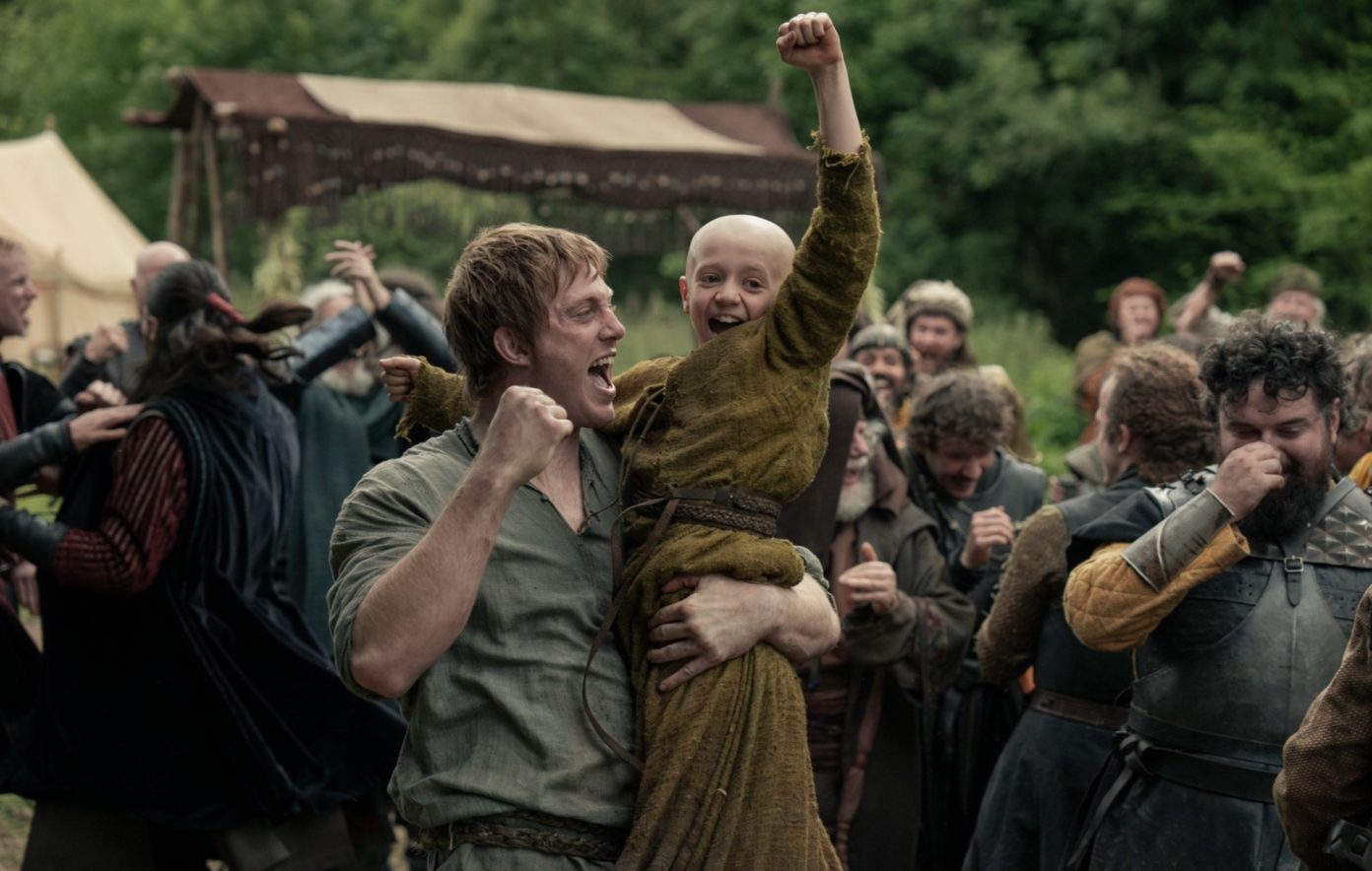
Ser Duncan the Tall, or simply “Dunk”, portrayed by Peter Claffey, was a peasant boy who was taken in as a squire and raised by Ser Arlan of Pennytree. Ser Arlan was a hedge knight, named for the places they sleep in place of the castles and holds where more noble or esteemed knights might rest. As exemplified in the quote I opened with, Ser Arlan imparts all of his knightly values on Dunk as two commonfolk who must earn their station, rather than be born with it.
After the unexpected death of his mentor, Dunk must set off on his own to make a name for himself, and trust that all of Ser Arlan’s lessons serve him. He decides to compete in a nearby tourney, so that maybe could win some money or catch the eye of a lord who might take him into his household. Along the way, he meets Egg, played by eleven-year-old Dexter Sol Ansell, a bald boy eager to squire for him.
As someone who has been a massive fan of Martin’s “World of Ice and Fire” for many years, The Tales of Dunk and Egg have always held a special place in my heart. The stories are straightforward, brief, and full of heart. They explore chivalry, heroism, and honor in a world that is indifferent to such values. Reception to the novellas’ new adaptation proves that these themes are resonating with a lot of viewers as well.
A Knight of the Seven Kingdoms is an excellent adaptation of the source material that stays true to its values and characters, and mostly succeeds where it chooses to add to the story. The story would not work if not for the excellent chemistry between its two leads. It mixes the visuals and setting of Ivanhoe, the sense of humor of Monty Python, and the spirit of Arthurian legend. We meet all sorts of characters as we delve into the core question of “what makes a knight?” Dunk crosses paths with princes– some cruel, some the epitome of honor and the knightly ideal– and he is faced with the reality that not all men live by the code they are sworn to. A prince is essentially guaranteed to be knighted, should he want it; he does not need to earn it.
These are not new archetypes, but they are especially resonant now, for one reason or another. The reception of James Gunn’s Superman film just last year shows such an enthusiasm for uncomplicated goodness. Optimism and heroism does not exist in place of cynicism or cruelty, but in spite of it.
“Within every man, there are many men,” Prince Baelor Breakspear tells Dunk.
Dunk is heroic but he is not perfect, nor is he ignorant. He doubts himself and his place in the world, even the value of his own life, but when an innocent is in danger, he does not hesitate to defend them; a true knight.
The premiere season of A Knight of the Seven Kingdoms asserts that a knight is not made by his sword, nor his spurs. He is made by his oath. The oath itself is uncomplicated. It is adhering to it with actions that truly make the knight. It’s not unrealistic (it is Game of Thrones after all); there are still consequences for doing the right thing, perhaps even punishment, but it’s doing good despite the consequences that makes a hero.
This is a series that I hope will get many seasons to come. Its heart is so big, and its characters so rich. People are eager to see a hero be selfless, to defend the innocent, to be a knight despite their imperfections. For “all men are fools, and all men are knights.”
1 Comment
I haven’t watched Game of Thrones or this new show, but I’m glad to hear that there are still works being made that portray heroes and knights without mockery or cynicism. We need heroism and examples of virtue, even if the characters may be imperfect. Imperfect, but still unabashedly good heroes are what we need in an era of skepticism.