

The current international community has a new game: presidents stand in a quick-draw duel position, tumbleweeds flying around their feet as they turn to pull their weapons, surveying and screaming at each other while they decide who has the biggest guns, who inflicts the most damage.
This might sound dramatic, but given the recent attacks in Iran and Venezuela, it could be what international affairs has come to.
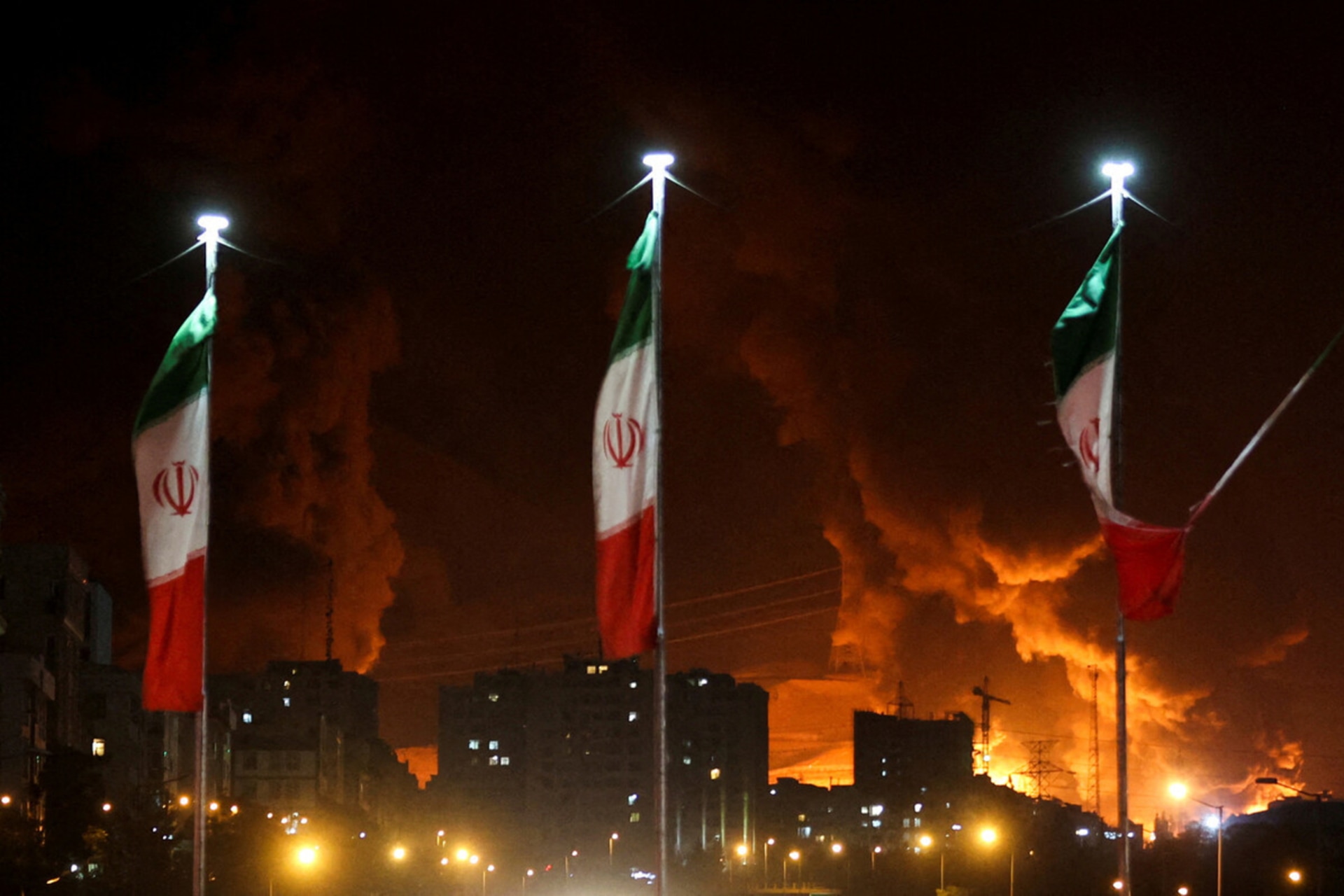
On Feb. 28, 2026, the U.S. and Israel attacked Iran. The attack was done to several military sites to target the country’s political figures. It was also spread out to other areas: for example, an elementary school in Minab, a city in the southern part of Iran and close to an Islamic Revolutionary Guard Corps (IRGC) base. The attack led to the killing of the country’s Supreme Leader, Ayatollah Ali Khamenei, which caused uncertainty on how the state would be governed.
President Trump framed the attack as a necessary measure of self-defence and military deterrence for future attacks, accusing Tehran of an “unending campaign of bloodshed and mass murder targeting the United States.”
But the President also implied another motive in January. Since December 2025, Iran had been experiencing a series of anti-government protests, resulting in brutal crackdowns that killed thousands of protestors. As a response, the President took to social media to say, “if Iran shots and violently kills peaceful protesters, which is their custom, the United States of America will come to their rescue.” The typo “shots” was included in the original statement.
Whether Trump’s principal motivation is to “rescue” Iranian citizens or the U.S.’s national security, the question arises of whether it is ever correct for one state to single-handedly decide how another state is run. Can these attacks truly be categorized as forms of aid or are they simply an imposition of Western beliefs on how a state ought to be governed?
After all, it is essential to consider how Iran operates under what has been categorized as a theocratic government. The presence of a Supreme Leader as head of state instead of a President represents how Iran, contrasting the U.S., does not separate church from state.
The enforcement of a regime change that is currently inherently religious could therefore be seen as an imposition of the Western belief that governance must be religiously-neutral.
What saves this from being the absolute narrative is how the country was illegitimately run. Had this been a sole perspective of an outsider, the possibility of an imposition would have been stronger. But, given the amount of protests that were occurring in Iran, it is clear that a regime change was more than desirable for Iranians.
That being said, the concern is in the extent and level of entitlement that Trump has experienced in the field of governance. Just earlier this year, the President made similar comments regarding the Venezuelan operation in a press conference, where he claimed the U.S. would “run the country until such time as we can do a safe, proper, and judicious transition.”
The threat to take over opposed what Venezuela’s own government proposed. Although Trump’s remarks were ultimately made in vain, as Maduro’s Vice President Delcy Rodriguez is currently in charge, the audacity behind the statement supports the aforementioned concern. It shows how comfortable the U.S. feels in undermining a state’s independence through the imposition of its own beliefs.
To a certain extent, the attack could force Iran to obey its own self-induced responsibilities in international law. As one of the states that originally signed the Universal Declaration of Human Rights (UDHR), Iran has bound itself to Article 21 of that declaration which guarantees citizens to a legitimate government.
With this in mind, the forceful regime change can be seen as simply a form of enforcement for the state’s supposed commitment to the UDHR and the subsequent well-being of its citizens. However, since the U.S. and Iran are supposedly equal under this code, the expectation would not be for the U.S. to be the appropriate agent for enforcement, especially considering the lack of an established plan for a new regime – leaving the state and the supposed interest of its citizens in an uncertain political vacuum.
Under international law, there are legitimate ways of starting war. A pre-emptive strike where a nation decides to attack first based on the knowledge that another nation will issue a strike is considered legitimate, whereas a preventive strike where there is no immediate precipitating threat is not. The lack of an immediate threat to the U.S. categorizes the attack in the latter.
The attack was not only unconstitutional, but undemocratic. The Constitution grants Congress with the sole power to declare war, and the President failed to receive congressional approval before initiating the attack. A report released in January also shows that 70% of voters believed the U.S. should not take military action against Iran for their killing of protesters.
The issue is far from simple. On the one hand, the enforcement of the UDHR might ultimately be beneficial for Iranian citizens who were so keen and desperate for change. On the other, conducting such an operation undemocratically and unconstitutionally, whilst simultaneously leaving the state with no solid plan for leadership, might cause more harm than good.
Acknowledgement: The opinions expressed in this article are those of the individual author, not necessarily Our National Conversation as a whole.