
By Erol Yilmaz
March 5th, 2026
On the night President Donald Trump announced airstrikes on Iranian nuclear facilities, a conservative livestream host in Arizona hesitated in a way his audience was not accustomed to seeing. The set was familiar, flag draped carefully behind him, microphone suspended in mechanical symmetry, comment feed cascading down the side of the screen. Usually, the chat moved in unison. That night was an outlier note. Some viewers praised decisive action. Others asked a different question, one that lingered in the news feed long after it appeared. Was this not the same war they had once opposed?
The White House called its February 28 operation “Epic Fury.” Trump described it as “necessary and historic” (historically infamous perhaps), framing the strikes as a preemptive act of defense against what he characterized as an intolerable threat. The language was confident, self-righteous and almost compressed. There was no visible doubt in his delivery.
But politics is as much about remembered promises as present events. In his 2016 foreign policy address, Trump pledged that the United States would “stop racing to topple foreign regimes that we know nothing about,” and insisted that the country must abandon “the failed policy of nation-building and regime change. Those lines were not rhetorical garnish. They formed part of the moral architecture of “America First,” a phrase that suggested sovereignty, restraint, and distance from protracted Middle Eastern entanglements.
The strikes on Iran surprisingly have not produced an immediate rupture within the mainstream Republican electorate. Early polling indicates majority support among GOP voters. Yet the internal conversation has grown more intricate. The tension is not between strength and weakness. It is between strength and consistency.
In an interview with MSNBC, Former CIA Director John Brennan warned in a televised interview against “cherry-picking intelligence to fit a predetermined outcome,” cautioning that policymakers must resist shaping evidence to justify action already chosen. His language revived familiar anxieties about the role of intelligence in the run-up to military conflict. For voters old enough to remember the debates preceding Iraq, the phrasing carried an echo.
Even former CIA officer John Kiriakou has asserted that Netanyahu pressured Trump, even allegedly threatening nuclear action if the U.S. did not intervene, making Trump the only president to act after decades of lobbying. The assertion remains difficult to verify comprehensively, but its political significance does not depend entirely on archival proof. It suggests that restraint was once possible and that this president was elected otherwise.
Israeli Prime Minister Benjamin Netanyahu praised the strikes and thanked the United States for standing “shoulder to shoulder” with Israel against Iranian aggression, according to reporting from The Times of Israel. The image is unremarkable in diplomatic terms. Within parts of the America First coalition, however, it complicates a narrative built on insulation from foreign influence. The word first implies sequence and priority. It implies that the United States acts on Israel’s clock.
The most pointed criticism has come from figures who once functioned as reliable amplifiers of Trump’s message. Nick Fuentes wrote on Telegram that the war is “a disaster for America but great for Israel,” adding that “if this continues, there is no reason to reward Republicans in 2026.” He escalated further, urging followers to boycott the midterms or even vote Democrat in 3dprotest, declaring the administration needs to qqbe “shut down” and calling Trump an “errand boy of Israel.
Alex Jones warned his audience that Iran is “three times the size of Iraq,” asking whether Americans were prepared for another drawn-out conflict. He criticized the shift as abandoning “America First,” lamenting that Trump was breaking promises on no regime change and calling the escalation a betrayal that could lead to World War III.
More mainstream conservative commentators have also expressed unease. Tucker Carlson described the escalation as “disgusting and evil,” arguing that American troops should not be committed to conflicts detached from core territorial defense. Even Steve Bannon called the strikes “an open betrayal of the populist mandate.” Matt Walsh stated “nothing positive” would emerge from another Middle Eastern war. Former House Member Marjorie Taylor Greene posed a blunt question to the public:
“Who are these decisions being made for?”
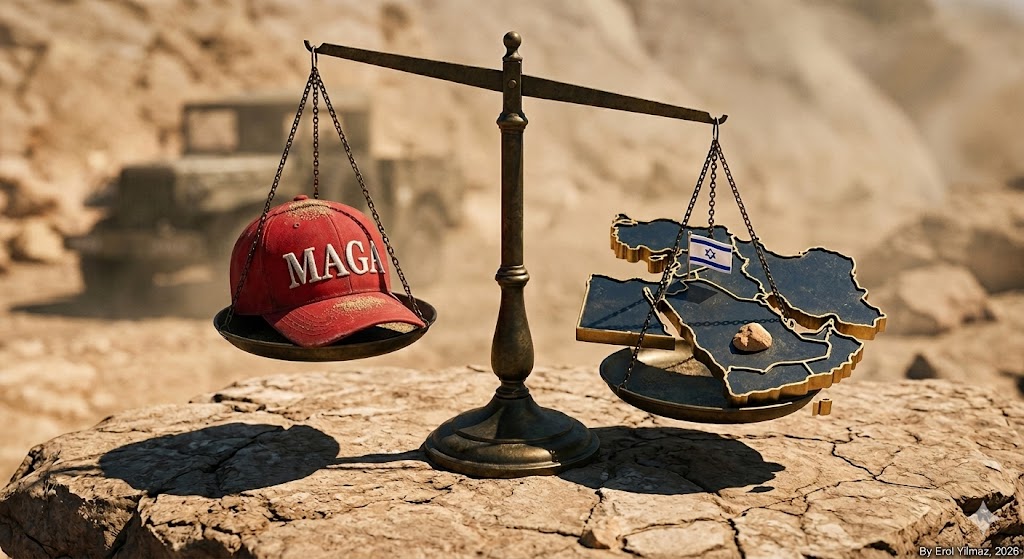
That question lands with force because it shifts the frame from strategy to alignment. The America First movement has always fused ideological claims with personal loyalty. At a rally days after the strikes, Trump told supporters, “MAGA is Trump.” The line drew applause. It also narrowed the argument. If the movement is defined by the leader, then policy becomes an extension rather than a deviation. MAGA is no longer for America, maybe never was.
A March 2026 YouGov survey found strong initial Republican support for the strikes, but enthusiasm declined when respondents were asked about long-term troop deployments or sustained financial commitments. Support, in other words, appeared firm in principle and more tentative in practice and duration. MAGA supporters liked the idea of a quick military solution, but seem ignorant to the nation we are up against.
The most striking fracture emerges not from mass exodus but from quiet erosion among those who once offered the loudest affirmations. For years, predictions of collapse centered on scandals, indictments, or electoral defeats, yet the coalition endured. Operation Epic Fury introduces a different pressure: a direct collision between campaign vows and battlefield reality. The dissent is measured, often couched in disappointment rather than rage, but its sources are telling. Figures like Fuentes, who now openly calls for abandoning the GOP, and Jones, who mourns the death of the “America First” dream he helped champion, represent not fringe outliers but amplified echoes of a broader unease.
“We’ll see how this plays out,” Jim Sharpe (a commentator known for his pro-Trump statements) said in a tone that was neither endorsement nor rebellion. The livestream host eventually ended his broadcast without resolution. In a movement long defined by unyielding conviction, such hesitation marks its own form of rupture.
Whether these strikes prove a temporary detour or the start of a deeper unraveling remains unclear. Charismatic leadership can bridge many contradictions, but it struggles against perceived betrayal of core promises. “America First” was once a rallying cry of clarity and resolve. In the wake of February 28, it has begun to sound, to some of its most devoted adherents, like an unfinished question.
For now, the divide is not yet a chasm. It is a crack visible, widening and impossible to ignore. In the unforgiving arithmetic of politics, visible cracks often become the prelude to consequence.
