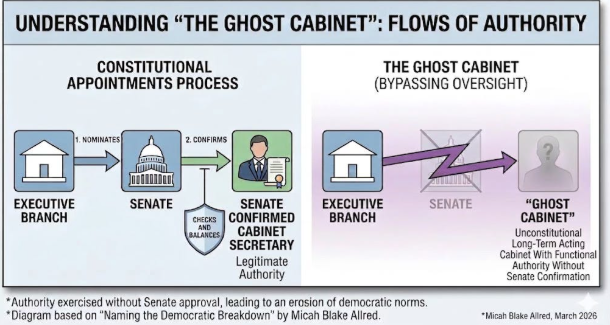

The United States Constitution does not anticipate a presidency that governs through temporary officials. It assumes the most powerful positions in government will be filled through a shared process between the executive and legislative branches. The president nominates. The Senate confirms. Authority flows from that joint act.
What happens when that process is systematically bypassed — not through open defiance, but through legal gray areas, strategic vacancies and political calculation?
A pattern emerges: a ghost cabinet. A governing structure in which officials exercise the functional authority of Senate-confirmed positions without actually receiving Senate confirmation, often for extended and constitutionally questionable periods. It is not a single violation; it is a method.
The Constitutional Design
The Appointments Clause of Article II requires that principal officers of the United States be appointed “by and with the Advice and Consent of the Senate.” In Federalist No. 76, Alexander Hamilton described Senate confirmation as a necessary check against “a spirit of favoritism.” Without it, he warned, presidents would elevate individuals based on loyalty rather than merit.
Congress passed the Federal Vacancies Reform Act in 1998 to allow temporary “acting” officials to fill roles for limited periods; generally 210 to 300 days. The law was intended as a stopgap. But it has increasingly functioned as a workaround. This constitutional vulnerability depends not only on formal rules, but on political actors choosing to enforce them. When that enforcement weakens, the distinction between temporary necessity and strategic evasion collapses.
A Pattern with Precedent
The ghost cabinet is not new to the Trump administration. During his first term, the Department of Homeland Security was led by acting administrators for a majority of Trump’s time in office. In August 2020, the Government Accountability Office concluded that key figures, including Chad Wolf and Ken Cuccinelli, were serving unlawfully due to improper succession procedures. Federal courts later invalidated multiple policies they had issued — not on the substance of those policies, but because the officials lacked legal authority to enact them.
Acting officials, by definition, serve entirely at the president’s pleasure, without the stabilizing force of congressional approval. For President Trump, this constitutional oversight is one that he has, can, and will likely exploit vigorously during his second term.
The Current Crisis
On April 3rd, President Trump fired Attorney General Pam Bondi over dissatisfaction with “the pace and outcome of cases” he had demanded. He replaced her with Todd Blanche, his own former personal defense attorney, as acting Attorney General. No senate confirmation hearing, or even a permanent replacement, has yet been announced.
Within days of his ascension to the highest ranking official in the Justice Department, Blanche held a press conference and declared that Trump has “a right and indeed a duty” to shape federal investigations into individuals the president believes should be prosecuted. When asked whether he hoped to be nominated permanently, Blanche said that if Trump chose someone else and asked him to leave, “I will say, ‘thank you very much, I love you, sir.'”
This is the ghost cabinet in its clearest form: an unconfirmed official, plainly installed for presidential loyalty rather than Senate consent and publicly subordinating the Justice Department’s independence to the president’s personal agenda. Presenting Hamilton’s warning about favoritism before the world stage in the form of the President’s former personal lawyer overseeing America’s justice system, unencumbered by constitutionally required congressional consent.
According to Politico, Trump is currently weighing the removal of Commerce Secretary Howard Lutnick and Labor Secretary Lori Chavez-DeRemer, with aides describing officials being targeted for underperforming or generating “too much negative attention.” Trump allegedly floated moving EPA Administrator Lee Zeldin into the vacant Attorney General role. A Senate-confirmed official being considered for a position he was never confirmed to hold.
Why Now
The timing is not coincidental. A source told Politico that “house-clearing is on Trump’s mind over fears that executive appointments may be hard to confirm next year — especially if Democrats gain more seats in the midterm elections.”
Those fears are grounded in data. As of early April, Democrats lead the generic congressional ballot by 5.8% in the RealClearPolling average. Trump’s approval sits at 41.2%. The Iran war, launched without congressional authorization, is opposed by double digits in nearly every recent poll, with disapproval reaching -28% in CNN‘s survey. In Maine, challenger Platner leads Senator Susan Collins 48% to 39%, suggesting even the most popular Republican senator in the country is vulnerable.
If Republicans lose the Senate in November, Trump’s ability to confirm new nominees through a Democratic majority becomes far more difficult. His incentive to install acting officials: loyal, unconfirmed, and answerable only to himself, becomes far greater.
The Larger Pattern
My coined term, ghost cabinet, does not imply vacant cabinet positions. Ghost cabinets require only that executive authority be exercised without congressional authorization by officials who hold their positions entirely at the president’s discretion.
This phenomenon connects to a broader pattern of President Trump’s erosion of democratic institutions. The administration willing to bypass Senate confirmation on personnel is also the same administration that launched military strikes on Iran without congressional authorization for the use of military force. With a holistic view, these are not separate stories. They reflect the same governing logic: that the constitutional sharing of power between branches can be functionally optional when politically inconvenient.
Yet the Appointments Clause remains in the Constitution, and its message is unchanged since America’s founding: the most consequential decisions of government belong to the American people, acting through their elected representatives in both branches. The prospects of a ghost cabinet are not merely a partisan dispute. They are a quiet, ongoing challenge to our founding democratic principles. One’s that becomes harder to reverse the longer they go unaddressed.