
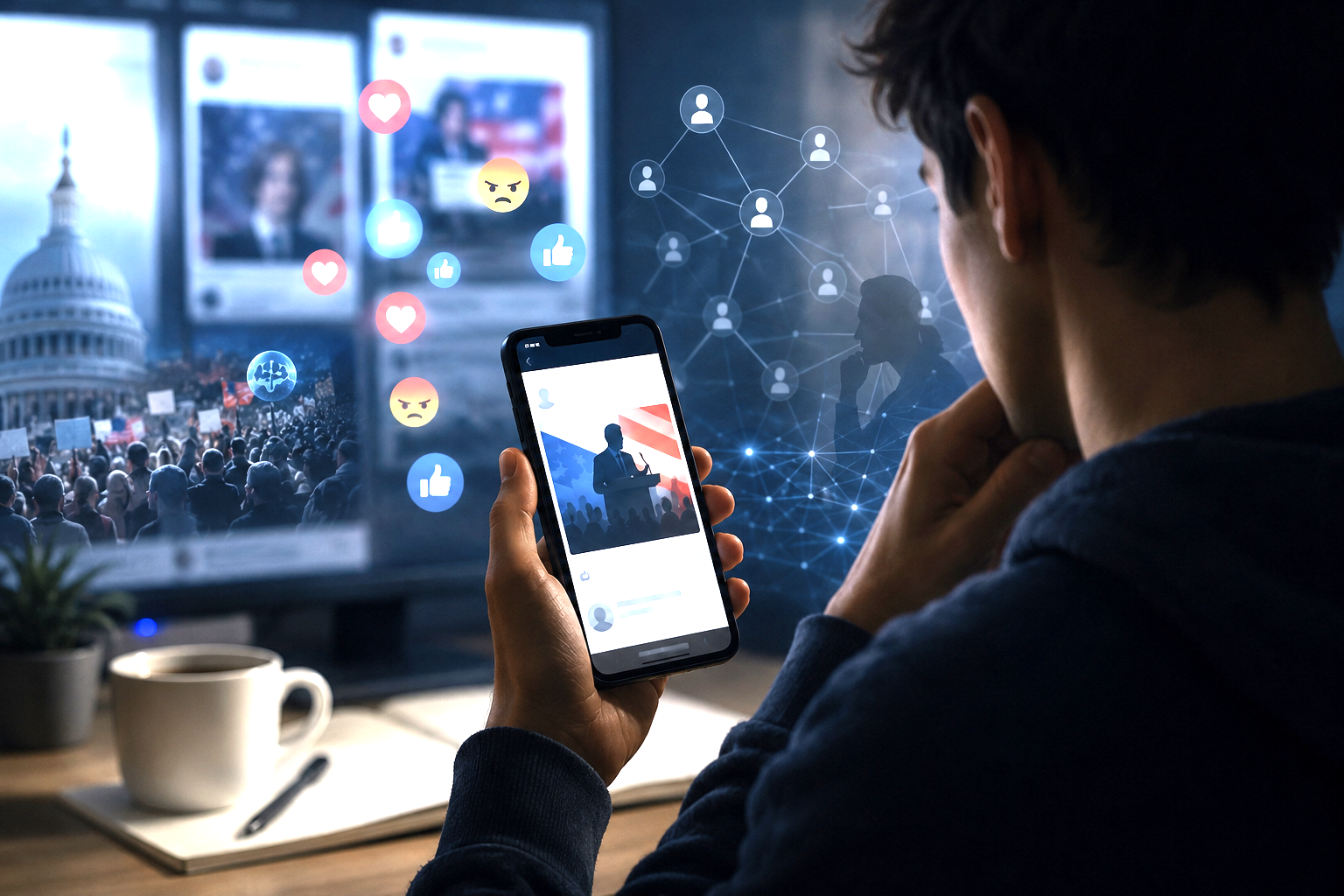
I was doing an assignment for one of my political science classes, and I came across a question regarding the ethical implications of certain experiments. The given example was an experiment investigating the connection between exposure to political advertisements (X) and individual voting outcomes (Y). The experimental design in this hypothetical consisted of researchers buying ad space on Facebook and randomly showing different political advertisements to users. When I was thinking about the potential ethical implications of this scenario, I came up with a few, what I thought were obvious concerns: privacy, informed consent, and the broader effects on a country’s political climate. Thinking about it further, however, I realized that this situation actually does happen in real life, albeit not as an experiment, and no one really deems it “unethical” at all.
Many corporations use purchased ad space to appeal to particular political audiences, and these practices rarely receive the same ethical scrutiny. Maybe it isn’t for an investigative purpose, but it is often for profit or some other benefit. Isn’t that also exploitative? To answer that question, let’s examine how these practices relate to the same ethical concerns raised by our hypothetical experiment.
Regarding privacy, social media platforms already use data to target users with specific content, and corporations that purchase ads benefit from this. Most people don’t realize that the consequences of this go far beyond TikTok showing you videos of cats because you like cats, for example. Social media platforms keep their users in a bubble based on what they interact with and what they don’t. Algorithms keep evolving to tailor content more specifically to individual users through features such as “Not Interested” or “Rate This Content.” Essentially, even though social media platforms are not conducting research in the same way as the hypothetical experiment, their algorithms are the product of ongoing research and experimentation that continuously refine how content is delivered based on users’ preferences and behavioral data.
Additionally, when you consent to using a social media platform, you legally consent to what that platform shows you. Therefore, informed consent is complicated in the case of social media political advertisements, much like in our hypothetical experiment. While users technically consent to the platform’s terms of service, few understand the extent to which their data are used to personalize political content. People know that advertisements exist, but they are not necessarily aware of who is behind them, why they are being shown to them, or what purpose they are meant to serve. Legal consent and meaningful informed consent are not necessarily the same thing. I’m not saying that all political media comes with a nefarious motive, but it is imperative that we understand who is trying to influence our thinking, voting, and overall civic participation, and why. Social media platforms and outside corporations that purchase advertisements are aware of the popularity of social media, the impact it has on users’ thinking, and the features of the algorithms they use.
Furthermore, there are some advertisements that don’t really seem like advertisements at all. There are explicit political advertisements, but there are also many forms of media that carry more implicit political agendas, allowing corporations to reap the financial and cultural benefits of reactive content, arguably more successfully than through explicit messaging. People are less likely to dismiss or criticize implicitly political content than content that is obviously meant to sway them in a certain direction. Politically charged content, especially when it relates to sensitive topics, often provokes strong emotional reactions, making it more likely to receive clicks and, consequently, generate more profit. Therefore, it is beneficial for companies to appeal to particular political audiences based on what will result in the most engagement, profit, reputational benefit, or other advantages. Additionally, this is even more rewarding for companies because people often expect popular companies, especially their favorite ones, to take a stand on specific issues.
Plus, the large-scale consequences that present concerns in our hypothetical are still present in reality, as social media is the main source of political news for a significant portion of adults—48% of those aged 18–29 and 40% of those aged 30–49, according to the Pew Research Center. Consequently, it is plausible to say that social media has a significant impact on users’ individual votes and political views, which, in turn, affects the broader political climate of a nation.
Moreover, we’ve established that, in most cases, political material is targeted based on users’ activity and demographics, not randomly assigned. So, what is more ethically dubious in this case: random or targeted political content? The algorithmic targeting of political material is concerning because most people are kept in a bubble on social media, rarely exposed to contradictory material and constantly exposed to content that reinforces their existing views. Consequently, it is plausible that the average social media user is more likely to question political advertisements that are both explicit and random rather than those specifically tailored to them. Social media has become a relatively new arena for political campaigning, and the rules governing it are still evolving. In an environment where misleading or even entirely false content can spread rapidly, the ability to target users with personalized political messaging raises important ethical questions about how opinions are shaped and reinforced.
One could argue that people would likely be alarmed if they found out that a group was conducting research on how they vote by randomly exposing users to political advertisements. As we’ve seen, existing political advertisements raise many of the same ethical concerns as our hypothetical experiment. So why are political advertisements purchased by corporations seeking to profit from people’s social media engagement not considered a problem? Why is it not an issue that they have access to users’ data in order to target them with the content they are most likely to engage with?
One explanation is that this has become so normalized that we’ve been conditioned not to see this level of interference as a problem. Unlike academic experiments, which are explicitly labeled as research and subjected to ethical scrutiny, algorithmic features and advertisements are often an invisible part of social media. Their influence has become so ingrained in the online experience that it is perceived as normal rather than as something worthy of ethical concern.
“So all political content on social media is bad? But what about raising awareness?”
Ultimately, there is a difference between exposing people to information and encouraging them to adopt a particular interpretation of it. Social media can be a great tool for spreading awareness about current events and prompting critical thinking as a result. However, too often, users are presented with a pre-packaged interpretation of events. This is harmful because it takes away a crucial part of political participation: forming your own opinion. This creates an environment that is especially advantageous for companies and other actors seeking to shape public opinion. The point is not that all political content on social media is inherently unethical, nor that commercial advertising and academic research are identical. Rather, it is that they raise many of the same ethical questions surrounding privacy, informed consent, and political influence. If we scrutinize one, perhaps we should be more willing to scrutinize the other.
References: