

Imagine being forced to leave your home right now. Saying goodbye to the life you once knew — the home you love, the city you navigate like the back of your hand, the country you’ve known for so long. Imagine walking past your neighbor’s door for the last time and taking your final steps on the street you’ve walked along countless times. Imagine the immense pressure of deciding within minutes where the next chapter of your life will unfold.
Imagine this all happening because your people face systematic persecution and mass killings right in front of your eyes. You fear for your own life and worry tirelessly about your loved ones. Imagine not knowing when, if ever, you’ll come back.
For countless Armenian families, this was the devastating reality of the Armenian Genocide.
The Armenian Genocide began in 1915, when Ottoman Turkey carried out mass killings and forced deportations of Armenians from their ancestral homeland. Although 1915 marks the conventional beginning of the Armenian Genocide, Armenians had experienced persecution and massacres in preceding decades, and the violence continued even beyond that year. During this period, many survivors fled in desperate search of safety and peace elsewhere in the world, hoping to have a fresh start to safely preserve the culture they had been forced to leave behind.
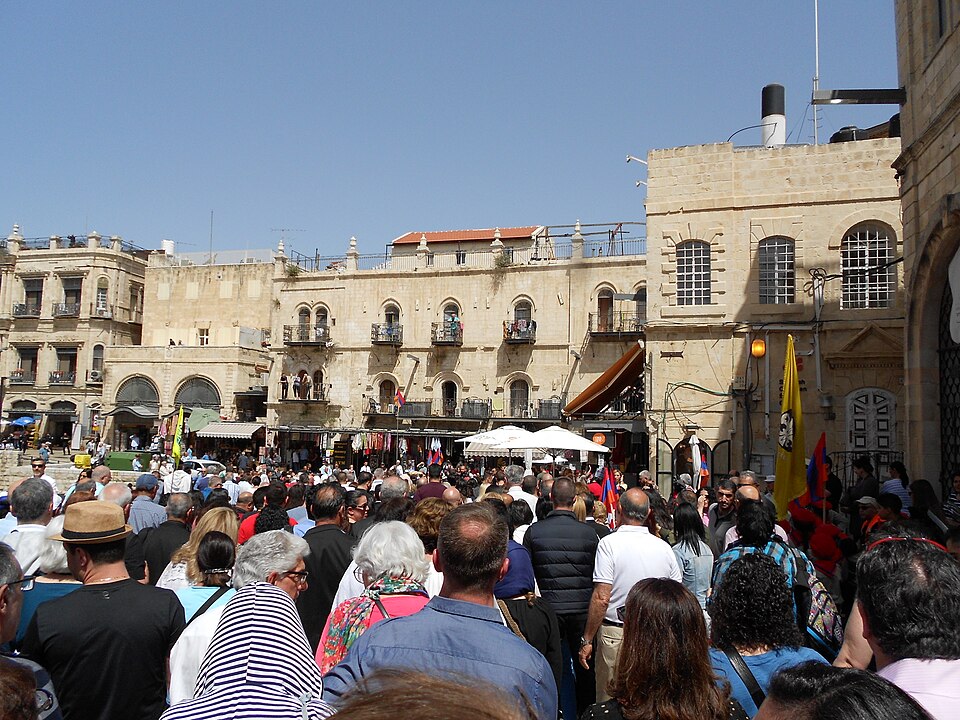
Some of those families found refuge in Jerusalem, where Armenians had already lived for centuries. As Ara Daglian so eloquently explains in a University of Washington article, Armenians first arrived in the fourth century, and the community stayed stable for centuries. Then, between 1915 and 1920, thousands of refugees fleeing the Armenian Genocide arrived in Palestine, most settling in Jerusalem. They did more than just survive there. Armenian silversmiths, goldsmiths, tailors, and photographers opened shops and joined the city’s economy. A printing press and the Gulbenkian Library preserved Armenian knowledge and literature.
Still, more than a century after the Genocide, Jerusalem’s Armenian community is being made to feel unwelcome.
In the first three months of 2026, the Religious Freedom Data Center, an Israeli monitoring group, recorded 33 incidents of harassment against Christians in Israel, most of them in Jerusalem. Between April and June, that number nearly doubled. In August, police arrested six people — five of them minors — after they were filmed spitting at the entrance of St. James Monastery in the Armenian Quarter and throwing stones at the walls. Later, four more were detained for spitting at the Armenian Patriarchate. Then, in September, a 9-year-old Armenian boy was pepper-sprayed while riding his bike through Jerusalem.
He is one of the many targets of a surge in harassment centered on the Armenian Quarter.
Today, an estimated seven million Armenians live outside of Armenia. Together, they constitute the Armenian Diaspora; communities that have endured hardships across generations while building lives far beyond their ancestral homeland. Despite the geographic distances separating them, these communities remain connected through a shared commitment to preserving Armenian identity.
On the surface, preserving that identity may seem like a duty that falls solely on Armenians. However, looking deeper, it becomes clear that societies must also recognize their role in this. They must also uphold the rights and dignity of the Armenian communities that live alongside them.
So where does the responsibility of the societies around them begin?
The answer is simple.
Regardless of race, ethnicity, or religion, we all share one fundamental trait: our humanity. The obligation of inclusivity is not born of shared suffering but rather of shared humanity.
Disregarding this shared humanity comes with severe consequences. The recent incidents of harassment targeting Jerusalem’s Armenian community illustrate why global inclusivity is crucial.
What does inclusivity look like in practice? It looks like a child riding his bike home from school without checking over his shoulder. It looks like the entrance to a monastery being just a door, not some kind of target. It looks like a neighbor who sees harassment and says something instead of keeping quiet.
Authorities should treat spitting, stone-throwing, and assault against Christian clergy and residents as the hate incidents they are and make the results of these cases public. People everywhere can learn the history of the Armenian Genocide and recognize the Armenian communities that live in their own cities. All of us, wherever we live, can ask the same question: who is made to feel unwelcome, and what exactly are we doing about it?
The Armenian Genocide left many lessons behind. One of the most important is what happens when a society decides that some people matter less. Inclusivity means understanding that every life is dear to the person living it as ours is to us. Humanity is the home we already share. No one should be made to feel like a mere guest in it.
Acknowledgement: The opinions expressed in this article are those of the individual author, not necessarily Our National Conversation as a whole.
1 Comment
Hi Maya. The Armenian community’s experience in Jerusalem reminds us that discrimination does not disappear simply because generations have passed. Society has a responsibility not only to recognize the historical suffering of minority communities but also to ensure that they can live safely, practice their faith, and preserve their cultural identity without fear of harassment. Ultimately, inclusivity should not just be something we talk about; it should be reflected in how we treat those whose backgrounds, beliefs, and traditions differ from our own.