
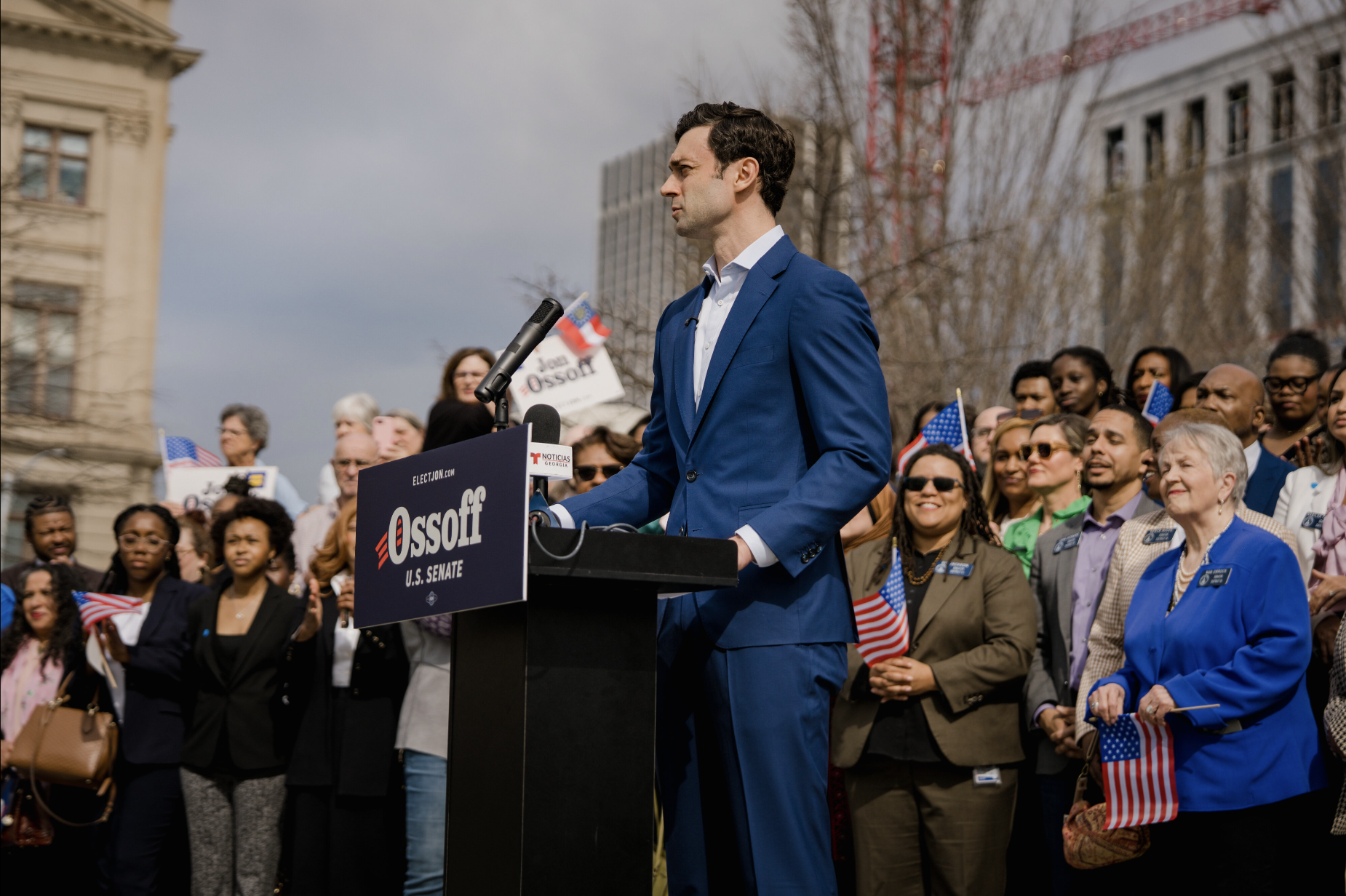
Earlier this year, I got to stand behind the podium alongside other young activists as U.S. Senator Jon Ossoff (D-GA) led a rally in Atlanta. We waved signs, clapped and cheered, and became symbols of resistance against Donald Trump’s chaotic and disastrous presidency. However, when the man of the hour gave his speech without a single wasted word or unflattering pose, I realized that he is scarily good at what he does. The former investigative journalist comes to life under the spotlight, packs quips, quotes, and comebacks for every occasion, and now cruises through election season with a cool confidence. As impressive as he is, I can’t help but feel alienated by a politician so skilled in his craft.
Ossoff has supported major legislation on infrastructure, healthcare, and government accountability, but among Democrats, he’s recognized more as the face of the party’s next generation and one of its best communicators. As the youngest sitting U.S. Senator, he’s Gen Z’s ambassador to the Senate and he boasts about a campaign optimized for the algorithm. His attractiveness makes him shine on camera, and his words are confrontational enough to be exciting but restrained enough to stay within reason. If scientists tried to make a perfect politician, they would say you can’t do better than Ossoff.
As reassuring as that should be for Democrats, I find it hard to connect with someone so on top of their game, and I find myself gravitating towards those who are genuine to a fault. Take Geoff Duncan, for instance. The former Republican Lieutenant Governor of Georgia became a Democrat after refusing to back Trump’s election denial, but he retained some of that “tell it how it is” attitude that tends to make Republicans more controversial. When I saw him speak at a town hall in the Atlanta suburbs, he told a room of devoted liberal activists that Joe Biden’s border policies were a mistake. It resulted in some frowns and looks of doubt, but it was a moment of imperfect authenticity that told me that he wasn’t afraid to speak his mind. I actually happened to agree with him and his candor inspired me to express my beliefs more confidently, even if doing so could cause a stir.
Duncan, who ran to be the Democratic nominee for Governor of Georgia, went on to lose the primary to former Atlanta mayor Keisha Lance Bottoms. Although he was far from the favored candidate, one wonders if holding his tongue would have done him better. Ossoff, however, might have the opposite problem of being too tight-lipped. If he aspires to move up in Washington, he may have to work on appearing more personable. It’s not that he’s a poser or insincere—it’s that authenticity is demonstrated when you’re willing to risk upsetting many for what you believe.
Trump’s habit of speaking his mind scored him points with an electorate tired of polished and inauthentic politicians in his 2016 campaign. Kamala Harris’ loss in 2024 can also be partially attributed to perceived inauthenticity, so future Democratic nominees will want to avoid seeming like they’re mouthpieces too afraid to be their own person. It may seem irrational to judge a candidate for being too controlled and composed, but Al Gore and John Kerry showed how a restrained public image can make a politician seem manufactured instead of relatable. Americans, like myself, want to see a part of themselves in their leaders, and since we aren’t perfect people, we don’t want our representatives to be perfect way either. Democrats don’t need to be as rough as Trump, but they don’t need to be as smooth as Ossoff.
As a senator for a battleground state, Ossoff may find himself perpetually focused on defending his seat. It would be a respectable choice and one the party may push him to make, though White House hopefuls have to be willing to make a few enemies. Breaking with the party on this or any other matter would demonstrate his ability to go against the grain, and any executive should be able to say no to having their strings pulled anyway. To reference the Harris campaign again, overreliance on corporate consultants created a rift between candidate and voter that may have factored into her loss. It would be best for Ossoff to learn from Harris’ mistakes by not seeming like a puppet putting on a pre-rehearsed show.
It’s an odd line of thinking that got us George W. Bush as president, but the million-dollar question is: “Would you want to have a beer with Jon Ossoff?” Even as a long-time supporter and constituent proud of his legislative record, I don’t have the answer—and I really wish I did. Ossoff is on track to win reelection come November, but his team would be wise to use the next six years as a way to tell the world who he is and the direction of the path he’s charting for himself. Whether through their own messaging or having him participate in low-stakes interviews, they must show the man, not just the mission.
The Democratic Party may want a communicator and a fighter, but the people need a human being to lead. Ossoff went out of his way to intern for the late civil rights activist John Lewis, he exposed corruption and human rights abuses across the globe as a journalist, and he’s now defending democracy as a senator. He has the resume and the rhetoric to show he cares, but when I stand behind a leader, I want to know that they represent me in character, not just in beliefs. If there’s a story Ossoff’s life can tell, it should be told. And, if he has his fears or a reason to think he won’t get it all right, then we should know. He doesn’t need to create flaws out of thin air or be someone he’s not; he just needs to show the people that he’s not as distant or spotless as his public image can make him seem. Democracy is flawed—it’s only right that those who keep it alive have a few blemishes too.