
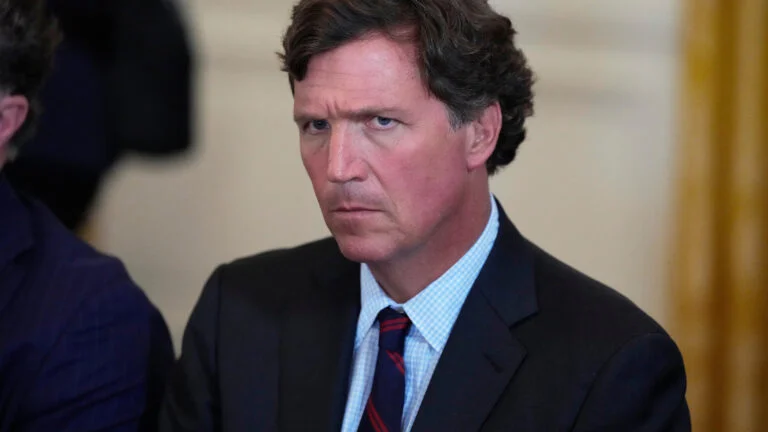
Conservative commentator Tucker Carlson is no longer a friend of the Republican Party. Since his tumultuous exit from Fox News, he has drifted further and further away from the MAGA brand that once defined him. He’s not the only one: former Georgia congresswoman Marjorie Taylor Greene and former Trump official Joe Kent both cut ties with the President. Now, Carlson wants to help form a third party that he can support in good conscience.
However, Carlson is not very well-liked. The latest public opinion data from YouGov shows him at a 40% disapproval rating. Years of partisan pandering and sensationalism have granted him many enemies and weakened his credibility. And yet, in an era where the bar for competence and righteousness drops lower and lower, it may be worth hearing him out. He has ruled out running for office, but his fame allows him to reach a large audience and inspire discussion amongst Americans. His ideas, even if hollow or motivated by self-interest, may lead to a change in thinking and a meaningful alternative to the dominant parties.
In an August video for his podcast, Carlson highlighted ten goals for America, or ten principles it should live up to. This manifesto of his is largely “vibes-based,” but Americans of all backgrounds may find it to be surprisingly agreeable. The first point, for instance, is treating all people the same, whether that be in schools, workplaces, or courts. He highlights the high-profile case of sex trafficker Jeffrey Epstein as an example of how the nation has abandoned fairness to give certain individuals, often elites, an edge. He also targets diversity, equity, and inclusion (DEI) initiatives, tying them to the same kind of unfairness that let a criminal of the highest order off easy.
The rule of law and meritocracy embody American ideals held by the left, right, and center. DEI advocates may disagree that race-based policies are unfair, but they can at least agree that fairness is imperative. Most, if not all of us, would also agree that justice must never be denied. The United States will soon lose its status as a liberal democracy if its institutions and laws continue to deteriorate like this. Corruption in broad daylight erodes public trust, encourages further wrongdoing, and threatens the American way.
The manifesto’s second point is sovereignty. He alleges that U.S. involvement in Iran is a direct result of our association with Israel and its need for control in that region. His reasoning is that were we fully independent and sovereign, we would have no need to get involved. This is arguably the point most important to him, as he has long been fixated on the isolationist America-first ideology. It’s practically guaranteed that any party formed by him will focus on this as its driving principle. Given widespread anti-Israel sentiment and general opposition to foreign intervention, many Americans may once again be on the same page as Carlson.
The third and fourth points are productivity and beauty. Instead of investing in surveillance systems and peddling weapons of war, he believes the United States should use its resources to support agriculture and create art. In that spirit, he also asserts brutalist architecture and graffiti as issues that need to be addressed. One could argue we have bigger problems, but when a majority of Americans think the country is on the wrong track, we may need a multitude of changes across society and culture.
His fifth point is healthiness. He brings up toxic food additives and addiction to prescription drugs, like Adderall, as examples of a deeply unhealthy nation. Health Secretary RFK Jr’s Make America Healthy Again (MAHA) initiative promised action on public health issues, but MAHA supporters claim the administration has failed to live up to its word. A former advisor for RFK Jr’s 2024 presidential campaign likened the administration’s handling of this issue to “a blatant slap in the face.” Carlson didn’t bring MAHA’s failures to light, but he expressed a desire for progress in relation to the issue.
Where he does confront the administration is with his continued crusade against the Iran War. The conflict has been the greatest source of friction between him and Trump, but it also gives him common ground with independents and Democrats. When speaking on honesty—the sixth point in his plan—he says that the administration lied about Iran’s nuclear capabilities and used it as a false pretense for war. Americans historically do not trust the government, and secrecy around events like the assassination of JFK has made it worse as time passes. Carlson says that politicians should stop telling bold-faced lies and that government documents on controversial events should be declassified in order to achieve an honest country.
Optimism and wisdom are points seven and eight. He elaborates that optimism isn’t just choosing to be positive, but having a society that encourages looking ahead. Aging leaders with no care for the future or stock traders after their daily profit, he argues, aren’t who we want to hold power or dominate society. The future belongs to the next generation, and society should improve itself for their sake. As part of that forward-looking mindset, Carlson believes we should teach wisdom to children, namely about the world’s functionality and adulthood.
The final two points are decency and unity. Carlson wants an America where kindness towards our neighbors is the law of the land. Though these are among his more respectable positions, he also criticizes sexual indecency and mass migration in the same breath. If he means to bring Democrats into his movement, he will have to get rid of or compromise on some of his more conservative views. A call for unity might not hold much water coming from someone who was once among the most incendiary figures in America, but his populist views and rebranding may grant him the means to bring people together.
It’s hard to rule out that he may be an opportunist switching to the winning side; it would be a shrewd yet fitting plan for someone so used to the spotlight. Trump, after all, got his foot in the door by promising to drain the swamp—now he’s its king. However, Carlson is isolated and without many allies. But, vulnerability can change people for the better, so we should practice healthy skepticism in the name of wanting what’s best for our country. Maybe we should consider that Carlson is better than who he used to be.
If a changed and radicalized Tucker Carlson can help bring an end to America’s wars abroad, wouldn’t that be a good thing? And if conservatives demand the same changes that progressives want, like government transparency and accountability, then it becomes difficult for Trump and his allies to ignore those issues. Carlson’s ten point manifesto reveals that his views are not so extreme that they can’t be reconciled with. Americans may want to keep a close eye on him to see if he can be trusted to do the right thing and stand by his new beliefs. With how chaotic and unknowable the future of the country seems to be, we may find ourselves making allies out of former enemies.
Acknowledgement: The opinions expressed in this article are those of the individual author, not necessarily Our National Conversation as a whole.