

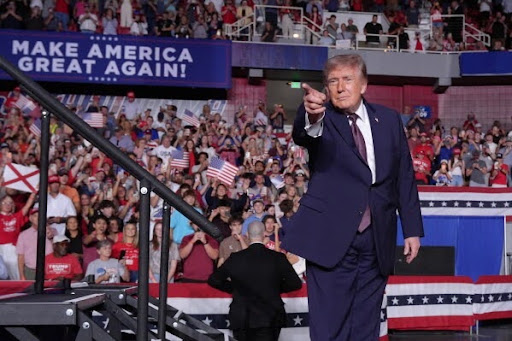
With only 28 days to go until the November midterms, President Donald Trump is hitting the campaign trail hard by visiting Republican strongholds. As Republicans fight to maintain their majorities in Congress, is Trump’s campaign strategy helping or hurting the Republican Party’s chances of retaining control?
His strategy consists of energizing the Republican base. But his decision to focus heavily on Republican strongholds comes with a cost. On the campaign trail, Trump is visiting states where Republicans have traditionally performed well. The question remains whether increased Republican voter turnout will be enough to outweigh the potential benefit of reaching voters in the races that can determine the control of Congress.
Trump backed Republican Sen. Pete Ricketts in his Nebraska campaign stop on Monday, Oct. 5. Ricketts is facing independent U.S. Senate candidate Dan Osborn in a closely watched Senate race, where no Democrat appears on the ballot.
Trump’s decision to campaign for Ricketts shows his broader political strategy of focusing on Republican-leaning states. Nebraska’s Senate race provides a useful case study for why Trump’s strategy is worth examining. His appearance in Nebraska also underscores how closely the president has tied himself to Republican candidates during the final weeks of the campaign.
Trump has also directly urged his supporters to mobilize for Ricketts. In a September 18 endorsement video, Trump called on his supporters to “knock doors, volunteer, and get out and vote” to help send Ricketts back to the Senate.
Political scientist John Mark Hansen of the University of Chicago said Trump’s presence can have a measurable effect on Republican turnout.
“What we’ve seen over the course of the past decade is, when Trump is on the ballot, you get better turnout if you’re a Republican,” Hansen said
In his 32-day campaign blitz, he has already visited places like Texas, Alabama, and Oklahoma, all states that have traditionally been strongholds for Republicans.
I believe Trump’s rallying could have both a potential benefit and a drawback. One way it could serve as a potential benefit for Republicans is voter turnout. Midterm elections typically have lower voter turnout than presidential elections, making voter turnout important. Trump’s rallies could motivate those voters who support the Republican Party but may be less likely to participate in a midterm election. Pew Research Center found that in the 2022 midterms, Republicans benefited more from differences in voter turnout than from voters changing their party preference. At the same time, Trump’s approval on economic issues is quite low, with 26% of Americans approving of his handling of the economy, and 17% of Americans approving of his handling of the cost of living according to a new poll from the Associated Press-NORC Center for Public Affairs Research.
However, the same strategy can have a potential drawback. While Trump remains a powerful figure among his supporters, the president’s overall national approval rating remains low at 32%. A Washington Post poll conducted in August showed that Republican House candidates held a 6-percentage-point advantage over Trump, with 44% of voters supporting the Republican candidate in their district, compared with 38% who approved of Trump’s job performance.
Whether that strategy can translate into enough additional turnout to benefit candidates such as Ricketts remains a key question heading into November.