


(Image Source: Sabbir Ahmed, Vecteezy)
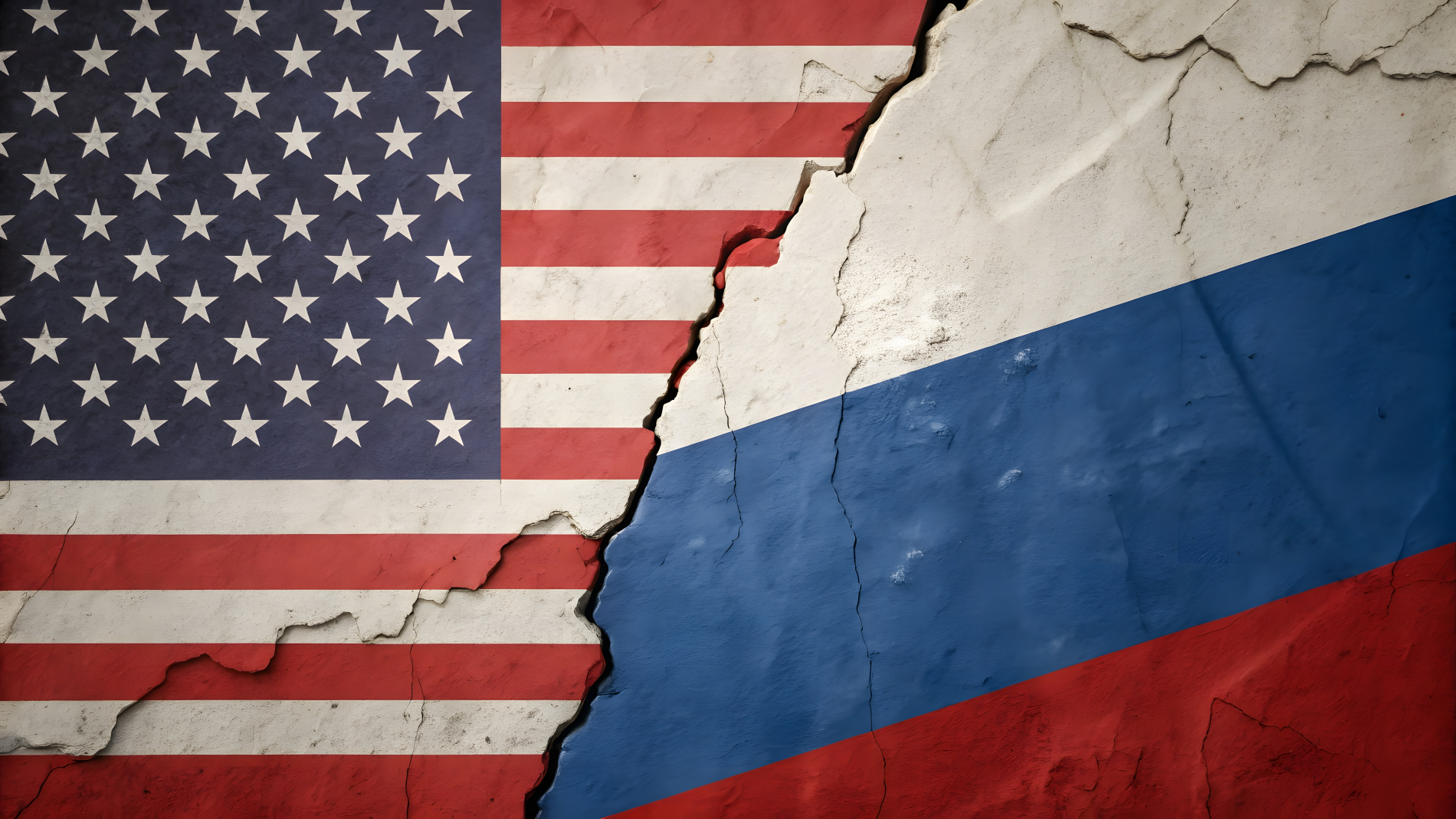
In this exchange, the two writers work to find common ground on an issue not currently discussed much in a bipartisan manner. What they do share most is that civil discourse is vital: Looking at an issue from both sides without being judgmental. There is no intention of determining a right or wrong answer, but to express two divergent views and leave it to the reader to decide.
Break Free from Europe: US & Russia as Partners – Not Adversaries
James C. Bates
Once the Russian-Ukraine War is settled, it will then be time for the US to view Russia with America’s interest at heart, not that of the Europeans; our geopolitical interests are not the same. Unlike Europe, the US does not have centuries of mistrust of Russia. Granted, the US and Western Europe viewed the Soviet Union with deserved alarm. It was an “Evil Empire”. But the Russia of today is not the Soviet Union of yesteryear. Yet, subconsciously, many Americans and Europeans perceive that they are pretty much the same malevolent colossus, with Putin being “Stalinesque”. Moreover, in many American minds, Europeans are the embodiment of advanced societies and fierce proponents of our shared “Western Values”, with the US and Europe joined at the hip. After all, Europe is the setting for numerous character-building “fairy tales” imbued within us during our early childhood formative years; think Snow White, Hansel and Gretel, Cinderella, and Little Red Riding Hood. The average American perceives that what is good for Europe is good for the US and that since Europe has an adversarial relationship with Russia, the US must as well.
But why are European countries like France, Germany, and Belgium seemingly more important to the US than countries like Brazil, Egypt, Turkey, Indonesia, and Bangladesh, all of which have larger populations than Germany, which is the most populous country in Europe (excluding transcontinental Russia)? Why does America (primarily via NATO) concentrate on Germany, France, the Netherlands, etc. over Thailand, the Philippines, Chile, Argentina, etc.? (Because it’s been this way for decades is not a good answer.)
The Cold War is over. It is no longer a bipolar world, and the unipolar power of the US is coming to an end; a multipolar world is fast emerging. The days of US good, Soviet Union bad; democracy good, totalitarianism bad; capitalism good, centralized planning bad; are over. No country even tries to stridently heed to these ideologies anymore. Similarly for America: the idea that Europe is good and Russia is bad should be overcome as well. Now is the time for some “Realpolitik” instead.
America cannot be the world’s primary policeman, especially since Europe consistently refuses to join the force. (For example, they have done nothing to prevent Iran from obtaining a nuclear weapon, though they sure talk and talk about it.) Similarly, the USA can’t afford to ensure the spread of democracy and capitalism to far-reaching corners of the world anymore (as JFK often did). Our focus should be here at home, with an emphasis on limited government, individual liberty, the welfare of American citizens, patriotism, morality, and freedom of speech. The truth is that if we adhere to our country’s founding principles, our nation’s current and future success will entice others to be like us, as we set the standard. There will be no need to cajole others; they will do so on their own.
Europe, on the contrary, is in the process of expanding government (the European Union), banning popular political parties/politicians (Marine Le Pen, AfD, Restore Britain), rewarding non-citizens (unfettered illegal immigration), diminishing Nationalistic thinking (the EU again), increasing secularism (religiosity is declining precipitously, except for Islam), and limiting free speech (the Digital Services Act). In short, American values and European values are not the same, and the divide is growing. And more importantly, countries don’t necessarily need to share the same values to get along.
Determining our partners (whether military, trade, economic, political) should be based on what is mutually beneficial, with these partnerships being of limited duration. The term “Partners,” not “Allies” (NATO-centric), conveys this point. The latter word implies longstanding relationships and seems to be forever connected with World War I and II.
Can Russia be a partner to the US? YES, though this is probably not in the interest of Europe. (But why should this even be a major consideration of America?) Like Canada, Russia has tremendous natural resources and would be a great market for US manufactured goods and services. The US and Russia could even form a future limited military partnership to rein in a potentially hegemonistic China. Clearly, Russia and China are not suited for a long-term partnership, since for one thing, they share a 4,200-kilometer-long border, which may inevitably cause conflict over time. Secondly, like the US, Russia was founded on Christian principles, while China has embraced atheism. Like the US, Russia is increasingly controlling its borders from illegal entrants and has both Pacific and European interests. Aside from European considerations and the current war in Ukraine, America has no reason to be adversarial with Russia.
And regarding the current war, we should at least try to understand the Russian perspective. For the past 35 years, Russia has made it crystal clear that it opposed the eastward expansion of NATO. After the fall of the Berlin Wall, the US even suggested that it would heed this Russian REDLINE. We didn’t. The Russian annexation of Crimea and the current Russian-Ukraine war were the result.
But why does Russia abhor NATO expansion? For centuries in the past, Russia has been a rival of and experienced war with numerous European countries, most notably Napoleonic France and Nazi Germany. In the present, it fears that Europe (and the US) longs for its implosion so that it can then harvest the resources within. Russia also wants to avoid many of Europe’s “vices” such as open borders, lack of patriotism, the advocacy phenomenon of the Lesbian-Gay-Bisexual-Transgender-Queer-Intersex-Asexual-Plus (LGBTQIA+) agenda, a feckless military, lax drug enforcement, permissive courts, etc. Lastly, Russian citizens most likely feel that Europe has never shown their country the respect it deserves as a nation and world power. But America can and should. Let’s choose to make Russia a partner, not an adversary.
Rethinking Defense Engagement with Russia
Thomas Wuchte
One can research recent history and be reminded of when a potential olive branch pulled Presidents Bush and Putin together during their early 2000s encounters. Of all the symbolic gestures and posturing, I found the moment in Slovenia when Putin pulled out a classified Soviet message asking for NATO membership in the 1950’s most interesting. Having worked with Russians from the muddy-boot level to diplomatic negotiations in Vienna, this event and others like it once again raise in my mind the fundamental question, “Why has defense and national security engagement with Russia failed following initial efforts?” Must it? The idea of US/Europe-Russia defense engagement will return whenever the Ukraine-Russia War concludes during the Trump Administration – I am confident this will be the reaction, with the multi-year war leaving behind another Eurasian frozen conflict spanning Eastern Ukraine and Crimea.
I often address this same question with colleagues, and the shared critique is more one of what we could do differently to perhaps reinvigorate a well-intentioned but stalled process after the 1990’s Partnership for Peace (PfP) overtures. Since then, the basic approach to security engagement with non-NATO counterparts like Russia remains high-level meetings, non-operational scenarios, and exchanges for conferences or other similar avenues – the safe norm. There is currently an understandable unwillingness, especially among the Europeans who border Ukraine, to embrace Russia as a potential ally and partner in national security fora.
Times change, and 2025 ushered in the second Trump presidential administration, with an increased focus on America’s relationship with Russia and Russia’s relationship with the Chinese. Not much changed, however, from the perspective of the European Continent, resulting in a Russia increasingly frustrated by NATO enlargement, Europe’s increasing missile defense efforts, and Moscow’s own national prestige and influence diminishing across Europe and Asia. I personally witnessed Russia’s frustration while working in Vienna, Austria, and within the Organization for Security and Co-operation in Europe (OSCE). Russia was oft treated as a marginalized Cold War loser, which was perhaps true when Presidents George W. Bush and Vladimir Putin met in 2001, but such an attitude will not garner much Russian cooperation today, especially with the emergence of China and a multipolar world. Engaging less with Russia and its leader was, is, and will be a strategic mistake.
After the Cold War ended, we had had a lot of engagement, particularly in Europe, solely for the sake of engagement. US and European engagement with Russia seemed to the latter to be superficial, simply filling a void with non-purposeful discussions, which the Russians cynically described as “military tourism”, viewing them as costly and with little reciprocal benefit.
Reaching out to Russia from a US-centric point of view (and proceeding from the premise that Europe/NATO’s interests are no longer paramount for strategic stability as highlighted in the current American National Security Strategy) can reset the approach. Establishing an ongoing dialogue on such topics as piracy, nuclear proliferation and nuclear reduction, environmental protections, counterterrorism, and maritime law.
The point, building on Mr. Bates’ worldview, would be to find some things in European, Central Asian, or Far East parts of Russia that open a dialogue and alter or reaffirm views both sides feel are important – promoting at least collaboration in Russian leaders when dealing with shared concerns. Such an invigorated engagement plan would best be targeted between regional defense leaders in Russia and our unified commands.
What would the Russian security system find appealing, in broad terms? Here is the hard-edged, bottom-line Russian view: Programs that deliver valuable experiences but which do not expose cracks in the Russian system; anything associated with equal status that keeps a balanced level—each side kept Cooperative Threat Reduction (CTR) going because it provided resources, and things that strengthened the image of Russia internationally and domestically. Raising the bar and challenging Cold War thinking, here are a few practical, yet bold, suggestions for rethinking US and Russian engagement.
Environmental issues and preservation. The Corps of Engineers and/or EPA offer a wide variety of experts that can exchange ideas and techniques.
Co-sponsor and organize joint conferences in areas of the world that are relatively neutral – perhaps Thailand, Vietnam in Asia and Serbia in Europe. Possible topics could be out-of-area operations, maritime navigation laws, littoral military operations, and piracy. Many bilateral exchanges would be available from this conference scenario.
Involve Russian officers again with our counterterrorism operations and headquarters in an intern training program. If nothing else, this will help one another understand post-Ukraine intent and how we plan future collaboration.
Assign Russian officers to major headquarters to work with American chaplains. The Russian military after Ukraine will likely encounter morale, motivation, and group socialization challenges much like our military model.
Place a Russian Judge Advocate Corps (JAG) equivalent working with U.S. European Command (EUCOM) or at the Pentagon to share and understand each legal system’s approach to the rule of law.
Sponsor one or two Russian officers to serve as congressional liaisons in Washington. Obviously, sensitive issues must be avoided, but this is an idea worth pursuing in Trump’s spirit of strategic stability.
Offer to jointly develop some type of tactical field expertise and work procedures in an agreed area. This would enable a small group of U.S. military to interact with Russian military leaders – these shape perceptions much more than selected officers coming to U.S. soil. Examples: nonproliferation and counterterrorism are again always well agreed, or border security.
Personal experience working with Russian engineers in Bosnia and Herzegovina suggests we should move into operational training scenarios – and away from purely humanitarian or peacekeeping situations. These types of scenarios will build the trust and confidence that real engagement provides for professional military interaction. There are certainly risks associated with these alternatives, but they are a logical next step, and the benefits far outweigh them. These suggestions are pragmatic and will build a stronger relationship, provided Russia is willing to pursue these ideas.
The alternative to a bold approach now is an isolated to nonexistent Russia dialogue, each side irritated with the progress on strategic stability, and most likely Russia reaching out further for sympathetic allies. As grand strategy, a balanced and productive strategic relationship is American foreign policy that will mitigate Russian concerns and desires for further rapprochement with China. Our cultural similarities are natural, and even as recently as after 9/11 we were allied with Russia on many national security priorities. A prudent cultural calculation would place the olive branch in Russia’s lap as a more likely strategic partner. Can we afford to have half-hearted engagement with Russia?
—
Author’s Credit: Jim Bates is a retired Army Lieutenant Colonel who has had his thoughts published in the Army Logistician, the Air Force Journal of Logistics, the Defense Logistics Agencies’ Fuel Line, the U.S. Naval Institute’s Proceedings, the Army Quartermaster Bulletin, Marathon and Beyond, and the Washington Running Report.
Author’s Credit: Mr. Thomas Wuchte is the Founder of the Center for Multilateral Leadership, based in Washington, DC. He recently completed his assignment as the Executive Director for the International Institute for Justice and the Rule of Law (IIJ) located in Valletta, Malta. He is a graduate of the United States Military Academy at West Point.
Acknowledgement: The opinions expressed in this article are those of the individual authors, not necessarily those of Our National Conversation as a whole.