

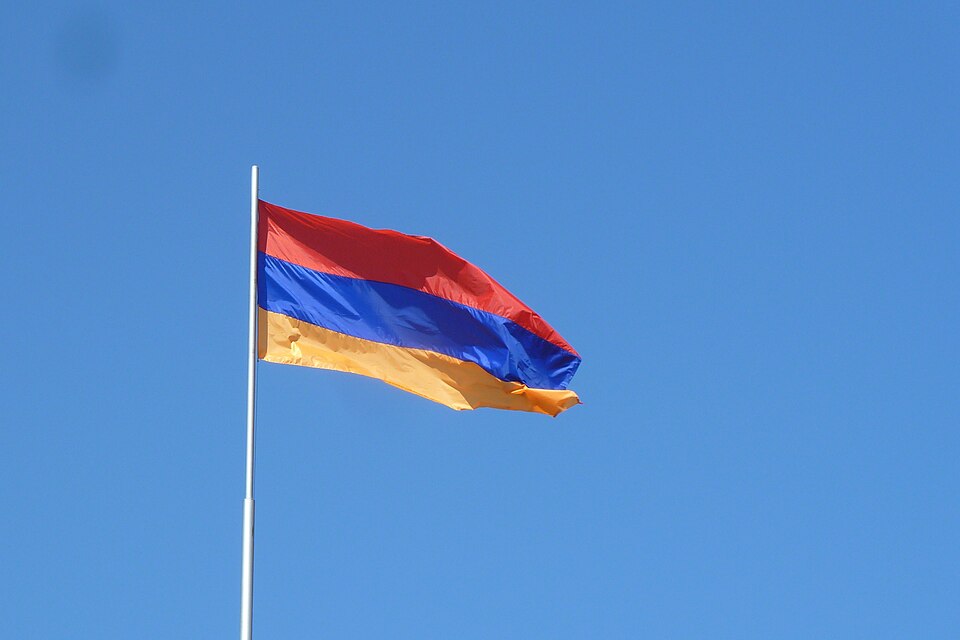
Shushi, a historic city of profound cultural and religious significance to the Armenian people, was captured by Azerbaijani forces on November 8th, during the 2020 Artsakh War. Home to approximately 4,000 Armenians before the war, the city witnessed the displacement of its Armenian population amid Azerbaijan’s military offensive. Families were uprooted, homes were destroyed, and civilians lost their lives as the conflict devastated a community woven into the very foundations of the city. Situated on elevated terrain, Shushi was known in medieval Armenian sources by names such as Karaglukh (Քարագլուխ), meaning “top of the rock,” and Shosh Berd (Շոշ բերդ), meaning “Fortress of Shosh.”
On that same date, six years later, the Azerbaijani-American Youth Federation raised the Azerbaijani flag in Manhattan, New York, to commemorate what Azerbaijan celebrates as “Victory Day.” New York is home to a significant Armenian-American community, many of whose members carry the historical memory of the suffering and displacement experienced by Armenians during the war. Labeling a day marked by tragedy as one of “victory” is a deliberate decision that serves as a painful reminder to the Armenian community of the lives and homes lost to the conflict. Morally, celebrating a military victory that came at the cost of human lives goes far beyond national pride and crosses into evident glorification of human suffering.
While looking out of her apartment window, New York resident Hripsime Biyazyan noticed the Azerbaijani flag flying at Bowling Green Park and immediately took action. Outraged that a public space was being used to celebrate such a devastatingly impactful event, she contacted Armenian advocacy groups, including the Armenian National Committee of America (ANCA), and the city itself, to alert them about the situation.
Following Biyazyan’s call for action, the ANCA reached out to Mayor Zohran Mamdani’s administration. In response, the administration reaffirmed Mamdani’s solidarity with the Armenian community, citing his previous commemoration of the Armenian Genocide and acknowledgment of the forced displacement of Armenians from Artsakh (Nagorno-Karabakh).
The efforts of Biyazyan, the ANCA, and the broader Armenian-American community demonstrate the power of collective advocacy in ensuring that Armenian voices are heard. What began as one individual’s refusal to remain silent grew into a coordinated effort to bring attention to an issue of immense importance to the Armenian people. Their mobilization serves as a reminder that communities can come together to create civic engagement. Mayor Mamdani’s support is incredibly meaningful, especially considering the hard work of the Armenian-American community in bringing these concerns to his administration’s attention. This demonstrates how the concerns can reach the highest levels of New York City’s government through the power of grassroots advocacy and collective action.
That is dedication; that is a community bound by an unbreakable sense of solidarity.
At times, minority communities may feel as though their voices are reduced to mere whispers amid those of the majority. However, instances like these demonstrate that through collective action, those voices can be amplified and, eventually, heard. Armenian communities around the world have faced countless challenges, yet their enduring unity and commitment to advocacy have allowed them to persevere, preserving their identity and standing together in the face of adversity.
In a country where the First Amendment guarantees the freedoms of speech, peaceful assembly, and petitioning the government, these rights should be put to use. They are not merely constitutional protections to be read on paper, but freedoms to be actively exercised, especially when matters of one’s community are at stake.
Acknowledgement: The opinions expressed in this article are those of the individual author, not necessarily Our National Conversation as a whole