

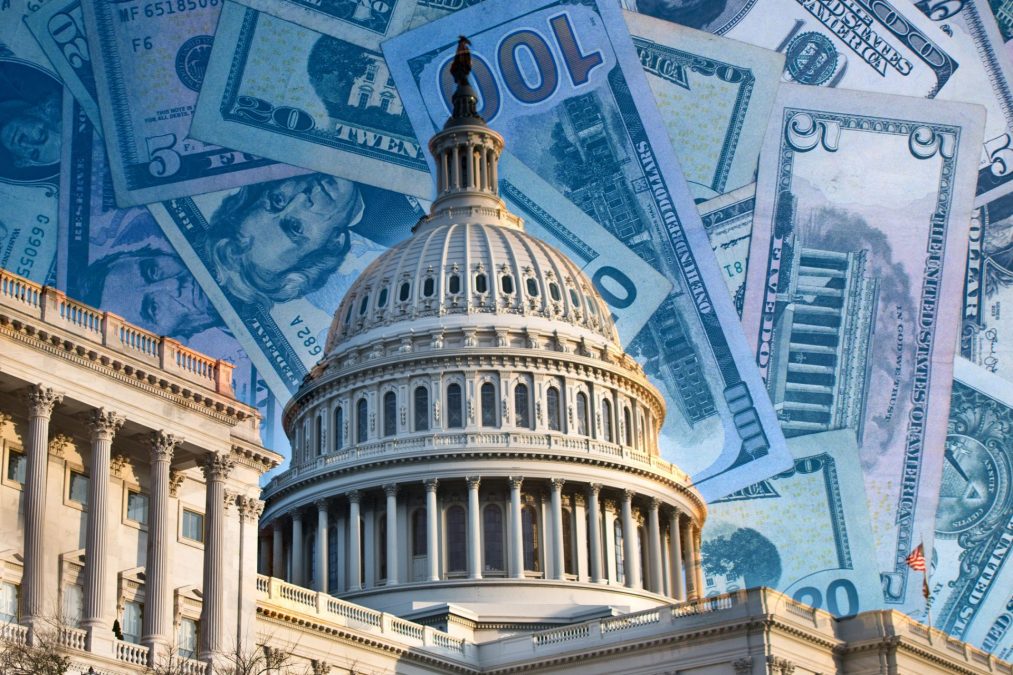
President Biden signed the $95 billion foreign aid package into law that was passed by Congress this week. The package comes after the Biden administration’s drawn-out conflict with Republicans on Capitol Hill over securing this overseas aid. The bill holds great significance for both U.S. allies and enemies alike.
Aid Package Breakdown
The $95 billion package is to be divided among three recipients.
Ukraine will receive $61 billion in the form of weapons and forgivable loans, this money will also aid in replenishing U.S. weapon stockpiles that have been sent to Ukraine throughout the war. This comes as Ukraine is in danger of losing the war to Russia within the year according to CIA director Bill Burns.
$26 billion in aid will go to Israel, with $9 billion of that going to the humanitarian crisis in Gaza. $4 billion will go directly towards resupplying Israeli air defense missiles, much of which was used throughout the beginning of the war in Gaza and more recently during the Iranian attack on April 13. The escalation of tensions in the region signals a need for Israel to not only resupply but also to ramp up military capacity as an all-out confrontation with Iran is potentially imminent.
$8 billion will be allocated to U.S. allies in the Indo-Pacific region focused on countering China. The money will be split between developing submarine infrastructure and replenishing and updating the arsenals of Taiwan and other U.S. allies in the region.
Significance
It is no secret that global tensions are rising. What began with the full-scale Russian invasion of Ukraine in 2022 has now culminated in a global chess match that has entered a new stage. The largest land war in Europe since World War II was followed by renewed conflict in one of the most contested territories in human history, Palestine; which of course set in motion the current proxy war between Israel and Iran. These events coincide with years of rising tension between China, the U.S. and its allies in the South China Sea, mostly over the status of Taiwan and its territorial claim to the water.
While some believe there is an obvious need for the U.S. to proactively prevent any further global escalation by allocating aid to allies, others think injecting aid into the problem will pour fuel on the fire. Democrats generally support aid to Ukraine to fight Russia’s invasion while Republicans are split on the matter. Israel, however, is a more complicated affair. Put simply, there is a large sect of bipartisan support, while the fringe extremes of both the right and the left tend to agree on the need to quell Israeli belligerence. Standing in opposition to China is much less contentious in terms of partisan disagreement. Some disagreement does exist but along the lines of fiscal responsibility more than anything else.
One way or another, the U.S. aid package is inbound. The geopolitical landscape remains fraught with conflict as the Russo-Ukrainian shows no signs of slowing, Israeli-Iranian tensions simmer and the war in Gaza persists. Furthermore, the U.S. and China are set to clash as tensions rise over Chinese expansion into U.S. Pacific hegemony.
