
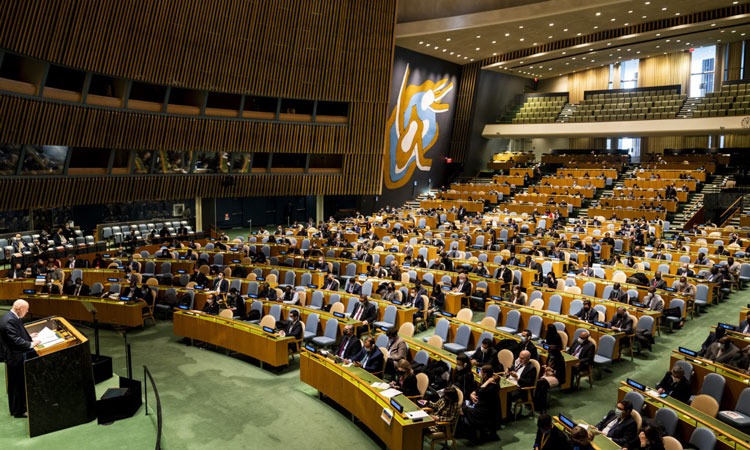
The United Nations (UN) once symbolized the promise of a world united for peace and security – bulwark against the atrocities of war. Now, it faces unprecedented scrutiny. With the UN’s Secretary-General Antonio Guterres’s recent attendance at the BRICS summit – where he met figures widely condemned for their roles in global conflicts – questions have risen about the UN’s capacity to uphold its mission and moral authority. When the organization’s highest representative meets with leaders accused of war crimes, it begs the question: Is the UN still fit for purpose?
A Diplomatic Misstep that Challenges Credibility
For Guterres, a self-styled advocate for peace, shaking hands with Vladimir Putin and embracing Alexander Lukashenko sends troubling signals. His call for a “just peace” in Ukraine, while aligning with the UN Charter, is undercut by his actions, which seem to legitimize the very leaders who disregarded international law. Such gestures weaken the credibility of the UN as a force for justice, suggesting that appeasement might be prioritized over accountability.
The Need for Urgent Reform
The UN is at a crossroads —“It’s reform or rupture,” as they say. While the organization has had success as a norm-setter with the Sustainable Development Goals, it is hindered by an outdated structure, found particularly in the Security Council. The veto power concentrated among a handful of nations too often paralyzes action on critical issues, from Ukraine to Sudan. This inaction isn’t just a bureaucratic failure; it’s a betrayal of the people and principles the UN claims to protect.
A System Stuck in the Past
Calls for reform echo loudly around the Security Council, whose composition reflects a post-World War II reality that no longer aligns with today’s multi-polar world. How can a country like Russia, which launched a war in Ukraine, remain a key player in an institution meant to uphold international peace and security?
This contradiction highlights the need for restructuring; geo-political shifts demand more representation and influence for nations beyond the current permanent members. Expanding the Council to include countries like Japan, Germany and key states from Africa and Latin America would address this outdated framework. Yet, commitment from powerful players who benefit from the status quo —a shift that remains glaringly absent.
A Choice Between Relevance and Obsolescence
Despite these structural issues, the UN retains potential as a global convener and a platform for essential cooperation. It remains the sole institution where countries can come together to address shared challenges. Without meaningful reform, the UN risks irrelevance, sidelined by a lack of decisive power in a world increasingly shaped by crises that demand action, not empty gestures. Diplomacy, after all, cannot replace accountability.
The UN stands at a critical juncture. It can choose to adapt, updating its structure to reflect today’s geopolitical landscape, or continue down a path where symbolic gestures and outdated power structures render it ineffective. Recent decisions by its leaders serve as a reminder: reform is not merely an option but a necessity for the UN’s survival and relevance in the 21st century.
Acknowledgement: This piece represents the opinion of the author, not Our National Conversation.
