
In May of this year, gasoline prices spiked to $4.50 a gallon, a 50% increase since the war in Iran began. According to a report from the BLS (Bureau of Labor Statistics), consumer prices rose by 3.8% from April 2025 to April 2026, the highest inflation rate over the last 3 years. According to the same report, energy prices rose by 17.9 percent, largely driven by the current hostilities in the Middle East. Amidst all this, consumer sentiment has hit a new low:
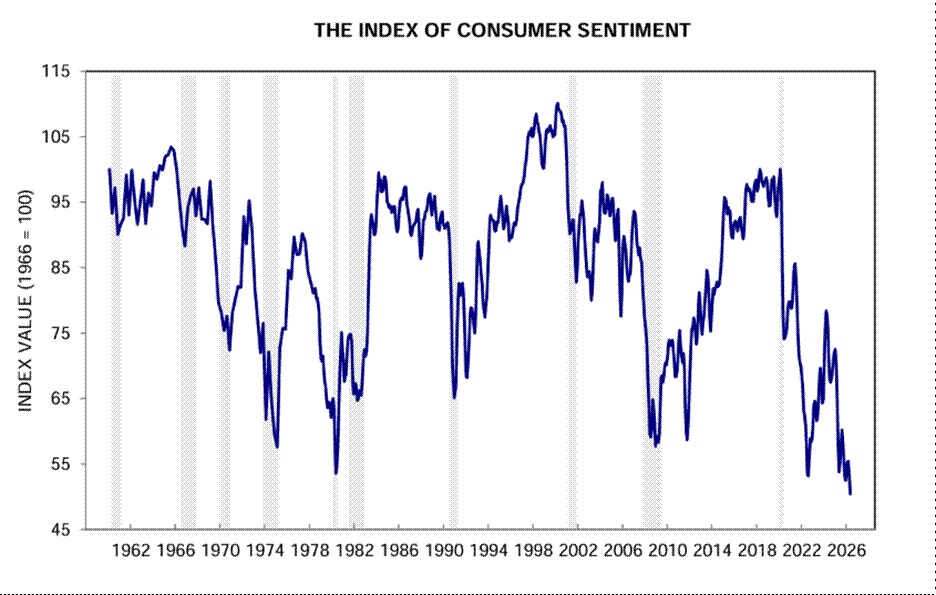
(Source: University of Michigan Surveys of Consumers)
Something is clearly wrong with the economy, and consumers can feel it; however, it doesn’t look like any recession we have a textbook for. The unemployment rate is not high, and inflation, while higher than the target rate of 2%, is far from out of hand. And yet, according to the well-watched Michigan Survey of Consumers, consumer sentiment on the economy is at its worst in over 60 years.
America is not in a recession, but perhaps we are facing something worse. Have we entered a period of stagflation?
What Stagflation Actually Means
Normally, unemployment and inflation have an inverse relationship. When the economy is growing fast, more money is circulating in the economy, creating more jobs as prices rise. A slowing economy leads to less spending and job cuts, as price inflation falls. When inflation rises at an unsustainable rate, meaning the economy is running too hot, the Federal Reserve increases interest rates to slow down spending. However, in the case of a contracting economy, the Federal Reserve cuts rates, and Congress spends more. This is the Keynesian framework, which suggests that the economy is usually pulling in one direction, growth or contraction, and the government can act as a counterbalance to maintain stability.
Stability, however, is not always good, especially when it leads to stagnation, or even worse, “stagflation”. When unemployment and inflation go up together, the normal Keynesian framework and levers of monetary and fiscal policy are less effective. Have we entered one of these periods, the last of which was in the 1980s?
The current numbers tell a certain story. According to the BLS report cited earlier, consumer prices rose 3.8% year-over-year, well over the 2% mark that the Fed targets as the natural rate of inflation. The unemployment rate is 4.3%, not historically high, but it is not low either, compared to 2023, when the unemployment rate was only 3.4%. Furthermore, labor force growth is projected to be “near zero” this year, suggesting a sluggish economy.
However, the historical benchmark for stagflation is critical. The last notable case of stagflation happened between the 1960s and the 1980s, where inflation peaked at 13.5% with the unemployment rate pushing above 10 percent.
Today’s inflation is barely a third of that 1980s peak, and the unemployment rate is not much higher than the pre-COVID-19 level, when the economy was booming in 2019. Therefore, calling the current sluggish job market “stagflation” is a stretch. A much more honest description is stagnation, where the structural conditions point to a stable, yet weak job market; possibly in a state of transition amidst a set of disruptions.
A Few Unique Factors To Flag
While America has not yet entered an era of stagflation, there are a few headwinds to consider:
Tariffs are causing increased prices and reduced demand. Even after the Supreme Court struck down many of the Trump Administration tariffs, the U.S. average effective tariff rate now stands at 11 percent, the highest since 1943 (excluding 2025, where it was even higher). Tariffs are inflationary because they raise the cost of trade, as imported goods now incur a higher tax to come into this country for consumption. Not only does this mean consumers pay more, but American businesses also lose out on exporting goods, as other nations impose retaliatory tariffs.
Based on a counterfactual analysis by the Yale Budget Lab, we can see how the Trump Administration’s tariffs deviated from the trend line and increased the price of goods:
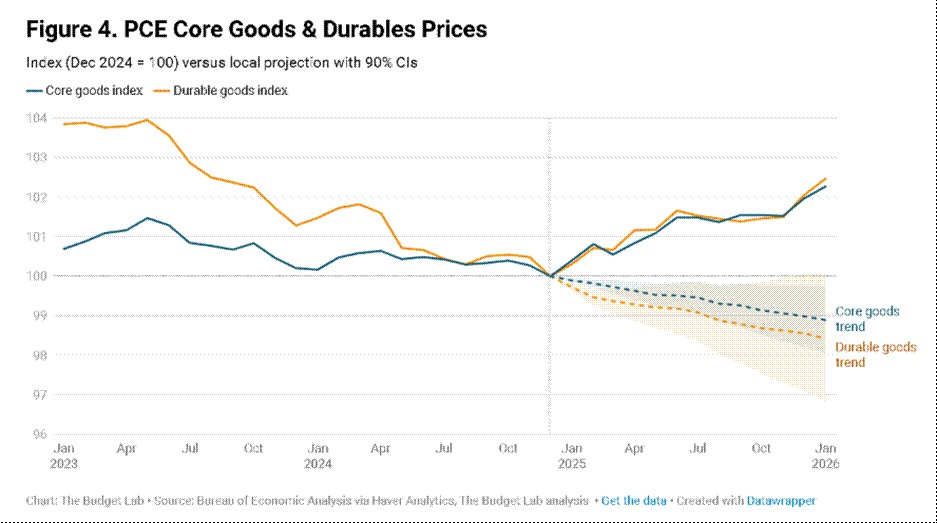
Had the new tariffs not been imposed, according to The Budget Lab, inflation would have trended downward (shown via the dotted lines) from January 2025 onward. Of course, we cannot take this evidence to be conclusive, as this is based on a probability model; however, when combined with the economic theory, this data tells a compelling story.
In the long-run, however, the result is reduced consumer spending, which risks a deflationary effect and a reduction of job growth. In this way, tariffs have a dual effect: creating rising prices before creating a negative demand shock, which is the case in a contracting economy.
The Iran War is, in my view, causing a bigger shock. The average price for a gallon of gasoline has risen to $4.50 as of May, a 50% increase since the war started after the U.S. and Israel struck Iran in late February. The restricted traffic through the Strait of Hormuz, which accounts for 20 percent of global oil supply, is a point of great concern for the global economy and the U.S., the longer this war goes on.
Here, the effect is more obvious when it comes to increasing prices, as gas prices are a method of calculating inflation. When gas prices go up, energy prices go up, and inflation is impacted significantly, leading to the highest year over year inflation rate in 3 years.
AI-driven labor is a slower-moving shock. However, the way I would frame it is to say that it represents a technological shift. Recent graduates and young professionals, like myself, are being affected, with a decline in entry-level jobs by 35% since January 2023.
On the one hand, AI investment is inflationary due to the productivity boom it brings and the increased spending on energy to maintain data centers. AI is intriguing because there is an argument both ways in terms of how it will affect the economy.
There is a fear that as AI develops and eliminates entry-level jobs, the pathway for success for entry level candidates gets harder. As someone who recently graduated myself, and who has been part of the job search process, I am part of this data point. What is the long-term implication? Would young professionals need to invest in even more education to be competitive for jobs, thereby taking on more student loans? This impact increases unemployment and reduces growth.
On the other hand, AI is a new technology, and because it can improve productivity, as these productivity gains come to fruition, inflation could cool down.
The Policy Question: What Should the Government Do?
The good news is that America has not entered into stagflation…yet. However, consumer sentiment is at an all-time low. Inflation is rising, and the labor market is resilient but sluggish.
There is a certain sense of worry among Americans, and perhaps for good reason. The Iran War could push prices to higher depths if it is not contained. AI continues its path of creative destruction, adding ways to produce more goods at scale, but at the cost of leaving behind those who either do not know how to use AI or whose skills are subsumed by it.
If not stagflation, I’d argue America risks entering a period of classic stagnation. An economy that is resilient, somewhat stable, but painful for those on the receiving end; for those who cannot afford increased grocery prices, for those who cannot find a job because AI is replacing their skillset, or for those who rely on importing inputs for their business, only to find the cost has drastically increased due to tariffs.
Now is a time, more than ever, to embrace abundance, not scarcity. Invest in trade and reduce tariffs, so we can bring in more goods to the American economy. Invest in AI to boost productivity through grants, but issue regulations to ensure there are guardrails. Furthermore, the federal government should consider making targeted grants to help those job seekers most affected by AI to either upskill or get access to entry-level jobs.
Furthermore, it should go without saying, but ending the Iran War will go a long way to reduce current inflationary pressures, because now is not the time for America to be involved in yet another military entanglement.
More free trade, more global cooperation and diplomacy, and more targeted investment to help those most affected by AI are three moves America should make.
While stagflation is not currently on the horizon, we remain in a precarious position. How we respond to the current moment could well define the future for decades to come.
Acknowledgement: The opinions expressed in this article are those of the individual author, not necessarily Our National Conversation as a whole.