
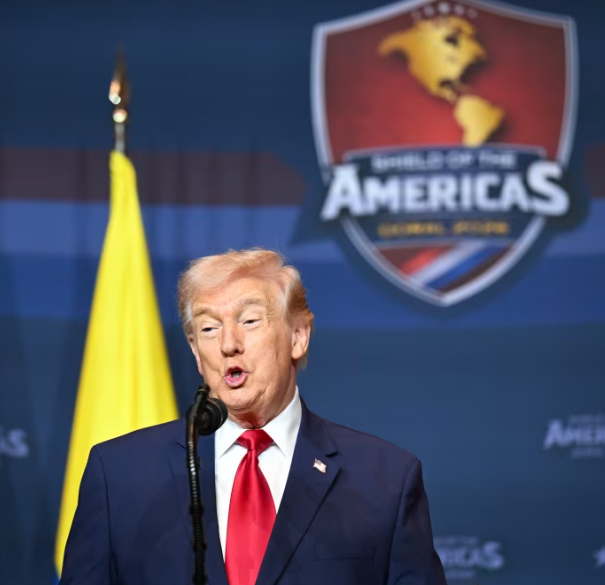
Last week, President Donald Trump announced a new security initiative in the Caribbean and Latin America called the “Shield of the Americas.” This initiative aims to get the U.S. and other South American and Caribbean militaries to combat drug trafficking. It is an admirable and much-needed initiative. Kudos to Trump for investing American military assets to actually help these countries, rather than just threatening them with tariffs to get them to do something. The United States should lead by example and help other countries with practical, material support (rather than just throwing aid money at nations).
Some people may worry that military force will cause widespread, violent backlash from cartels (as seen in Mexico in recent weeks after a Mexican military operation against an infamous cartel leader). However, allowing drug cartels to weaponize the fear of violence to make civilians and governments acquiesce to their illegal and immoral activities has resulted in an ugly status quo. It is a status quo where criminals get to basically rule entire regions and do whatever they want. Hopefully, this partnership between the U.S. and Latin American militaries will consider how best to minimize civilian suffering. But doing nothing will not help the people of both South and North America, who have suffered from crime, drugs and violence for decades.
Though this initiative is a good step, I do have some problems.
Trump nominated Kristi Noem to be a “special envoy” for this initiative. What is the point? She was ousted from her position as Homeland Security Secretary by a bipartisan vote over her mishandling of immigration. An interesting article by Matthew Hennessey of the Wall Street Journal analyzed Noem’s problems through the lens of the “Peter Principle,” which says that employees continue to get promoted until they reach a role beyond their competence, and then fail spectacularly.
This fits Noem’s story. Noem began as South Dakota’s House Representative, and then became its 33rd Governor. Eventually, she got promoted to Secretary of Homeland Security and met her ceiling. Perhaps she did well in her roles in her state, but she was unfit for a national job. But if she cannot handle a national role such as that, how will she handle an international role involving a multinational military coalition? This is a cold take, but she shouldn’t be a special envoy, or for that matter, have any role in the initiative. It appears to me that Trump is trying to appease one of his allies with a nice position far away from domestic politics in hopes that she will fade from public consciousness.
Another issue is the makeup of the coalition: all the leaders who met with Trump for this initiative were conservatives. Essentially, it seems that this bloc is dominated ideologically by conservatism or those aligned with the Trump populist right-wing movement. While I don’t mind that conservative-leaning Latin American nations, such as Chile, want to help the United States battle against cartels, I worry that this initiative will be hindered if it becomes too ideologically exclusive. Notably, the meeting did not involve major regional powers like Mexico (our close neighbor), Brazil and Colombia. Many cartels are residing within these nations, and they will need U.S. assistance to help root such cartels out.
These nations also have decently sized militaries, which will be helpful in this collective American (and I speak of the Americas as a whole) effort to battle crime. Trump has had testy relationships with the leaders of these nations for being left-leaning or belligerent toward him. But Trump should realize that the desire to stop criminal thugs transcends political ideologies, even if we disagree on how to handle them. Trump also needs to recognize that his own belligerence and unruly tariff policy have created unnecessary enemies, especially in South America. It would be both gentlemanly and politically savvy to invite leaders with whom he may not get along. It may be an opportunity to mend relationships, work together for a good cause and increase U.S. reputation and influence in this region, which has often been suspicious of us.
Trump has been starting several foreign policy projects in his second term. He has intervened in several conflicts, is currently fighting a war in Iran, and is now trying to get the U.S. more involved with its closed neighbors. It’s surprising for a President who campaigned on being less involved in foreign affairs, but perhaps he can do a lot of good for both the U.S. and the world. But he really needs to put away his worst impulses. He needs to appoint more capable people for crucial jobs and let go of his own ego. He will find that by doing so, he may achieve a more lasting legacy, one in which organized crime in the Americas is severely weakened and crushed.
Acknowledgement: The opinions expressed in this article are those of the individual author, not necessarily Our National Conversation as a whole.
The image accompanying this article was taken by Robert Schmidt for Getty Images.