

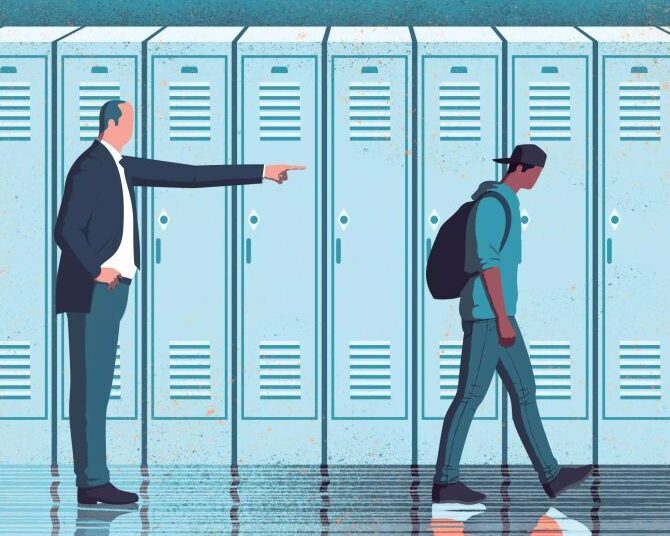
Classroom discipline efforts often rely on teacher discretion, and without proper diversity
training, teachers become judge, jury, and executioner of minority students. In a congressional
report, congress observed two key occurrences:
1) Racial and gender biases in school discipline practices and limited requirements in educator preparation and professional development all influence how school personal react to behavior by students of color; and 2) Improved and increased opportunities for culturally competence professional development programs can help teachers and related school personnel more effectively respond to student behavior misbehavior and thereby decrease the disparity between how Black and White students are disciplined.
I remember when I was in high school the zero-tolerance policy environment affected many of my black peers. I knew first-hand how many of these students were forced to transfer schools after disciplinary action. This disciplinary effort resulted in a misconduct record, a record which gives cause for future in-school offensive to be referred to criminal court.
In “DeAndre talks back to his teacher after arriving late to class”, compare the difference
in a traditional approach versus restorative justice:
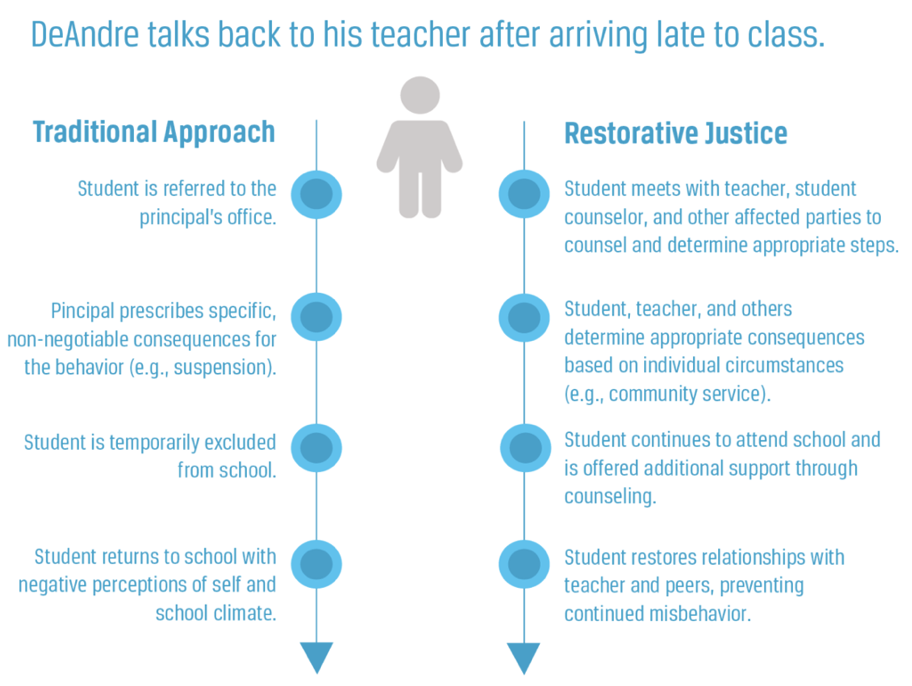
According to the ACLU, in Sigma Beta XI v County of Riverside, the traditional approach to dealing with “talking back to school officials, truancy, or academic problems” can result in being placed in a probation program. The article continues, many of these programs apply “oppressive tactics such as surprise searches, unannounced home visitations, restrictions on who participants could speak to”, and more.
For DeAndre, this means, merely being late for class, and trying to advocate for himself means he is now in the criminal justice system?
Turning in-school misconduct into a conviction record steadily accumulates into pushing minority youth into the juvenile (or in other cases) adult criminal justice system. In hindsight, once I learned that “African American children represent 32% of children who are arrested, 42% of children who are detained, and 52% of children whose cases are judicially waived to criminal court”, I understood that ending the school-to prison pipeline begins in the classroom (NAACP).
Within the classroom settings, teachers and administrators often believe misconduct codes, establish a safe environment by removing mismanaged behavior, maximizing learning by removing disruptions, promoting fairness over holistic discipline by promoting uniformity, and fostering self-discipline by promoting student accountability. However, these codes often function as probation programs.
Think back to DeAndre, with the above defined classroom objectives, if he does not mold himself to the “standard”, he becomes a deviant in the classroom. By molding students to standards versus supporting development by catering to student, schools become an institution where students are either filtered out of, or into the system.
To me, a traditional approach only means avoiding the extra effort of classroom management. This only emphasizes disparities for students who do not meet the standard of “good” behavior. Since teachers are the labelers of “good” and “bad” behavior, without training to facilitate equitable classroom management, teachers bias often criminalizes minority students in the classroom setting.
Yes, classroom discipline is arguably needed to promote a safe learning environment, however, harsh punishments or zero tolerance polices only exacerbate social stigma for students of color.
In “Racial Inequality in Public School Discipline for Black Students in the United States”, Emily Peterson presents data on in school discipline disparities. Peterson reports: “One study found that when a Black student misbehaves, teachers and administrators are more likely to believe the student is prone to violent behavior or “acting out” more in class. Meanwhile, a White student’s misbehavior tends to be attributed to external and individual circumstances, and as a result, a White student receives less harsh disciplinary measures” (Peterson).
To me the empathy towards white students within the study is a result of cultural competence, while the engagement with black students is a result of cultural stigma.
Understanding that culturally competence is a result of exposure, we must expose teachers and administrators to the cultural context of minority students. In fact, schoolhouses should respond to students’ differences, and instill general development catered towards student’s needs. A difference in lived experiences is not a hinderance, and it should not be viewed as a cause to push students towards specific social norms.
In response to these existing disparities, Representative Bonnie Watson Coleman sponsored the Commission on Advancing Restorative Justice in Elementary and Secondary Education Act of 2024. In short, this bill would legally require schools to amend traditional approaches in school discipline towards restorative justice practices by implementing “a set of informal and formal strategies intended to build relationships and a sense of community to prevent conflict and wrongdoing and respond to wrongdoings” (Peterson).
Restorative justice training would create an equitable in-school discipline environment, allowing for teachers and students to share authority in school discipline. By making teachers passive disciplinaries and students assertive conservators of their needs, school discipline would become offense oriented not offender oriented.
Because the school-to-prison pipeline at root is a result of inequities in school discipline, legalizing the congressional commission would be the first step in destigmatizing minority students and rehabilitating youth out of the system.
Acknowledgement: The opinions expressed in this article are those of the individual author, not necessarily Our National Conversation as a whole
Bibliography
Criminal justice fact sheet. NAACP. (2022, November 4). https://naacp.org/resources/criminal-
justice-fact-
sheet#:~:text=There%20are%203%20million%20people,nearly%20$81%20billion%20o
n%20corrections.
Emily Peterson. “Racial Inequality in Public School Discipline for Black Students in the United
States.” Ballard Brief. September 2021.
Graham, A., MacDougall, L., Robson, D., & Mtika, P. (2018). Exploring practicum: student
teachers’ social capital relations in schools with high numbers of pupils living in poverty.
Oxford Review of Education, 45(1), 119–135.
https://doi.org/10.1080/03054985.2018.1502079
Text – H.R.10189 – 118th Congress (2023-2024): Commission on Advancing Restorative Justice
in Elementary and Secondary Education Act of 2024. (2024, November 20).
https://www.congress.gov/bill/118th-congress/house-bill/10189/text
Sigma beta xi v county of riverside. American Civil Liberties Union. (2018, July 1).
https://www.aclu.org/cases/sigma-beta-xi-v-county-riverside