


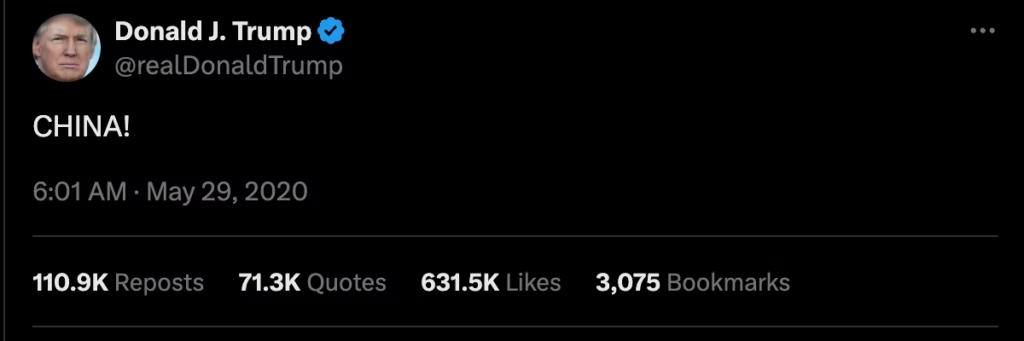
One of many internet sensations surrounding former President Donald Trump was his eccentric pronunciation of “China” as “Jina.” Trump has mentioned China so many times that the Internet circled compilation videos of him saying “Jina.” He certainly got America talking about “Jina,” even though he was adamant that the pivot to Asia, starting during the Obama administration, was a bad strategy that he would not follow. In reality, Trump adhered to many of his predecessor’s policies, though Trump’s “pivot” lacked a consistent long-term plan, as his Asia policies sometimes clashed with his “America first” rhetoric.
One thing Trump’s administration did do, however, was establish the Development Finance Corporation in 2019. This agency finances private investment in emerging economies and was created to boost U.S. efforts in response to China’s Belt and Road Initiative (BRI).
The Belt and Road Initiative—which has nothing to do with seatbelts, as I quickly learned—is one of the most ambitious infrastructure projects ever conceived. In a sense, the BRI is a modern extension of China’s historical Silk Road. It was first launched in 2013 by President Xi Jinping, and it aims to both link the globe through physical infrastructure and expand China’s economic and political influence.

Threats of the BRI
At best, the initiative brings financial resources to developing countries. At worst, it saddles poor countries with massive debt and causes environmental degradation. This includes the dozen of impoverished countries grappling with economic instability and the threat of collapse under the burden of hundreds of billions of dollars in foreign loans, much of which is owed to China.
The BRI also presents environmental threats, including oil extraction, excessive cement production and investments in carbon-intensive energy sources like coal. This is particularly concerning. While China aims to eliminate domestic coal use to meet the goals of the Paris Climate Accords, state-backed companies are shifting coal operations to developing countries. This allows them to profit financially at the expense of the environment.
The threat to America, emerging economies and the environment cannot be understated. If the United States does not address the development needs and economic ambitions of emerging economies, then these countries will turn to China instead. America should use its comparative advantages to strategically compete with China’s BRI by offering developing countries more financing for infrastructure—and it can do this through a bolstered DFC.
One success story of the DFC is its investment in telecommunications in the Indo-Pacific. This is especially salient amidst threats like cyberattacks. The United States, Japan and Australia worked together on this initiative, bolstering American partnerships in a critical region. This is just one example of how the DFC can provide funding in strategic ways, rather than match China’s BRI dollar-for-dollar.
Permitting the DFC an increased budget and percentage of risk could offer an alternative to China’s BRI in the affected countries. Leveraging soft power abroad and becoming a preferred partner for such countries is essential to counter China’s influence.
The United States as a Preferred Partner
To be a preferred partner, the United States needs to be preferable. This means engaging in clear financial negotiations without debt traps, avoiding investments in carbon-intensive energy and ensuring humanitarian standards are met. It also means that the U.S. should not simply demand that developing countries immediately cease working with China. Not only is this an ineffective strategy, but it also sinks the U.S. into the hypocrisy of criticizing China’s coercion while being coercive itself.
The Nov. election could bring changes regarding the BRI. With Trump and his erratic policies once again a leading contender and Kamala Harris’ relatively limited China track record, the future of the pivot to Asia—or lack thereof—is unclear. But one thing remains certain: while Washington is caught up in hyper-partisanship and slow policymaking, Beijing’s single-party system is swiftly and effectively advancing its interests on the global stage.
Acknowledgment: The opinions expressed in this article are those of the individual author.
