

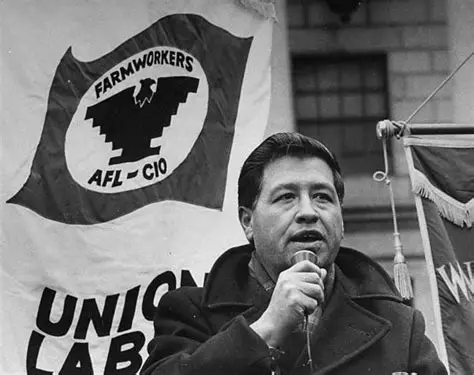
Tuesday, March 31st is Cesar Chavez Day, a federal holiday added by President Barack Obama in 2014. It commemorates the legacy of Cesar Chavez, cofounder and president of the United Farm Workers Union, which empowered more than tens of thousands of farmworkers to stand up for their rights and needs.
However, after what was learned about Chavez, his activism is forever tarnished.
On Wednesday, The New York Times published an investigation into Chavez which revealed that Chavez had sexually assaulted and abused children as young as 12. This statement was corroborated by Dolores Hureta, another civil rights leader and second founder of the United Farm Workers Union.
“I am nearly 96 years old, and for the last 60 years have kept a secret because I believed that exposing the truth would hurt the farmworker movement I have spent my entire life fighting for,” Huerta wrote.
Huerta also added that she had also been assaulted by Chavez twice, the first was via manipulation and pressure because she “didn’t feel I could say no because he was someone that I admired, my boss and the leader of the movement I had already devoted years of my life to,”.
The second assault occurred when Chavez pulled over to an isolated grape field and raped her. Both of these assaults resulted in pregnancies, which Huerta kept secret and gave the children to other families to be raised.
Huerta’s story was joined by many other women featured in The New York Times investigation. One, Ana Murguria, stated that she had known Chavez since she was 8 years old. Murguria was 13 and Chavez was 45 when he kissed her, stripped off her clothes, and tried to have sex with her in his locked office, which led her to try and attempt suicide after the abuse. Debra Rojas was 12 years old when Chavez began groping her and he raped her when she was 15 at a motel near Stockton, California. Esmeralda Lopez stated that she was 19 when Chavez tried to pressure her into having sex with him while they were alone on tour, offering to use his influence to get something named after her. Lopez refused his advances and her account is supported by her mother, who was also an activist.
To say that this news caused an outcry would be an understatement. The United Farm Workers announced that it would not take part in any events named after Chavez. Texas Governor Greg Abbot announced on that same Wednesday that Texas would not observe the holiday this year, with Arizona Governor Katie Hobbs following suit. California Governor Gavin Newsom said that he was “processing” the news and wouldn’t commit to making any changes to the holiday as of now. Events in Michigan, Milwaukee, and San Jose have all been cancelled or postponed as celebrations change to mark the contribution of the movement as a whole, not Chavez.
I am glad that swift action is being done to remove Chavez from the holiday and I am happy to see accountability towards his actions, but I look at other holidays and wonder about the same scrutiny. The 4th of July is one of them. It is the day where the United States signed the Declaration of Independence and declared that all men are created equal while African Americans slaved away at their feet. That’s not true freedom and it has never been true freedom, at least as a Black American myself. Juneteenth is my 4th of July but it only became a federal holiday in 2021 in comparison to Chavez Day being recognized in 2014. I acknowledge our Founding Fathers and the dream that they have inspired for this country, but they talk about freedom while still owning slaves. If the 4th of July is looked at with modern lenses, the holiday might be changed all together.
The United States has a habit of taking care of small problems while ignoring the biggest elephant in the room. Soon, that elephant might be too big for our country to handle.
Acknowledgement: The opinions expressed in this article are those of the individual author, not necessarily Our National Conversation as a whole.
