
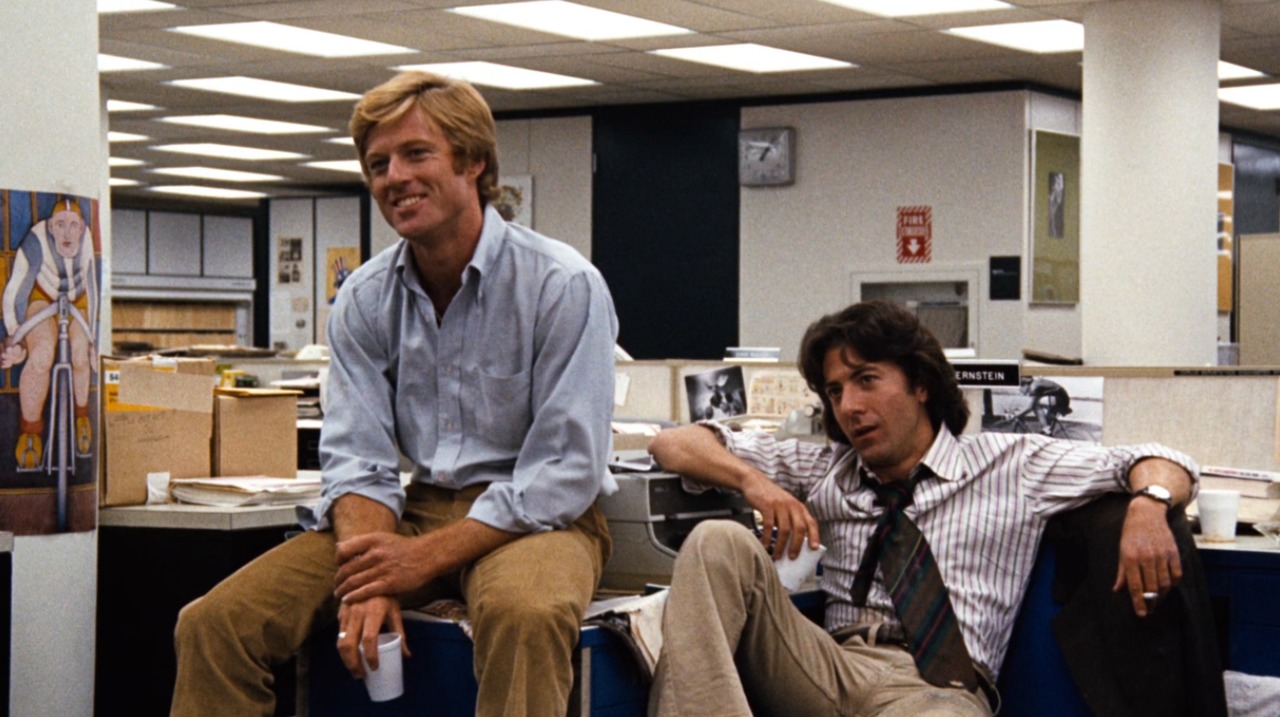
All the President’s Men was released in April of 1976, less than four years after the events which the film portrays began. To this day, it remains the definitive portrait of journalism on screen. The film was a passion-project of producer-star Robert Redford. The late movie star, who passed only months before the 50th anniversary of one of his greatest cinematic achievements, recognized the story of Bob Woodward and Carl Bernstein’s investigation of the Watergate Scandal early on as urgent and inherently cinematic, and pursued the two young, newly famous journalists to tell their story.
It was during the promotion of his now under-discussed 1972 political comedy The Candidate, that Redford became interested in making a movie about the Washington Post’s coverage of Watergate, after hearing journalists on the junket discussing the recent news of the break in at the Democratic National Committee office. The star eventually developed a relationship with Woodward and Bernstein after a period of trying to reach out to them, initially making contact with Bob Woodward, as Bernstein was allegedly hesitant to open themselves up to criticism from the RNC for getting involved with Hollywood.
Redford acquired the rights to their story for $450,000 with intent to make the film with Warner Brothers, where he already had good relations. He initially had in mind to make a smaller movie with lesser-name actors in black-and-white and in a more documentarian style. However, once Woodward and Bernstein’s book All the President’s Men became a massive hit, Redford saw that this had the potential to be a much bigger movie, and had to be much more mainstream. So the movie would now be in color, and the studio demanded it wanted Redford in one of its two starring roles in return for a higher budget.
When it came to finding a director for the film, Redford considered a few of the era’s most prolific American filmmakers, such as Michael Ritchie, whom he’d just worked with on The Candidate and Downhill Racer, William Friedkin, who’d recently come off of an Oscar win with The French Connection and a massive hit with The Exorcist. He specifically approached Hal Ashby, who had just made The Last Detail with Jack Nicholson, though his counter-culture realism was ultimately deemed too gritty for the setting of a D.C. newsroom. Eventually, Redford and the studio brought on Alan J. Pakula to direct.
Pakula was originally a producer, most notably having worked on the 1962 adaptation of To Kill a Mockingbird, for which he received a Best Picture nomination at the 1963 Academy Awards. This background is worth noting because while a gifted storyteller and an attentive craftsman, Pakula had the experience to deal with executives. Redford and Pakula believed the authenticity of the newsroom was crucial, as that was where the bulk of the story would be set. Understandably, the Washington Post was not open to lending its working newsroom to a film shoot, so the production went to great lengths to recreate it across two soundstages in Burbank at a cost of $200,000. It’s hard to imagine a studio giving the go-ahead to spend this much to construct such a faithful recreation of one specific room. One has to imagine the reputation and industry experience of someone like Pakula must have been instrumental in arranging this.
President’s Men came to Pakula at the perfect time to complete what would informally become known as his “Paranoia Trilogy”, following 1971’s Klute and 1974’s The Parallax View. Very few other Hollywood films of the time so succinctly and honestly communicate the general unease of that period in American history. The Paranoia Trilogy earns its name. All three films deal with the paranoia of surveillance, with tapes, wires and bugs being a frequent motif. Clandestine meetings and sinister underbellies presenting as civilized and respectable society run all throughout. The look and tone of Pakula’s Paranoia Trilogy would not be possible, however, without one specific collaborator: Gordon Willis.
All the President’s Men caught cinematographer Gordon Willis in the middle of a generational run. Willis first worked with Alan Pakula on Klute in 1971, and the two then reunited to shoot The Parallax View three years later. In between his collaborations with Pakula, Willis’s 1970s resume also includes both The Godfather and The Godfather Part II, as well as Annie Hall. Known as “the Prince of Darkness” to industry insiders and fans alike, Willis’s signature use of light and shadow was integral to creating the tone of paranoia and unease in Pakula’s work. To see an example of his mastery of shadows, look no further than Marlon Brando in the opening shot of The Godfather.
All the President’s Men shows a much more grounded straightforwardness in comparison to the very heightened contrast and energy of Pakula and Willis’s previous collaborations. Most of President’s is set in the Washington Post newsroom under buzzing fluorescent light. The shadows are very soft compared to the seedy New York apartments of Klute or some of the more thrilling action scenes in Parallax. However, whenever we leave the confines of the Post, the lighting style changes dramatically, most significantly in the scenes in which Woodward meets with Deep Throat and in the opening hotel break-in, but also in the homes of the journalists and their interviewees, where the paranoia is highest.
The film is littered with split-diopter shots, mostly in the newsroom, as the camera often focuses on one of our main characters in the foreground, with another event in the background simultaneously being held in focus on the other side of the screen. There is something always going on in the newsroom; every background actor feels like a real person with a real job to do. It feels like such a lived-in space.
Pakula’s instinct was to tell the story at a scale larger than what Redford originally had in mind. While technically more conventional, the look that Willis and Pakula brought to the film perfectly brings the drama and heightened paranoia to a fairly straightforward and old-school Hollywood movie. This all supports the spine of the story: process.
William Goldman had worked with Robert Redford three times before being brought on to adapt the script for All the President’s Men, most notably for 1969’s Butch Cassidy and the Sundance Kid. Despite it winning him a Best Screenplay Oscar, Goldman had a complicated relationship with the film. In the years after the film’s release, he spoke about his experience working on it in his memoir Adventures in the Screen Trade, saying, “If you were to ask me, ‘What would you change if you had your movie life to live over?’ I’d tell you that I’d have written exactly all the screenplays I’ve written. Only I wouldn’t have come near ‘All The President’s Men.’” It seems he and Redford faced a lot of creative disagreement, and Redford once said that only around ten percent of Goldman’s script ended up actually being used. Whatever the case, Goldman was a legendary screenwriter and it was his instinct to scrap the second half of Woodward and Bernstein’s book entirely – finding the moral core of the story which everything circles around. The movie is not about the triumph, but the work.
Redford and Pakula correctly identified that this was a story about the work, how it is done, and the people who do it. Everything is in service to process. The film is not concerned with informing the viewer. Partially, that is because this was such recent news at the time of release that it assumes an informed audience, but also the movie trusts its viewer to follow along anyway. We are taken step by step through Woodward and Bernstein’s investigation, and much of that is watching Robert Redford or Dustin Hoffman talk on a phone or sit at their typewriter, and yet it is captivating nonetheless. It identifies a meeting of true story and dramatic stakes that makes the viewer feel excited to see how it’s done.
The casting of the two leads is essential. Dustin Hoffman is so exciting to watch as Carl Bernstein. There might not be another male movie star of that generation to be a more perfect foil to Redford. Their energies are completely opposite; Hoffman nervy and small, Redford radiating confidence and classical waspy good looks. Looking back on it, this is probably the peak of both of their movie star profiles, though only the relative beginning of two long, successful careers. They are meeting at the tops of their respective games.
Redford had one of the all-time great movie star careers, and he really stood out to me as I rewatched the movie this past week, especially after thinking about him so much when he died last September. He was the type of actor who brought so much baggage to each role. This is to say it was hard to separate Robert Redford and his characters. What he did best was bring the mythology of his public persona into his roles. Because of this, Hoffman disappears into the role of Bernstein much more than Redford does with Woodward. Redford brings a very confident capability to most of his roles as with this one. He does little things like when he misspeaks and says “English” instead of “Spanish” in one scene that I find very convincing.
Despite starring two of the era’s biggest names in two of their signature performances, neither was nominated for Best Actor at the Oscars that year (Peter Finch posthumously won for Network). However, Jason Robards did win Best Supporting Actor for his performance as the Post’s managing editor Ben Bradlee, and Jane Alexander was nominated for Best Supporting Actress for her two-scene performance as Judith Hoback. Worth mentioning also are Jack Warden and Martin Balsam in supporting roles as men who truly do not exist anymore. The 1970s were full of character actors with weathered, lived-in faces that you just never see anymore; middle-aged men who look actually aged and interesting.
In preparation, I read Woodward and Bernstein’s book which the movie was based on, and was surprised by how similar in structure the two were. The book is much more narrative than I expected. They were writing the book when Redford first approached them about making a movie, and it was allegedly his recommendation to orient the story around their own investigation rather than what they were investigating. The book reads like it was made to be a movie. The story is almost too good to be true from a narrative point of view. The idea of someone like Deep Throat is so cinematic it’s hard to believe it’s true.
What makes this movie’s legacy last is that it is true. The story of the Watergate Scandal is really so confounding, and it left a mark on the American consciousness that can really never go away. There was a trust that was broken there, and can probably never fully be repaired. Watch any handful of movies from the mid-70s into the early-80s and that unease is there. Yet this movie has heroes in it, in the form of journalists, or at least people who value the truth.
There’s a way to talk about this movie, and be holier-than-thou, thinking it’s clever to recognize this is a story where a dishonest president faces the consequences of his actions, and that is true, but there’s a lot more there. The movie celebrates truth; it shows the pains and frustration it takes to pursue it. It does not show the results of the labor, only the headlines printed out on a teletype machine in the final seconds of the movie. It ends with our heroes messing up, and getting back to work. Neither Nixon, Haldeman, Liddy nor any other accomplice in the cover-up is a character in this movie, because it is not about them.
This past weekend, All the President’s Men celebrated its 50th anniversary and the contrast to the height of the Post’s reputation – the era of Kay Graham and Ben Bradlee – feels timelier than ever. Fifty years later, the Washington Post, the institution whose efforts the film valorizes, is owned by Jeff Bezos, one of the wealthiest men in the world. The Postdid not endorse a presidential candidate for the first time in thirty years after Bezos nixed its endorsement of Kamala Harris in the 2024 election. Earlier this year, the Washington Postannounced it was laying off a third of its newsroom – about 300 journalists. The capital city’s local paper which broke the stories on the Pentagon Papers and the Watergate Scandal, that brought down a president, now seems to prioritize accommodating that same power in order to protect business interests.