

America is rich, but many Americans are not, and a middle class that stops believing the system works will eventually stop consenting to it.
Free-market capitalism is often defined, within economics, as the rational framework. More precisely, individualistic, self-interested behavior is the “realist”, rational view.
To be opportunistic is to be clever and resourceful, one may say. The word “capitalize” means to make use of the opportunities before us. The word “capitalism”, by extension, means a system that rewards the opportunity-takers.
In an ideal world, a well-functioning, capitalist society is thus one that is meritocratic. If you have the skills and you work hard, you will make money. If you don’t, you will simply be left behind in the market.
To some, this is fair and should reflect the divide between the haves and the have-nots. It is no coincidence, therefore, that some of the most successful economies in the world are indeed built upon capitalist structures. A free, open market allows for competition, innovation, a diversity of ideas, and thus the production of goods and services that give value to consumers.
America prides itself on being at the vanguard of enterprise, and we have a lot to be proud of. We are the home of Microsoft, Apple, Google, Amazon, OpenAI, Netflix, Pfizer, and so much more. We dominate the technology market, the pharmaceutical market, and the cultural market through Hollywood and other media sites. Facebook is owned by an American. X, formerly Twitter, is owned by an American. YouTube is owned by an American.
America dominates the commercial world, and we are also a liberal country that allows businesses of nearly all kinds to flourish. That is the capitalist way. It is no coincidence, therefore, that America’s GDP per capita is well beyond the average among developed nations. GDP per capita is a rough estimate of the per-person income in each country. In emerging and developing economies, the average GDP per capita is $19.6 thousand. In advanced and developed economies, the average GDP per capita is $77.8 thousand. In the U.S., comparatively, the average GDP per capita is $94.4 thousand this year.
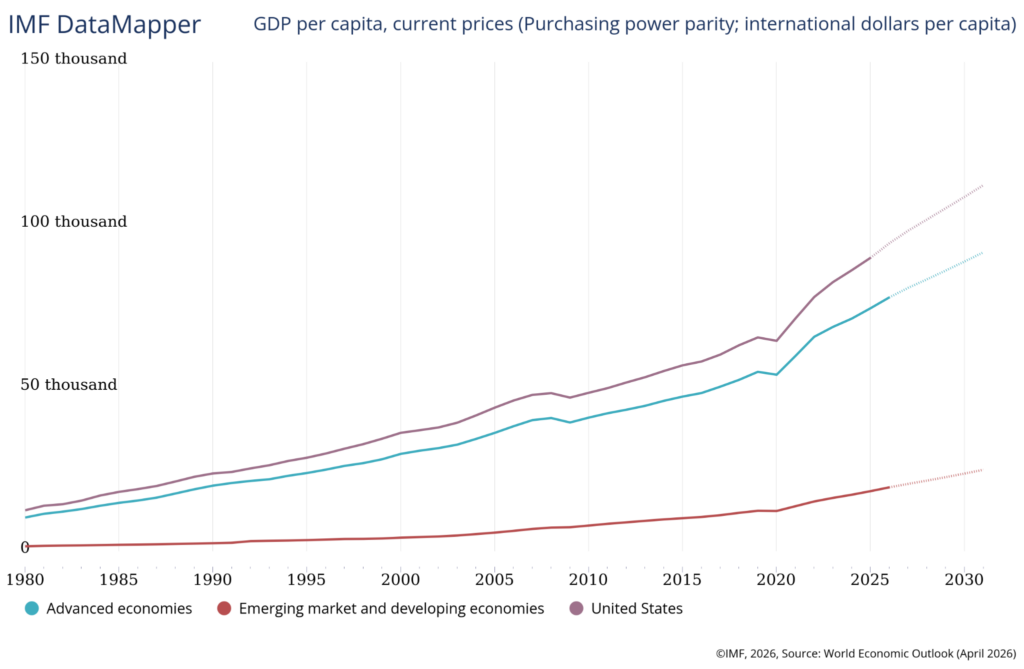
Yet, even amidst this success story, there is nuance. GDP per capita measures only the average, but it does not give us a true sense of what the economics of most Americans look like. If we look at the share of income for Americans in the bottom half of the economy, for example, we see a different picture:
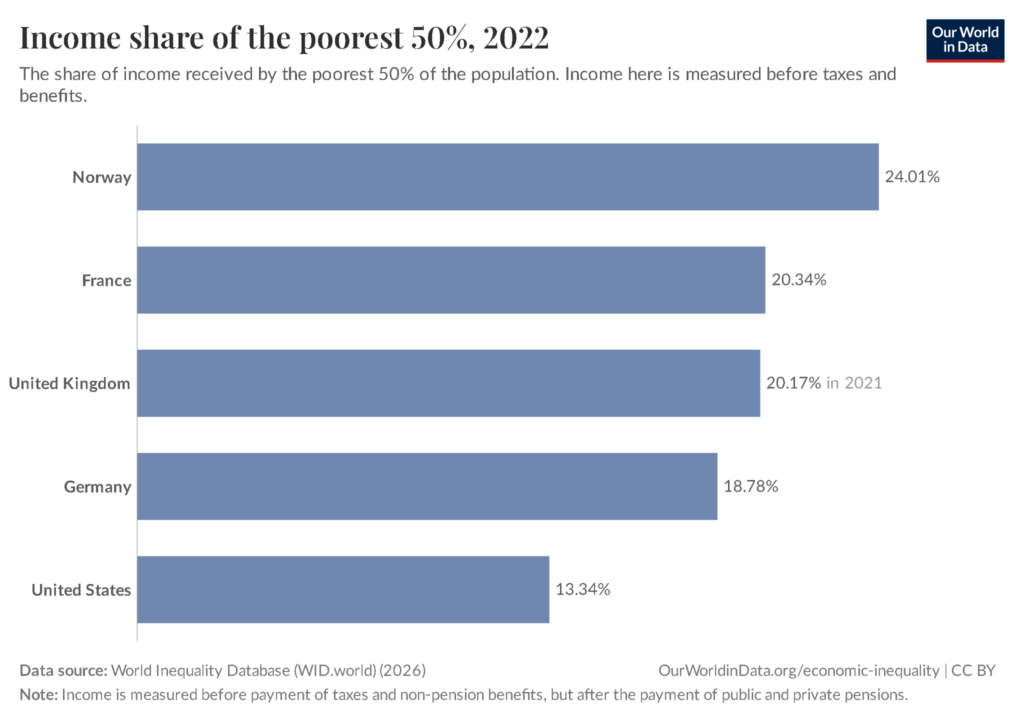
Relative to peer countries, the way money is distributed is such that a smaller percentage of it goes to the average American. Thus, looking only at the overall wealth of America does not provide a full picture of what most Americans experience in the economy. To put it simply, Norway might have a slightly lower GDP per capita than the U.S., but middle-class Norwegians enjoy more of that richness.
The nuance in this data is that it only accounts for incomes before taxes. When accounting for taxes, the difference between the U.S. and peer nations is still stark but narrower:
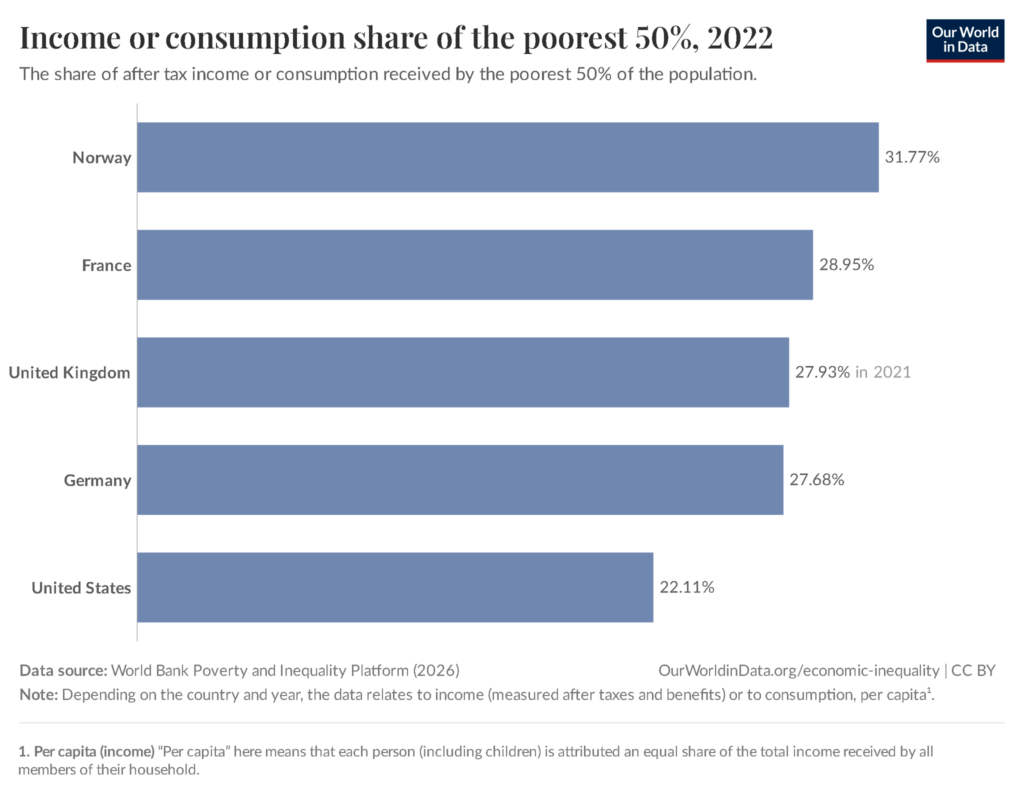
What was once an 11 percentage point difference between the middle class of Norway and the U.S. is now a 9 percentage point difference. All this to say that the redistributive effect of taxes makes a difference, to ensure that Americans enjoy the benefits of the richness we produce. Another way to look at it is that, pre-taxes, the bottom 50% of Americans only enjoyed 13% of the national income. Post-taxes, they enjoy 22%.
If we look, however, at the share of the richest 1%, we see how the distribution differs between the U.S. and other peer economies:
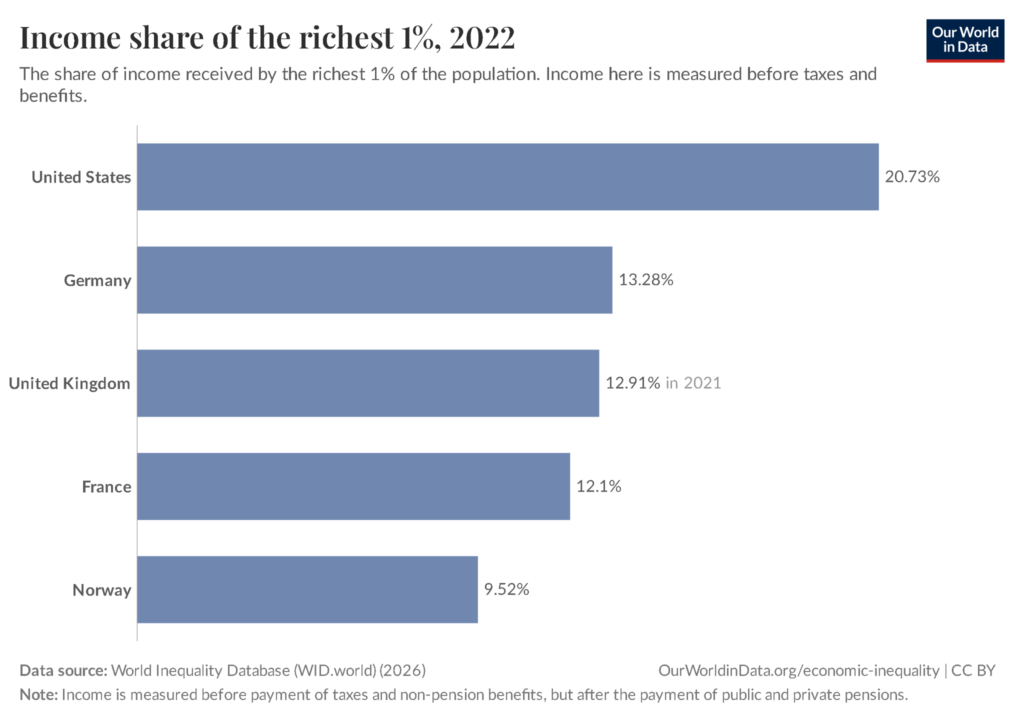
In the U.S., the richest 1% enjoy 20.7% of the national income, relative to Norway, where they enjoy less than half, at 9.5%. While we don’t have data for post-tax effects for this group, even this pre-tax data is eye-opening, because it accounts for nearly all the difference between America’s distribution of income versus peer nations. America is rich, but the bottom half is not getting those riches, while most of it consolidates to the top.
If we compare France with the U.S., for example, we can see a diversion at the 1980s, where the wealth of America’s middle class shrank relative to that of France:
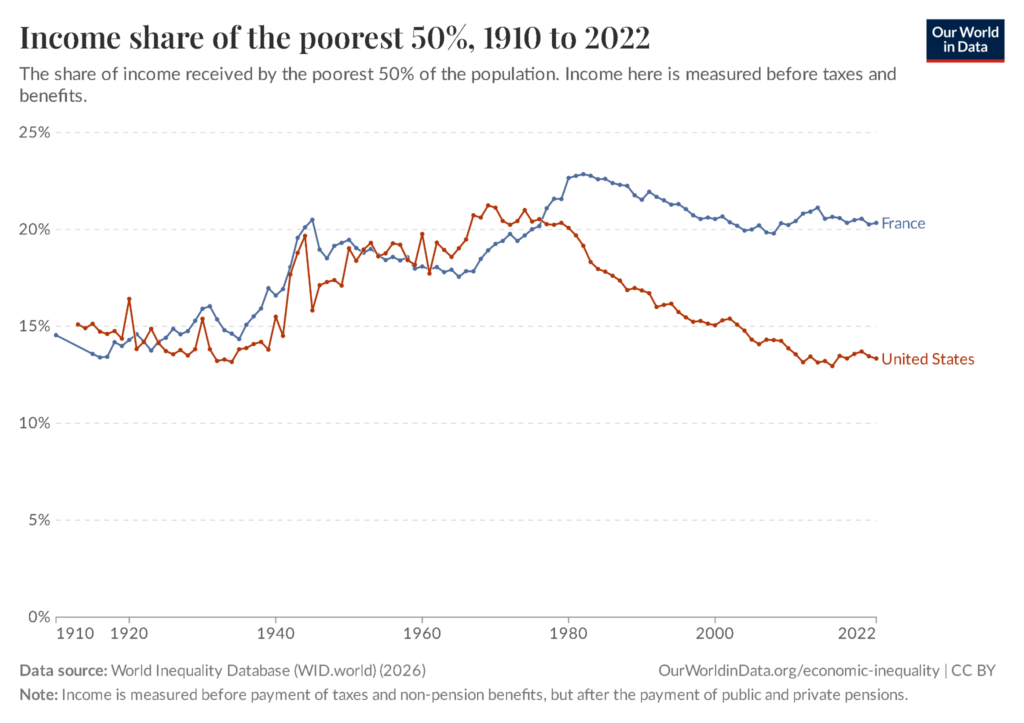
In 1980, the income share of the poorest half was 20%, on par with the French. Then, there was a diversion, creating the wide gap between the French middle class and the American one. Today, France’s middle class enjoys the same share of income it did in 1980, yet the American middle class enjoys only two-thirds of that.
It is not a coincidence that at the same time period that the American middle class has shrunk, the U.S. practiced austerity under Ronald Reagan, elected in 1980. He enacted reforms to cut welfare programs and successfully employed the “welfare queen” narrative, which has since been used to weaken poverty-alleviating programs like SNAP, Medicare, Medicaid, and others. Once you weaken the redistributional effects, that reduces access to income for poor families for generations to come.
Welfare Is Needed to Share The American Success Story
The American story illustrates the limits of “laissez-faire” capitalism and the need for well-targeted welfare policy. It is no coincidence that Americans, despite our nation’s wealth, have grown pessimistic about the economy. We need a new model, one that respects the benefits of capitalism, values a meritocratic system, yet uplifts most Americans.
A government that can balance both the need for free enterprise and protecting the middle class is one that works for all of us. The argument here is not anti-capitalist, but rather in favor of a stronger, fairer economy, one that can sustain itself before rampant inequality destroys it from within.
If more and more Americans are pessimistic about our economic system, where neither political party is addressing it properly, not only do we risk instability as a nation, but that anger may boil over into violence. When democracy is perceived to be ineffective in addressing the needs of the many, the people revolt. My argument is that for our economic and political system to sustain itself, the average American needs to feel optimistic about the economy, and yes, that does require sharing some of the riches that those at the top enjoy.
To what degree, what tax rates should we implement, what welfare programs should we pursue, and other such questions, remain part of further debate. But first, we must agree that a sustainable capitalist system is one that can survive. Without getting buy-in from the working class, we risk not only dismantling our capitalist system, but we also risk our democratic institutions.
Thus, my defense for welfare is one based on values, yes, but it is also a pragmatic consideration to defend what we have now. Expanding SNAP, Social Security, providing affordable healthcare, housing, and livable wages, are not just policies to benefit the middle class. They are policies, which, in my view, are necessary, to protect the stability of the current structure.
If our peer countries can do it, so can America. Welfare policy is a rational choice.