
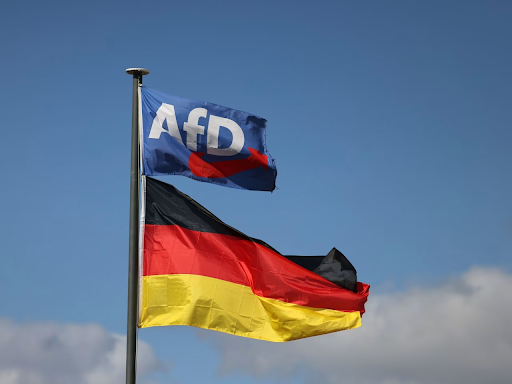
Sunday, September 7, 2026. Saxony-Anhalt state election. According to CNBC-reported exit polls, the Alternative für Deutschland party took 44.4 percent of the vote, putting Chancellor Friedrich Merz’s conservatives in the rearview mirror at only 18.3 percent.
No far-right party has come this close to running a German state on its own since 1945. Zoom out to the national election, and it’s the same story on a bigger stage: AfD is polling around 28 percent nationally. Comfortably first, with the CDU trailing behind by seven or eight points.
This change isn’t a blip. This didn’t come out of nowhere. AfD has been gaining ground for years, and now it’s worth asking what the party would actually do with power.
What They’d Do in Office
Alternative für Deutschland’s economic agenda is a good place to start: the party mixes tax cuts and deregulation with a heavy dose of economic nationalism. It is marketed as protecting German industry from both Brussels and global competition.
Regarding energy, the platform seeks a near-total reversal of the last decade of German climate policy: keep gas and coal plants running, restart mothballed nuclear reactors, scrap the CO2 levy, and end renewable subsidies. Alice Weidel has outright said that she’d tear down wind turbines to cut grid fees.
The party also wants Germany out of the Paris climate agreement entirely. Not only that, its 2025 federal manifesto calls for immediately lifting sanctions on Moscow, and repairing the Nord Stream pipelines to restart cheap Russian gas imports.
Russia is not a side issue here. On foreign policy, AfD has moved from garden-variety Euroskepticism to something more drastic: the manifesto argues that if Germany has to pick a side, it should leave both the EU and NATO, and instead align with Russia’s political and economic bloc.
Additionally, they want Ukraine kept permanently outside both institutions as a neutral buffer state. That’s not a fringe faction talking. That’s the federal platform.
On social policy, the Alternative für Deutschland party explicitly opposes state action on LGBTQ+ equality, and is skeptical of same-sex marriage. They branded the anti-discrimination policy as “gender ideology”, and said they want it stripped out of schools and public life alike.
A direct break from decades of cross-party consensus, the party’s official platform states plainly that “Islam does not belong to Germany,”. Additionally, its immigration platform goes beyond asylum limits to include ending refugee spending, mass repatriation, and stripping the right to claim asylum in Germany altogether.
Less attention gets paid to the party’s institutional agenda. Critics and researchers tracking the party note AfD rhetoric that includes expanding police powers, restricting press freedom, and questioning judicial independence, alongside expressed admiration for authoritarian leaders abroad.
In Saxony-Anhalt specifically, the party’s candidates have vowed to rewrite the state’s history curriculum to shift emphasis away from the Nazi era and toward the century before it, and to pull the state out of its regional public broadcaster altogether. This is a deeply concerning, direct shot at one of the few remaining ways far-right agendas are kept in check.
Who’s Actually Running This Thing
The AfD party began with Björn Höcke, the head of AfD’s Thuringia branch and the informal leader of its hardest-line faction. German courts have convicted him twice for using the phrase “Alles für Deutschland,” a slogan lifted straight from the Nazi SA. He’s paid fines both times and kept his job.
This isn’t a rogue backbencher; Höcke sets the tone for a huge chunk of the party’s eastern base: the same base that just delivered Saxony-Anhalt.
Then there’s the party’s legal status: Germany’s domestic intelligence service classified the entire AfD as a confirmed right-wing extremist organization in May 2025. A court provisionally blocked a designation in February 2026, while the party’s lawsuit against it proceeds. That tells you the label landed somewhere it doesn’t want to be.
‘Remigration’ has become one of the party’s most controversial buzzwords. It is a shorthand in some party circles for mass deportation extending beyond undocumented migrants. This reportedly came out of a 2023 meeting in Potsdam, where AfD figures met with identitarian activists to discuss pushing out immigrants, including some holding German citizenship.
When it became public, close to a million people marched in protest across German cities. That crowd size demonstrates how strongly Germans heard and disagreed with this plan.
The Billionaire in the Group Chat
This story cannot be told without mentioning Elon Musk; he’s called AfD “the last ray of hope” for Germany in a column for Welt am Sonntag. Musk even joined a live online chat with co-leader Alice Weidel to tell Germans to get behind the party, “or things are going to get very, very much worse.”
Chancellor Olaf Scholz publicly pushed back, saying free speech “also means you can say things that are not right and do not contain good political advice,”. U.S. lawmakers across the aisle even called the endorsement unnatural.
Alternative für Deutschland’s connections to parties like France’s National Rally and Hungary’s Fidesz exist, but stay at arm’s length. AfD remains politically toxic, even within Europe’s own far right.
Real Anger, Aimed at the Wrong Target
None of this lands without genuine grievance underneath it. Eastern Germany has spent three decades watching factories close, and young people leave for the West. Brandenburg, a region that’s felt governed from afar for a generation, is now polling AfD support above 37 percent.
The AfD is the first party in decades to show up and validate the anger, rather than explain it away. Even if the party’s policy answers- leaving NATO, scrapping renewables, cutting off Ukraine- don’t obviously fix a stagnant regional economy.
Chancellor Merz’s government has spent the past two years tightening national asylum policy in hopes of winning back AfD-leaning voters. It hasn’t worked; AfD’s polling lead has only widened since.
Voters who want the hardline version keep choosing the original over the CDU’s watered-down copy.
The Part That’s Still Undecided
The “firewall”- the informal agreement among CDU, SPD, Greens, and others never to govern with AfD- is a habit, not a law.
Roughly 65 to 70 percent of German voters nationwide still don’t want mainstream parties cooperating with AfD, citing its migration and LGBTQ stances, Russia-friendly foreign policy, and tolerance of elements tied to National Socialism. That majority is what’s keeping the firewall standing, even as AfD keeps winning pluralities.
Germany built its postwar constitution with tools specifically meant for this scenario: a popular, authoritarian party trying to win power through the ballot box, rather than around it.
Whether those tools hold depends less on court rulings about the word “extremist”, and more on whether the parties still competing for the other 70 percent of the vote can offer eastern Germany a better solution than managed decline. As of right now, they haven’t.
Acknowledgement: The opinions expressed in this article are those of the individual author, not necessarily Our National Conversation as a whole.
