

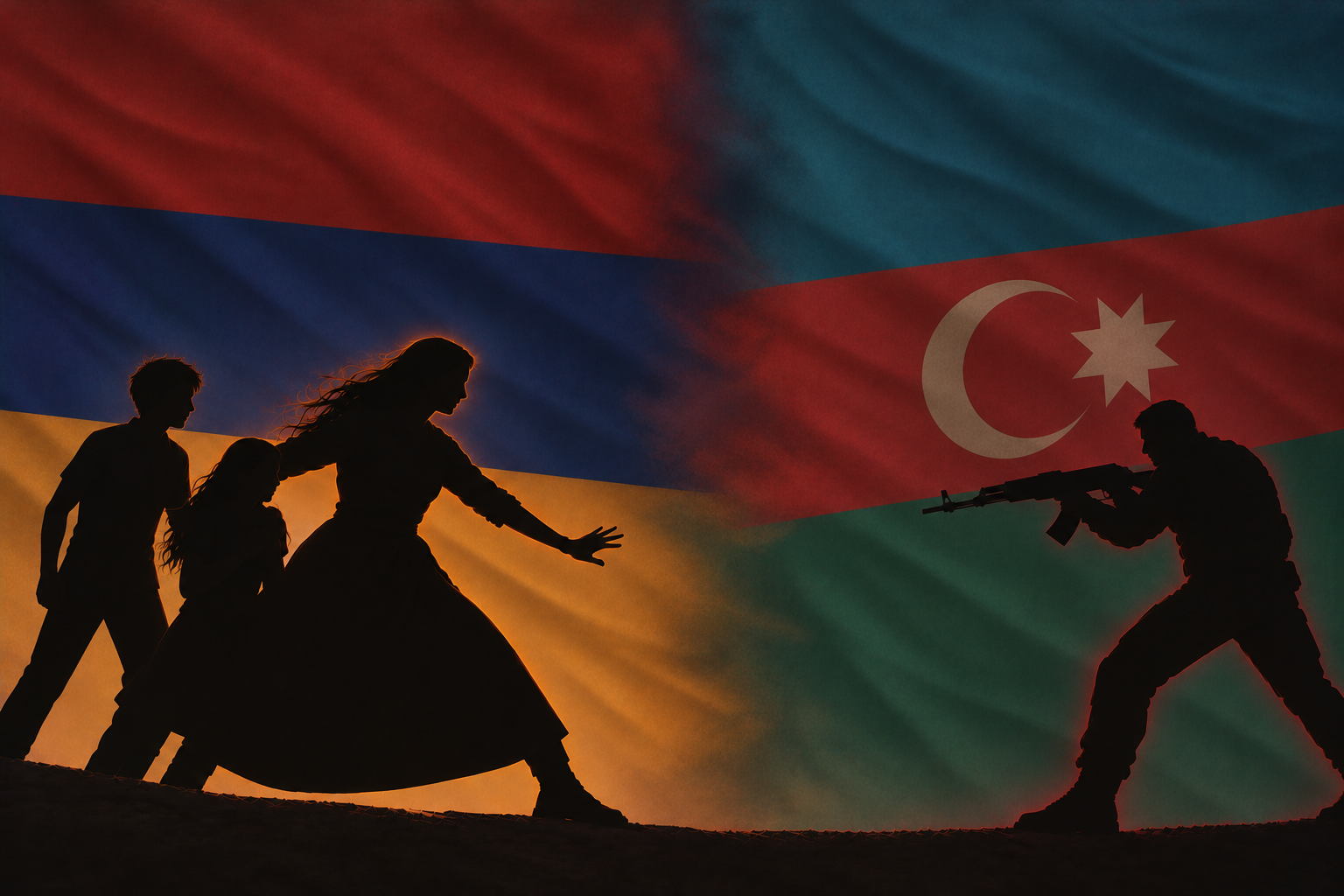
“If I hadn’t resisted, we wouldn’t have survived.”
That is how Ani Avetisyan rightly justified her decision to defend her children and herself against Nasimi Musayev, an armed Azerbaijani soldier who had illegally crossed Armenia’s border. He held her children at gunpoint in their home in Shaki — a village in Armenia’s southeastern Syunik Province, roughly twelve miles from Armenia’s border with Azerbaijan. Avetisyan was at a hotel in the nearby town of Sisian when one of her children called to say someone had broken into their home. Avetisyan immediately phoned the police and drove to the village.
In an interview with Azatutyun, the Armenian service of Radio Free Europe/Radio Liberty, Avetisyan said she estimated the soldier held the children for about fifteen minutes before she arrived. While the children were left alone with Musayev, he spoke in a language completely foreign to them and took their phones right out of their hands.
Avetisyan said that when she walked in, the soldier raised his rifle and fired at her, but missed his shot. As she moved closer, Musayev turned the weapon toward her son. Without hesitation, she grabbed hold of the rifle. The second shot cost her the thumb of her left hand and seriously damaged her other fingers.
Musayev then threw Avetisyan onto a bed and began beating her. Despite her horrible injuries, she relentlessly fought back — at some point getting hold of a kitchen knife and striking him with it — as her teenage son hit the soldier from the side. Amid all this, she found her voice and instructed her daughter to open the gate. She tried to get her son out of the house as well, but he refused to leave her side. Avetisyan’s sister, Arpi Avetisyan, told Azatutyun in an interview that her nephew’s wrist was broken in the struggle.
While instructing her daughter to leave, the soldier aimed the rifle at Avetisyan’s chest. Wounded as she was, she forced the barrel down with all the strength she had left, redirecting the third shot to her leg instead. Avetisyan explains that the bullet completely destroyed her knee. While Avetisyan was already on the ground when Musayev tried to shoot her again, instead, he found the rifle empty and tried to reload. The soldier ultimately fled and was caught shortly afterward, exhausted from blood loss, according to the village chief.
When asked what she thought when she first learned someone was in her home, Avetisyan said there was nothing in her mind but her children. She had no idea the man was Azerbaijani — he never uttered a word to her. Avetisyan emphasized that it would have made little difference if she had known; all she cared about was her children’s safety.
The police had every advantage in reaching her children first. Sisian’s police station, Avetisyan points out, is closer to Shaki than the hotel she drove from. Yet she reached the house before the officers, who arrived after the soldier had fled.
Armenia’s prime minister, Nikol Pashinyan, faulted Avetisyan for not waiting for the police. His remarks implied that waiting would have resulted in a better outcome. He conceded that “maternal instinct is strong,” but told parliament that once officers are called, you wait for them to act.
Armenia’s National Security Service said Azerbaijan sent a warning to Armenia on September 29 that a soldier had left his unit and might have crossed the border; both countries began searching for him. Given the warning, authorities should have treated the emergency call from Shaki with particular urgency. Knowing an innocent family could be in a life-threatening situation, they should have counted every second. The mere possibility should have been more than enough; the risk should have been impossible to overlook.
Instead, the authorities failed at what they quite literally exist to do: protect. When even Armenia’s own defense minister acknowledged shortcomings in how the soldier’s crossing was handled, it’s hard to argue that Avetisyan should have trusted the system to arrive in time.
Had she waited for them, as Pashinyan suggests, who would have stood between the soldier and the children? Who would have arrived in time to keep the children out of harm’s way?
Earlier in the interview, Avetisyan put it plainly: if she hadn’t made up her mind at that exact moment, neither she nor her children would be here today. When she was asked about the prime minister’s remark, she said she could not have waited, as she had already called the police. Every second counted in that situation, and she made sure that none of it went to waste.
The lives of Ani Avetisyan’s children were secured by acts that arose from the maternal instinct Pashinyan talked past. She took hold of a rifle that was aimed at her son, sent her daughter to open the gate, tried to get her son out of the house, and forced a rifle barrel away from her chest — all while being beaten. To treat that instinct as something to simply set aside overlooks a major reason they are alive today. Avetisyan’s determination to protect her children not only got her home before the authorities, but kept her fighting an armed soldier until he fled — with no rifle of her own. All she had was a severely wounded hand, a kitchen knife, and her teenage son at her side.
Ani Avetisyan protected her children. Pashinyan faulted her for not waiting, as if relying on the police — who, as she highlights, failed at the simple task of arriving in time — was a plausible option.
If Pashinyan places that much responsibility on the authorities, why couldn’t they carry out their duty properly? Why weren’t residents notified of such a great threat? Why was it so easy for the soldier to remain undetected? Why did Avetisyan have to take matters into her own hands — one mother with nothing but a kitchen knife, fighting an armed soldier?
The answers all lead to the same failure: a government that did not treat the warning with the urgency it demanded.
Avetisyan said the very thought of a mother leaving her children alone with an armed soldier was beyond her imagination. Pashinyan’s implication that waiting would have spared her injuries ignores what was at stake. Her children’s lives depended on her.
What she did that day was more than an act of heroism; it was a testament to the lengths a mother will go to protect her children, even when those entrusted with protecting them fail to do so.
Acknowledgement: The opinions expressed in this article are those of the individual author, not necessarily Our National Conversation as a whole.