

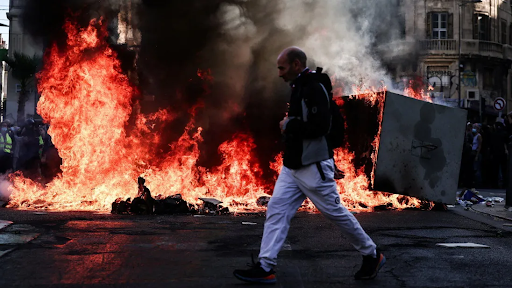
In France and across Europe, we are seeing protests, violent ones, emerge. According to most reporting, it is being dubbed the “cost-of-living” protest. The demonstrations sparked in France, where more than 550,000 people have joined. What started as student marches has evolved into looting, setting fires, and attacking police vehicles.
In Brussels, Belgium’s capital, similar demonstrations have arisen, with police using tear gas to disperse protesters whom police accuse of launching missiles and setting fires.
In the Portuguese capital, Lisbon, tens of thousands of protesters are also marching in the streets to speak out against stagnant wages, inability to access affordable housing, and a cost of living crisis.
In Milan, Italy, rioters clashed with police, looted stores, and set properties on fire. Again, the march started peacefully, but devolved into violence when rioters started throwing stones and other objects at police.
Government responses from European leaders, like Emmanuel Macron, President of France, offer a central theme: you have the right to protest, but violence is unacceptable.
Shared grievances, however, starting with protests in France, are spreading across Europe. The theme from the side of protestors across the EU (European Union) is based on the issue of “underfunded education, rising living costs and, for students, uncertain prospects after graduation”.
These, often violent, demonstrations come at a time of great political activity, as elections are scheduled in Spain, France, Italy and Poland in the next 12 months.
Now, this situation raises the question: why now? What are the economic conditions that Europe faces that are causing such unrest?
Let’s look at some of the main economic indicators in these European countries, and how they have changed from 2025 to 2026:
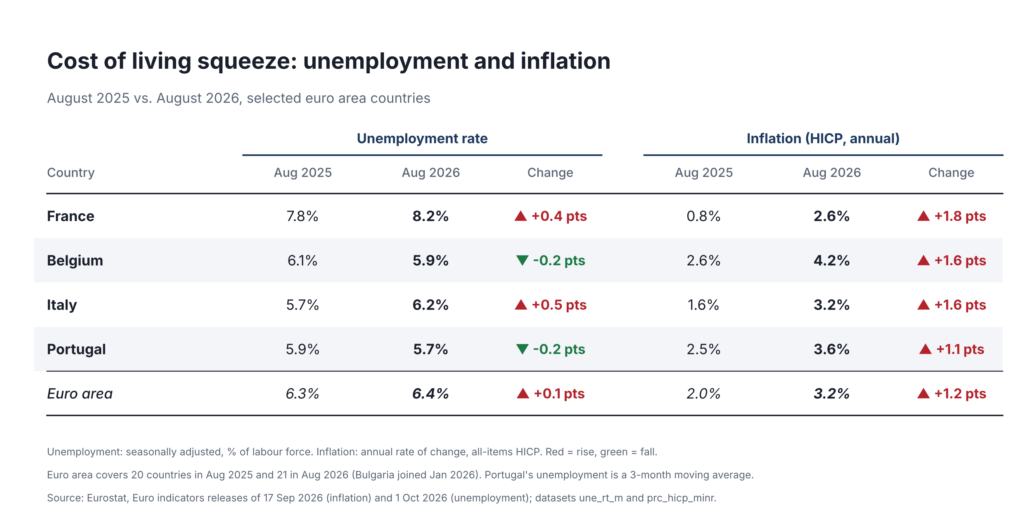
If we look at the unemployment rate, year over year, from August 2025 to August 2026, it has not increased much. In fact, it has even gone down slightly for Belgium and Portugal. That being said, it has not gotten better, and France’s 8.2% unemployment rate is double that of the U.S., which has a recorded 4.1% unemployment rate in August 2026.
Inflation is where the real issue lies. In France, inflation more than tripled, from 0.8% to 2.6%. That means the rate of the general rise in prices, which is what inflation is, has increased, and it was not met with any relief in the labor market. So the same scarcity of jobs existed in France, as last year, while the cost of living has gotten worse. The same issue exists in Italy, where unemployment, year over year, got marginally worse, while inflation doubled from 1.6% to 3.2%.
In Portugal and Belgium, we see a similar story, as we do across most of Europe. Unemployment has barely improved, but the rise in prices has become noticeably worse; this makes it harder for people to be able to afford their lifestyles while the job market remains challenging.
What has changed from 2025 to 2026? The Iran War is probably a key variable, as it has exacerbated the price of oil; unlike America, Europe does not have access to the same domestic oil reserves. Europe is thus more affected by events that weaken the external supply of oil. Combine this with the war between Russia and Ukraine, which is hurting Russian exports of oil, and the problem remains difficult to solve.
The EU is also recovering from the residual effects of debt-based government finance during the COVID era, amid concerns that a lot of the money was unaccounted for. Then, consider the increased American tariffs, leading to a reduction in trade between the U.S. and the EU, and we can see why high prices remain a significant issue.
Does it justify the extremity of the riots in France and other parts of Europe? That remains to be seen, but the timing of the riots is not coincidental. They are the result of a tightening and an ever-growing cost of living crisis, one that seems arguably worse than the one we see here in America.
Will we see similar unrest in the United States, which also faces an affordability issue? I hope not, but that means leaders have to take heed of the economic conditions people are facing. For Europe, it has already come.