

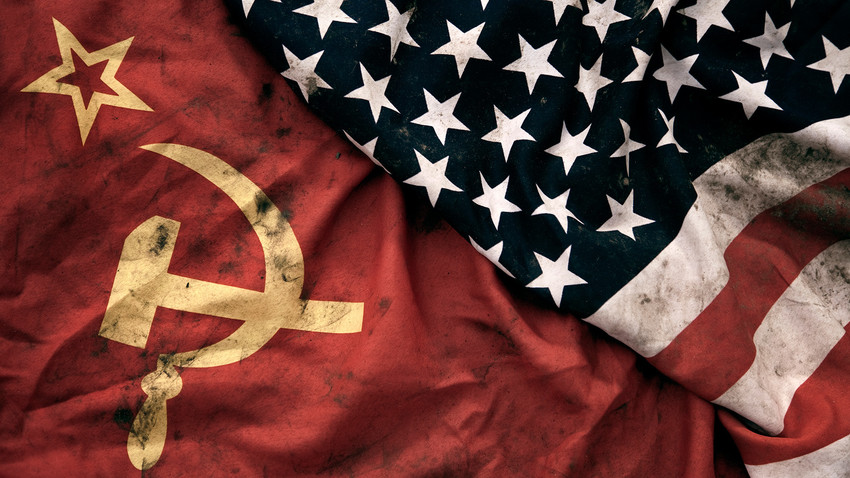
Whilst the Soviet Union (USSR) collapsed, the United States (U.S.) never stopped needing it. For much of the twentieth century, the USSR gave the U.S. more than rivalry. The USSR’s existence gave the U.S. an opponent that could be milked for moral absolution, all the while making appearing as the patron saint of righteousness and the champion of ultimate evil. Against Soviet communism, the U.S proclaimed an unmoving stance of fighting for freedom against tyranny, capitalism against communism, faith against atheism, and democracy against dictatorship. The Cold War was not merely a geopolitical contention between two superpowers. Instead, the Cold War upkeep for the polished image the U.S. fought two wars to craft. The Library of Congress described the Cold War as an era shaped by competing political and economic ideologies between the U.S. and the Soviet Union. At the same time, Reagan’s 1983 “Evil Empire” speech transformed the contention into one of moral debate, alluding that the Soviet Union was not simply an adversary, but a malevolent entity that must be extinguished.
The analogy matters because U.S. exceptionalism can only function with a polar comparison. To say capitalism is natural becomes easier when communism can be conveyed as artificial and coercive. To say America leads the world becomes a convincing reality when the world is divided between those who follow Washington and those trapped behind the enemy line. The Soviet Union helped build this narrative, becoming instrumental in America’s nationalist campaign. The end result turned the growth of American power into a necessary progression towards world peace.
When the Soviet Union fell in 1991, that power dynamic did not disappear. George H. W. Bush announced the fall on December 25, 1991, marking the formal end of the adversary that had organised American foreign policy for nearly half a century. However, the collapse of the Soviet Union left a problem in its wake. If America built its national identity against the hatred and comparison of the fallen Soviet Union, what happens when the enemy vanishes? For the U.S,the answer was not a peaceful retirement of Cold War thinking. For America is a nation of exuberant pride no matter if the competition is now unclear. The U.S kept in the habit of understanding itself through hostile outside forces.
Trump’s politics emerge from this afterlife. His foreign policy rhetoric differs from that of Cold War anti-communism, because it is not organised around one ideological rival. Russia is no longer the Soviet Union, and China is not a clean replacement. The global order is not black-and-white like previous eras: capitalism versus communism. Trump keeps the structure of Cold War exceptionalism while scattering enemy labels across the rest of the world. His America does not simply claim greatness because of ideological contrast, it reveres this idea by insisting that foreign countries, institutions, migrants and trading partners are cheating, exploiting and invading the U.S.
Trump’s deflective tactic gives the slogan “America First” an entirely new meaning. On Trump’s first day back in office in 2025, Trump signed the “America First Policy Directive,” stating that the U.S. foreign policy would champion American interests and put American citizens first. On the surface, the policy boasts a relatively expectant delivery of nationalism paired with yet another promise to prioritise its citizens. However, understanding Trump and his clinginess to U.S. greatness provides interesting details about the moral atmosphere surrounding the signing of this policy. In Trump’s rhetoric, the outside world is not simply competition; it’s a predatory entity that consistently seeks to take advantage of his country. International institutions do not only constrain American power, but actively impede American sovereignty.
The trade agenda shows this clearly. In 2025, the White House’s “Fair and Reciprocal Plan” argued that reciprocal tariffs would stop Americans from being “taken advantage of” by a selfish international trade system. Another White House fact sheet framed tariffs as an effort to “take back” economic sovereignty, pushing that foreign trade practices were direct threats to American workers and national security. That is not a defensive statement alone. It is a worldview perpetuated to American audiences as truth and aims to condemn foreign agencies as a whole rather than pointing the finger at one.
The same pattern appears in Trump’s treatment of alliances. NATO was created in 1949 in the shadow of Soviet power, with mutual defence at the center. Writers note that the alliance was formed with a primary aim of countering the risk of a Soviet attack on allied territory. However, Trump often treats NATO less as a global strategic community, and more as a delinquent business organisation. In 2025, he cast doubt on whether the U.S. could defend NATO members that, through his eyes, were not contributing enough to warrant American protection.
The Soviet Union disappeared, but this did not extinguish the insatiable need for the U.S. to validate their pride. As we can see, Trump’s America is what happens when a country keeps the Cold War thinking, but it runs out of a single enemy large enough to keep it going. The enemy has not vanished; its label has been extended and scattered towards any nation that Trump sees fit. In that sense, the world becomes the new Soviet Union: exploitative, profoundly ungrateful and always standing in the way of American greatness.