

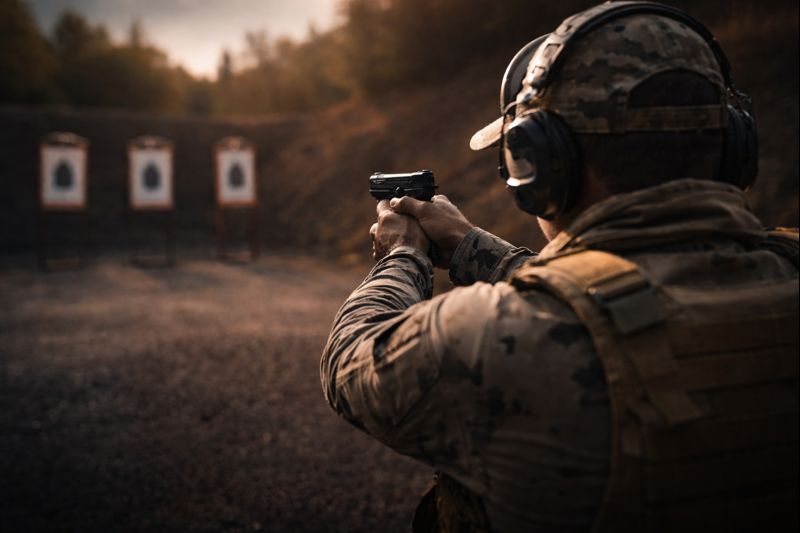
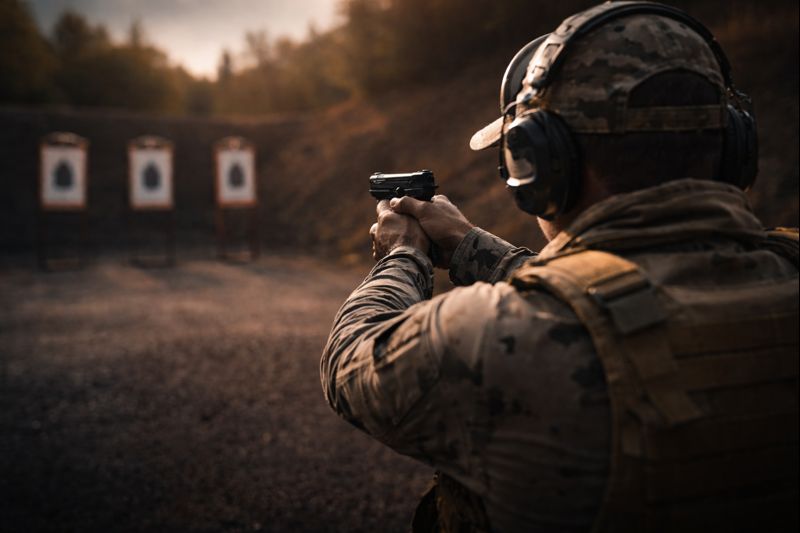
Guns are scary, yet people often speak about them as if they are not. I am not saying that any officer or individual who shoots another person is automatically right, nor am I saying they are automatically wrong. The public will always have questions, and those questions matter. I cannot determine whether another person’s actions were justified or not. What I can speak to is what it means to actually be trained with a gun and what it feels like to carry the responsibility of deciding when to use one.
I have been on the receiving end of gunfire. More than once. That experience changes how you think about weapons, decisions, and life. Despite that, I have always given people the benefit of the doubt before engaging a target. Even though I have been to war multiple times and have fired my weapon many times, it was never casual and it was never automatic. Every time I fired, it was to protect the people to my left and right and to protect myself.
Even standing tall in body armor with a weapon in my hand, I still showed human respect. A Gun was never about power or dominance. It was a last resort. In war, we operated under strict rules of engagement, and I remember them clearly to this day.
Show.
Shout.
Shove.
Shoot a warning shot.
Then shoot to destroy or kill if absolutely necessary.
Those steps existed for a reason. They were designed to delay lethal force, not rush it. Show force so intent is clear. Shout commands to give a person a chance to comply. Shove or physically position to control space. Fire a warning shot if the situation allowed. Only then, if the threat remained, was lethal force authorized. Even in combat, where every day carried risk, restraint and discipline were expected.
As I watch events unfold in America, I find myself asking a simple but uncomfortable question. Are you really trained with a Gun?
Training is not just about knowing how to shoot. Training is about decision making under pressure. It is about discipline when fear is present. Every person’s brain is wired differently, but the process is largely the same. When a person feels threatened, the amygdala takes over. It pushes the body toward survival. Fight or flight.
No matter how long someone pauses, when the brain determines a threat, it prepares to fight. That response is biological. It is not moral or immoral. It simply exists. Over time, however, training can reshape how the brain responds. Repetition, exposure, and disciplined scenarios allow the brain to recognize familiar situations and choose restraint when possible. It learns that not every perceived threat requires force.
The problem arises when an untrained person is given a Gun and placed into a situation where fear takes over. When the smallest perceived threat occurs, the brain is likely to default to fight. Not because the person is bad, but because the body is trying to survive without a trained framework to rely on.
Throughout my career, I have been placed in many different situations that required me to carry and potentially use a weapon. In every one of those situations, I went back to my training. I asked myself what I was trained to do in that moment. I relied on discipline, not emotion. I did what I was trained to do.
A Gun is a tool for survival, not a symbol. Being trained with a Gun does not mean being eager to use it. It means understanding the weight of the decision, the consequences that follow, and the discipline required to hold back when possible. That is the part of the conversation that often gets lost.
This article is not about politics. It is not about blaming institutions or individuals. It is about understanding what real training actually demands. The question remains simple and worth asking. Are you really trained with a Gun?
References
LeDoux, J. E. (2000). Emotion circuits in the brain. Annual Review of Neuroscience, 23, 155–184.
This foundational neuroscience paper explains how the amygdala rapidly processes threat and initiates survival responses before conscious reasoning occurs.
Arnsten, A. F. T. (2009). Stress signalling pathways that impair prefrontal cortex structure and function. Nature Reviews Neuroscience, 10(6), 410–422.
This research shows how acute stress weakens rational decision making and strengthens automatic survival responses, supporting the idea that fear drives action unless disciplined training intervenes.
