

“No work, no school, no shopping!” became the anthem for a massive nationwide protest demanding the total defunding of U.S. Immigration and Customs Enforcement (ICE). The movement culminated on January 30, 2026, in a “National Shutdown” as the federal Operation Metro Surge swept through 46 states.
The movement was ignited by the deaths of Alex Pretti and Renee Nicole Good, both of whom were fatally shot by federal agents during earlier demonstrations. In a display of solidarity, anti-I.C.E. citizens and non-citizens converged with labor unions and student groups to stage walk-outs, street marches, and yes, more protests. They even took aim at Target, picketing the retailer for being ‘not-as-woke-as-they-used-to-be’ following reports of the company’s cooperation with federal agents.
While the “National Shutdown” is hardly the first time Americans have revolted against federal immigration arrests, the current tension suggests it won’t be the last. Chants continue to dominate the streets of sanctuary cities and news feeds as the Department of Justice (DOJ) Civil Rights investigation into the shootings unfolds.
Many argue that the protests against ICE today are a response to a display of authoritarianism unlike anything seen under a modern presidency. This perspective often contrasts with the Obama administration, where—despite high deportation numbers—there were far fewer public outcries. News and social media coverage were notably less critical than they were under the Trump administration. Since sanctuary cities did not protest former President Obama’s actions with this level of intensity, some argue he was not perceived as acting authoritatively. If the Trump administration is following similar patterns of enforcement, it raises a provocative question: Does this mean Trump’s actions are not very authoritarian, or has the public and media’s threshold for what they consider “authoritarian” simply shifted?
Under the Obama administration, interior enforcement was managed by Thomas Homan, who served as the Executive Associate Director of Enforcement and Removal Operations (ERO). In 2015, Obama honored Homan with the Presidential Rank Award for Distinguished Service—the highest honor for career federal executives—specifically citing his effectiveness in managing record-breaking removal operations. During Homan’s tenure under Obama, nearly two-thirds of those deported from the interior had either no criminal record or were removed for minor infractions. Despite the fact that roughly 1.2 to 1.6 million individuals were removed without serious criminal convictions between 2009 and 2014, the era saw an absence of the “No Kings” parades or “Defund ICE” movements that define today’s political landscape. Today, Homan serves as President Trump’s designated “border czar,” overseeing an immigration mandate that utilizes a very similar enforcement apparatus he managed under Obama.
Though Obama was labeled the “Deporter-in-Chief” by critics who felt his humanitarian efforts on deportation fell short, the disdain for his tactics remains minimal compared to the widespread revolt against the Trump administration. This raises several questions: Are the current administration’s tactics simply more visible due to heavier media scrutiny? Are political leaders more eager to speak out now than they were during the Obama years? Or is the friction caused by local officials who, unlike during the Obama era, now refuse to cooperate with federal immigration authorities?
Like President Trump, the Obama administration frequently relied on administrative warrants to deport non-criminal immigrants. In many ways, the Trump team simply adopted the existing immigration playbook, even as public perception of these actions shifted dramatically. Does this suggest that Obama’s methods carried an authoritarian undertone? Or is Trump simply fulfilling his administrative duties as Commander-in-Chief to the American people?
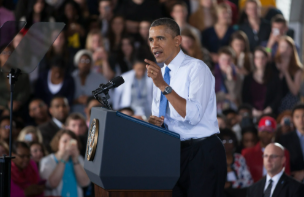
Image taken by photographer Kelly Kline.

2 Comments
Hey Dominick, this is a very important perspective you’ve laid out that brings to mind immigration actions from previous administrations that have been similar to Trump’s, yet have not received the same level as criticism. One theory I have is that the way the Trump Administration has been going about it has purposefully been in a way to generate attention and drama. Unfortunately for the Trump Administration, this backfired on them. Immigration enforcement isn’t supposed to be a show, it’s just something mundane and difficult that needs to be done with methodical precision.
So while I do agree that certain people are being hypocritical in condemning Trump but not Obama, I do think the Trump Administration put extra fuel in the fire when it was not necessary.
Hi Jason, Thank you for your input and insight. You are not wrong.
I agree and feel that is an important extension to the article. It was political drama, which is why I think the administration has changed its approach. Beyond the drama, my theory is that the Trump administration was so forceful because they faced unprecedented border crossings caused by the preceding administration, as well as city leaders who were unwilling to work with them to mitigate the situation.
While much of the negative press and protest was self-inflicted, much of the cause was political theater from the opposition—leaders who were unwilling to come to the table or work with the President as they had with his predecessors. The Obama administration did not have to deal with immigration on this level, yet their handling was quite forceful with little to no opposition from the media, mayors, or governors.
This is not a full defense of Trump’s strategy, nor a protest against Obama’s actions. Hopefully, it will put the spotlight on current political leaders on both sides of the aisle. Two wrongs don’t make a right; if you peel back the lens, there are plenty of wrongs on both the right and the left. Let’s hold all leaders accountable, acknowledge the administrative changes that maintain the republic, and keep the conversation going.