

By Micah Blake Allred
Jan. 14, 2026
China’s trade dominance rests fundamentally on a “low labor rights” economic model that systematically suppresses labor costs, environmental protections, safety standards and worker rights to maintain artificial price competitiveness (Autor et al., 2016). The Chinese Communist Party (CCP) intentionally constrains independent worker organizations, enforces wage suppression, imposes restrictions on labor mobility and entrepreneurship, and tolerates widespread forced labor and human rights abuses, all to sustain export advantage (U.S. Department of State, 2023). To properly address the foundational issue of these international trade disputes, the United States must reframe its trade war with China as a campaign for international labor rights.
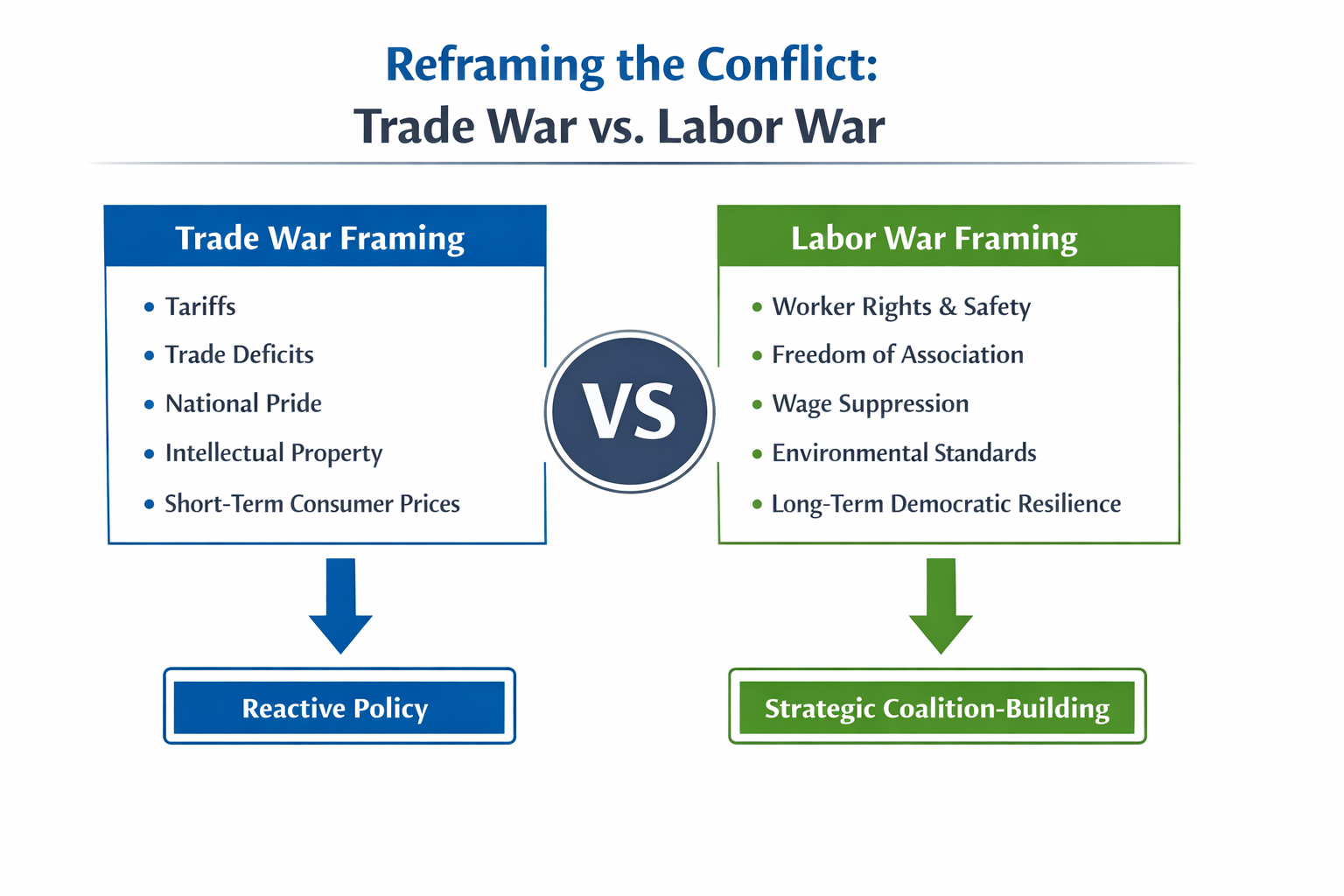
The ongoing rivalry between the U.S. and China has been framed almost entirely as a trade war—a contest over tariffs, deficits and national pride (Bown & Kolb, 2020). What is actually unfolding is a labor war between fundamentally different political and economic systems, and by refusing to name it as such, the U.S. is missing a major opportunity, economically and in terms of long-term national security, to not only change our trading relationship with China but to change China’s trading practices universally to benefit the laborers the CCP claims to represent (Farrell & Newman, 2019).
At its core, the U.S.–China conflict is not about what Americans pay more for consumer goods or trade imbalances (Bown & Kolb, 2020). It is about whether democratic societies can remain competitive while enforcing labor protections, environmental standards, and human rights, when authoritarian systems can suppress wages, restrict organizing, subsidize favored industries, practice political nepotism and absorb economic losses without personal accountability. China’s advantage is not simply efficiency or scale, but the political capacity to direct labor and coordinate capital in ways democracies cannot and should not emulate (Farrell & Newman, 2019).
President Donald Trump frames the trade war as retaliation for unfair trade practices, intellectual property theft, and imbalanced trade deficits (in manufacturing, while conveniently ignoring our surplus in services). Those concerns are real, but the strategy that followed emphasized spectacle over structure (Bown & Kolb, 2020). Tariffs were imposed inconsistently and irrationally, allies were alienated instead of cooperating to combat China, and the underlying moral argument of the abuse of labor rights that fuels China’s economy and is the foundation from which all our other trade issues arise remains underdeveloped (Farrell & Newman, 2019). Rather than presenting the conflict as a defense of democratic labor norms, Trump reduced it to a nationalist standoff, one that oscillates between threats and praise depending on markets, headlines, or personal relationships—with little to show for it (Bown & Kolb, 2020).
That framing squanders a powerful coalition-building opportunity (Farrell & Newman, 2019). A labor-centered approach would align the U.S. with labor unions, environmental advocates, European democracies and even Chinese workers themselves (European Commission, 2021). The list of their grievances, and the issues the U.S. must help the Chinese working class address, is long: unsafe conditions, political repression, discrimination, forced labor in specific regions and supply chains, excessive hours, inadequate pay, limited vacation time, restricted upward mobility shaped by region and political status and little meaningful legal recourse (USDS, 2023).
Communities hollowed out by offshoring are told to celebrate cheaper goods while absorbing long-term job losses and declining civic stability (Autor et al., 2016). Without a clear moral explanation for why certain industries deserve protection or reinvestment, industrial policy appears arbitrary or corrupt. A labor-centered narrative connects trade policy to lived experience, clarifying that the goal is not isolation, but fair competition between systems operating under comparable social and economic constraints (Farrell & Newman, 2019). Until the U.S. clearly articulates the conflict as a war for domestic labor policy changes in China, policy will continue to look reactive rather than strategic, defensive rather than values-driven, and overlook the foundational issue of America’s trade issues with China over the last century (Bown & Kolb, 2020).
Reframing the China trade war is not about being softer or tougher on Beijing (Bown & Kolb, 2020). It is about connecting and negotiating with the true power in China: its one billion laborers (International Labour Organization, 2022). Democratic societies cannot and should not compete on who can suppress labor more effectively (Farrell & Newman, 2019). They must compete on innovation, productivity, legitimacy, and shared prosperity (Martin, 2010). In this regard, American and Chinese laborers share a remarkable amount in common for the things they want in life, a list of aspirations that has become collectively known as the American Dream (Tobón, 2013). Naming the conflict as a campaign for labor rights allows democracies to defend their values without apology and to explain why certain economic tradeoffs are not only necessary but justified (Freedom House, 2023).
The missed opportunity is not merely economic. It is political. A labor-centered framing could unite progressives concerned with workers’ rights, moderates focused on national resilience, and conservatives who support challenging China’s increasing global influence.
Works Cited
Autor, David, David Dorn and Gordon Hanson. 2016. “The China Shock: Learning From Labor-Market Adjustment to Large Changes in Trade.” Annual Review of Economics 8: 205–240.
https://www.annualreviews.org/doi/10.1146/annurev-economics-080315-015041
Bown, Chad and Melina Kolb. 2020. “Trump’s Trade War Timeline: An Up-to-Date Guide.”
Peterson Institute for International Economics. https://www.piie.com/blogs/trade-and-investment-policy-watch/2018/trumps-trade-war-timeline-date-guide
European Commission. 2021. Trade Policy Review: An Open, Sustainable and Assertive Trade Policy. Brussels, Belgium. https://eur-lex.europa.eu/resource.html?uri=cellar:5bf4e9d0-71d2-11eb-9ac9-01aa75ed71a1.0001.02/DOC_1&format=PDF
Farrell, Henry and Abraham Newman. 2019. “Weaponized Interdependence: How Global Economic Networks Shape State Coercion.” International Security 44(1): 42–79.
https://www.mitpressjournals.org/doi/10.1162/isec_a_00351
Freedom House. 2023. Freedom in the World 2023. Washington, D.C. https://freedomhouse.org/sites/default/files/2023-03/FIW_World_2023_DigtalPDF.pdf
Martin, R. L. (2010). Trade, innovation, and prosperity (Working Paper No. 14). Institute for Competitiveness & Prosperity. https://rogerlmartin.com/docs/default-source/default-document-library/wp14_trade-innovations-and-prosperity.pdf?sfvrsn=96310182_0
Tobón, Natalia. 2013. “Pursuing the Chinese Dream.” Americas Quarterly, July 18, 2013.
International Labour Organization. 2022. Global Estimates of Modern Slavery: Forced Labour and Forced Marriage. Geneva, Switzerland. https://www.ilo.org/sites/default/files/2025-09/ILO_GEMS-2022_Report_EN_Web.pdf
United States Department of State. 2023. 2023 Country Reports on Human Rights Practices: China. Washington, D.C.
https://www.state.gov/reports/2023-country-reports-on-human-rights-practices/china

1 Comment
I hope you all enjoy my first ONC article. There will be plenty more coming this winter and spring!