

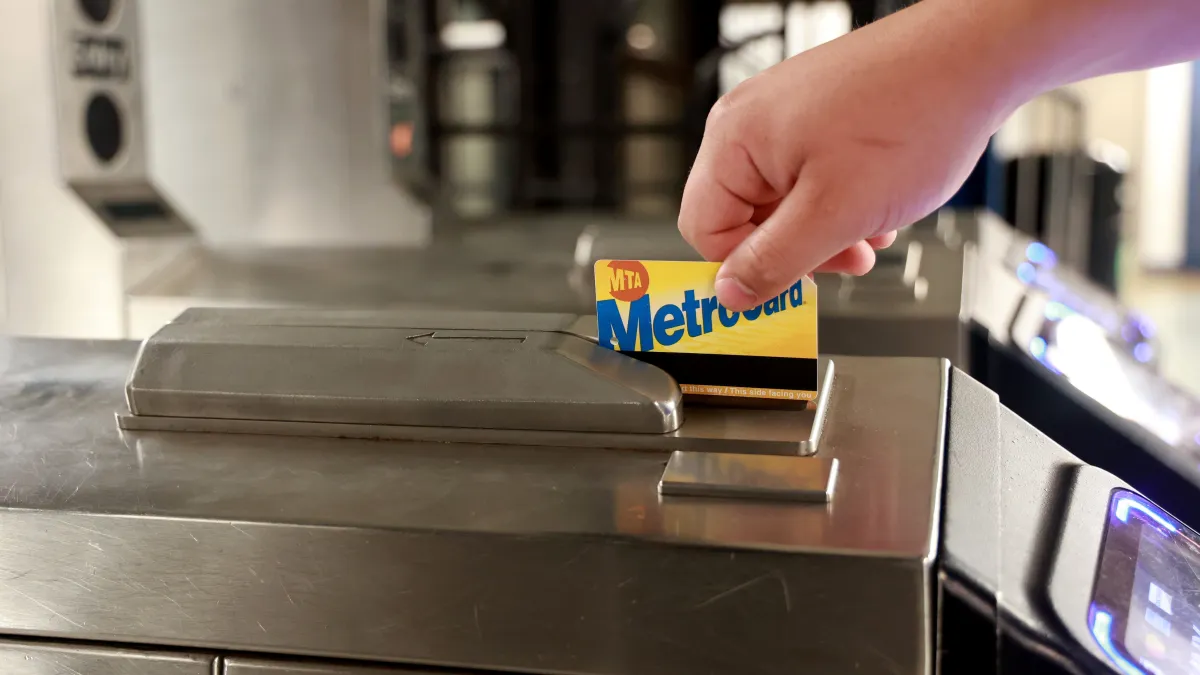
For more than three decades, the MetroCard functioned as a quiet constant in New York City life, a thin rectangle of plastic bent in wallets, demagnetized in pockets, and occasionally rejected by turnstiles with a small, public humiliation. That era is now ending. Beginning Jan. 1, 2026, the Metropolitan Transportation Authority (MTA) will stop selling new MetroCards, completing the transition to One Metro New York (OMNY), its contactless tap-to-pay fare system (The New York Times, Dec. 22, 2025).
Introduced in 1994, the MetroCard replaced subway tokens and eventually came to dominate the city’s transit economy, powering billions of rides across subways and buses. OMNY, first rolled out in 2019, now handles more than 94 percent of paid fares, a shift the MTA says will save at least $20 million annually by eliminating card production and vending machine maintenance (The New York Times, Dec. 22, 2025). While some riders still report missed taps or delayed charges, adoption has been swift, driven by the convenience of phones, contactless credit cards, and smartwatches.
The disappearance of the MetroCard, however, has revealed a parallel history of the object as an artifact, archive, and raw material for art.
Among the most devoted collectors is Lev Radin, a Bronx resident who has assembled what is likely the most comprehensive MetroCard collection in existence. His archive includes at least one of every publicly issued design, totaling more than 400 limited-edition cards (THE CITY, Dec. 29, 2025). The collection traces a visual history of the city, from early blue-heavy cards used on a limited number of lines in the mid-1990s to commemorative releases celebrating the New York Rangers’ 1994 Stanley Cup victory, the 2000 Subway Series, and a 2022 tribute to the Notorious B.I.G. Radin began collecting after noticing advertisements printed on the backs of cards, and the project gradually evolved into a timeline of fare hikes, branding shifts, and cultural moments unique to New York (THE CITY, Dec. 29, 2025).
Artists have long treated the MetroCard as something more than disposable infrastructure. In the East Village, Thomas McKean has spent roughly 25 years collecting thousands of used cards, many retrieved from subway platforms, which he cuts and reassembles into collages and sculptural works (Observer, May 22, 2025). By isolating recurring elements such as the curved “M,” the MTA logo, or the black magnetic strip, McKean constructs cityscapes, taxis, brownstones, and abstract compositions. Slight variations in print color between card batches provide shading and depth, allowing the cards themselves to dictate the aesthetic outcome of the work (Observer, May 22, 2025).
Brooklyn artist Juan Carlos Pinto takes a more destructive approach, shredding MetroCards into tiny fragments to create mosaic portraits of figures such as Nina Simone, Barack Obama, and Jean-Michel Basquiat, as well as reinterpretations of famous paintings (Gothamist, Dec. 29, 2025). Pinto estimates that he has thousands of cards stockpiled, many salvaged from subway floors. His labor-intensive process transforms discarded transit ephemera into marketable art that often explores themes of migration, diversity, and urban identity (Gothamist, Dec. 29, 2025).
Another Brooklyn-based artist, Nina Boesch, works on a larger scale, incorporating tens of thousands of MetroCards into expansive mosaics depicting the Brooklyn Bridge, subway maps, pigeons, squirrels, and other familiar city symbols (Observer, May 22, 2025). Limited to the cards’ signature palette of yellow, blue, black, and orange, Boesch sources her materials through donations and earlier station collections. With enough cards to last decades, she has noted that the coming scarcity may lend additional historical weight to works made from what is soon to be an obsolete object (Observer, May 22, 2025).
Since 1994, the MTA has issued approximately 3.2 billion MetroCards. Promotional editions generated modest additional revenue, roughly $641,000 in recent years, but the card’s significance was never purely financial (THE CITY, Dec. 29, 2025). The MetroCard functioned as a daily ritual, a repeated physical gesture that bound riders to the mechanics of the city itself.
Existing MetroCards will continue to function into 2026, and riders can transfer remaining balances to OMNY at service centers and mobile vans (The New York Times, Dec. 22, 2025). Still, the swipe is fading, replaced by a quieter, frictionless tap. What remains are the cards themselves, preserved in binders, cut into fragments, or assembled into mosaics.
What disappears with the MetroCard is not plastic but presence. The swipe required timing, pressure, and failure, a small negotiation between human and machine repeated millions of times a day. OMNY replaces that exchange with invisibility. The artists and collectors who preserve MetroCards are not resisting progress; they are documenting a moment when the city asked its residents to participate physically in their own movement, and when infrastructure left behind something tangible to remember.
The New York Times. “What to Know About OMNY, MetroCard’s Tap-and-Go Successor.” December 22, 2025.
https://www.nytimes.com/2025/12/22/nyregion/omny-nyc-subway.html
The New York Times. “Goodbye (and Good Riddance?) to the MetroCard.” December 22, 2025.
https://www.nytimes.com/2025/12/22/nyregion/new-york-city-metrocard-end.html
THE CITY. “They’re Holding on to Their MetroCards, as OMNY Ends an Era.” December 29, 2025.
https://www.thecity.nyc/2025/12/29/metrocard-omny-subways-collectors/
Observer. “Last Swipe: NYC’s Farecard Artists Face Extinction as the MTA Eliminates the Beloved MetroCard.” May 22, 2025.
https://observer.com/2025/05/new-york-city-farecard-artists-metrocard-phase-out/
Gothamist. “MetroCards Are More than a Way to Pay Transit Fares for Some New Yorkers.” December 29, 2025.
https://gothamist.com/news/metrocards-are-more-than-a-way-to-pay-transit-fares-for-some-new-yorkers
Nina Boesch. Artist website.
https://www.ninaboesch.com
