

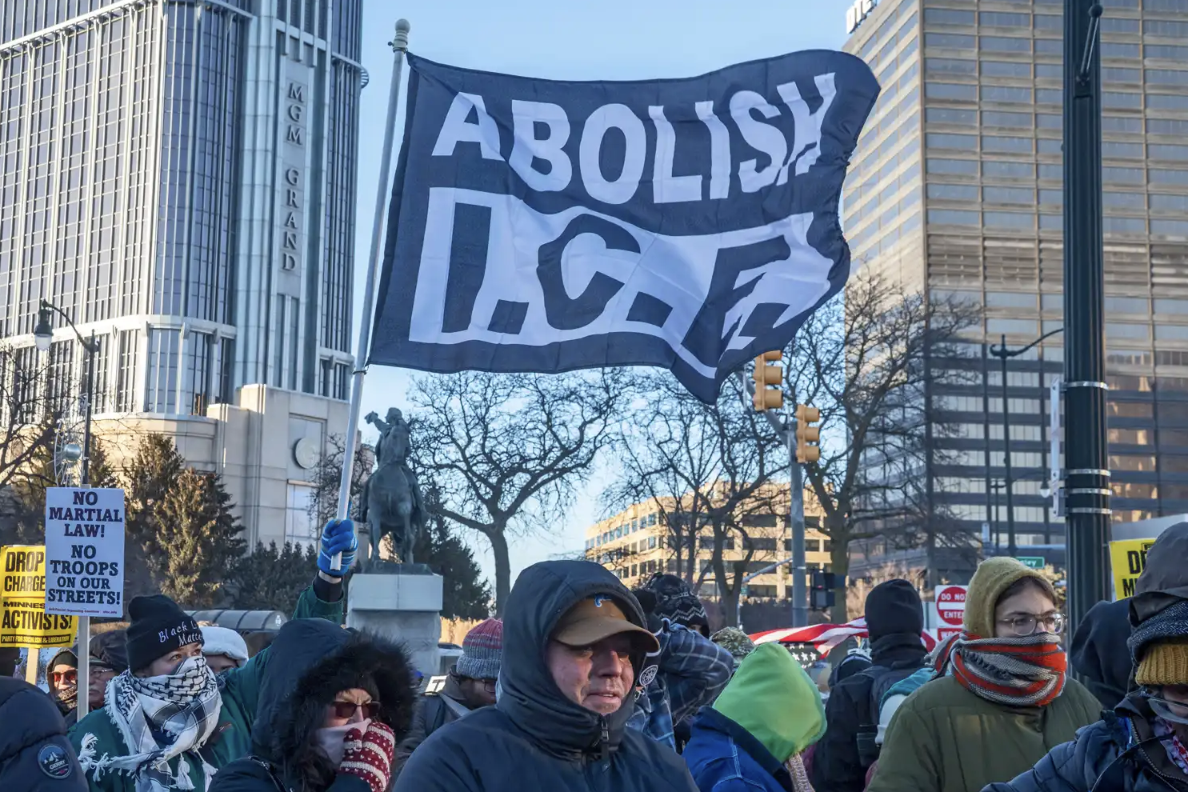
The prevalence of ICE in the United States and the consequences of its recent actions offer a clear illustration of what has gone wrong in the contemporary conservative reaction to power. I am bewildered by the sight of Second Amendment armed conservatives cheering while the federal government moves into their communities, conducts raids in broad daylight, and, in several cases, kills American citizens. This would have been inconceivable a few decades ago. Conservatives and liberals alike would have been alarmed at the sight of masked federal agents operating domestically with such latitude.
However, years of hyper-xenophobic commentary have trained audiences to see immigration not as a policy question but as an emergency scenario. The language is always familiar and repetitive. Dangerous illegals. Cities overrun by gangs. Terrorists slipping through the border unnoticed. PBS NewsHour even reported how these claims are often exaggerated or unsupported by available crime and terrorism data, yet they remain persuasive because they trade evidence for urgency (PBS NewsHour, Jan. 2026). Fear, once established, has a way of flattening nuance.
That fear has had a measurable effect on public opinion. Polling cited by PBS shows that support for aggressive immigration enforcement has increased even as trust in the federal government overall remains historically low (PBS NewsHour, Jan. 2026; Pew Research Center, 2025). This contradiction would have been difficult to square with conservative ideology in earlier decades, when skepticism of federal authority was a core belief rather than a situational preference.
Conservatism once meant something specific. It meant limited government, local control and an instinctive skepticism toward federal authority. The federal government was not assumed to be benevolent. It was thought to be powerful and prone to overreach if left unchecked. Armed federal officers entering a town without coordination would have been cited as proof of that danger, not its solution.
The events in Minneapolis brought this shift into sharp focus. Beginning in late 2025, federal immigration agents were deployed across the city as part of an enforcement surge coordinated by the Department of Homeland Security. Local officials said the operation occurred with little consultation, while residents documented masked agents conducting enforcement in residential neighborhoods (Associated Press, Jan. 31, 2026; PBS NewsHour, Jan. 2026).
Then things intensified on Jan. 7, when Renée Good, a 37-year-old U.S. citizen, was shot and killed by an ICE agent while sitting in her vehicle. Federal authorities initially claimed Good attempted to strike an officer with her car. Video footage reviewed by journalists and civil rights organizations raised serious questions about that account, showing a rapidly escalating encounter inconsistent with key elements of the official explanation (PBS NewsHour, Jan. 2026). Protests followed across Minnesota, with demonstrators questioning not only the shooting but the legitimacy of the enforcement operation itself.
Less than three weeks later, Alex Pretti was killed during a protest against ICE activity in Minneapolis. Pretti, who was filming officers on his phone moments before the shooting, was fatally shot by Customs and Border Protection agents. The Department of Justice subsequently opened a civil rights investigation, citing concerns over the use of force and officer conduct (PBS NewsHour, Jan. 2026; U.S. Department of Justice, 2026). The proximity of the two deaths underscored the seriousness of the dire political situation in our country.
According to reporting by The Guardian and data reviewed by advocacy groups, 2025 was the deadliest year in ICE custody in more than two decades, with at least 32 deaths recorded nationwide (The Guardian, Jan. 4, 2026). A separate ACLU analysis of prior ICE custody deaths found that the vast majority were preventable with adequate medical care, raising longstanding concerns about detention conditions and oversight (ACLU, 2024).
What is striking is not only the violence but the reaction to it. If similar events had unfolded under a Democratic administration, conservative media would likely have framed them as proof of tyranny or constitutional breakdown. Instead, many commentators minimized the deaths or treated them as unfortunate necessities. The difference was not the action itself, but who it was directed against.
This is the deeper cultural shift. Federal power is no longer judged by its scope or restraint, but by its target. When enforcement aligns with fear of an outsider, long-held principles give way. PBS NewsHour reporting has emphasized that immigrants, including undocumented immigrants, are statistically less likely to commit violent crimes than native-born citizens, yet this data has struggled to compete with emotionally charged narratives (PBS NewsHour, Jan. 2026).
Public trust in government has collapsed since its mid-century peak. In 1958, roughly 73% of Americans said they trusted the federal government to do what is right most of the time. By 2025, that figure had fallen below 20% (Pew Research Center, Dec. 2025). What has changed is not distrust itself, but its selectivity. Government power is feared when it regulates markets or raises taxes, yet welcomed when it promises protection from a perceived threat.
Ronald Reagan famously once said, “The nine most terrifying words in the English language are ‘I’m from the government, and I’m here to help.’” That warning was not conditional. It did not depend on who was being policed or which fears were being activated. If those words no longer unsettle us, then something fundamental has shifted, and it has shifted quietly.
SOURCES
ACLU. “95 Percent of Deaths in ICE Detention Could Likely Have Been Prevented.” June 2024.
Associated Press. “Judge Won’t Halt Immigration Enforcement Surge in Minnesota.” Jan. 31, 2026.
Pew Research Center. “Public Trust in Government: 1958–2025.” Dec. 4, 2025.
The Guardian. “2025 Was ICE’s Deadliest Year in Two Decades.” Jan. 4, 2026.
